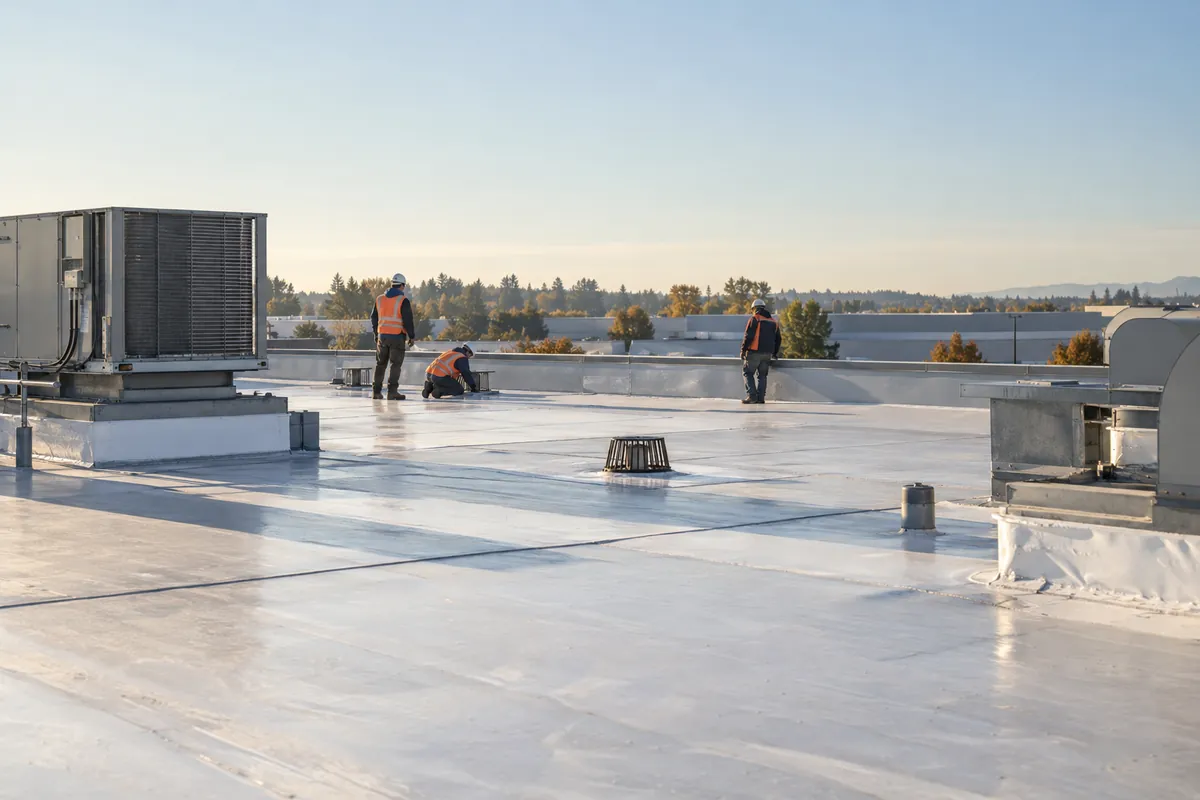
A commercial roofing opportunity often needs to make sense to more than the first person who contacts your company. A property manager may gather options, an owner may approve the investment, and another professional may help define the project. Your marketing needs to give those people clear, reusable information about the work you provide.
We know how thin commercial roof inquiries run from our own Indiana network. Our 209 Indiana commercial roofing microsites, run on Garrison, the microsite software from Trojan Digital Marketing, brought in four inquiries from June 29 through August 31, 2026. They were a strip center with leaks, a rubber roof leak, a tarp over a commercial building and a commercial inspection.
With counts that small, a monthly click total tells you very little, so we follow each commercial inquiry by name from first call to proposal.
Commercial roofing marketing FAQs
What does commercial roofing marketing cost with Trojan Digital Marketing?
Ongoing SEO, content and ad work for a commercial roofer is priced after the free strategy call, once we know how many counties you cover and which building types you're after. If your site can't carry commercial pages as it stands, the Marketing Startup Kit is $7,997, or three monthly payments of $2,799, for a custom 15 page website, Google Business Profile optimization, twenty blog posts and three months of consulting.
Can we separate commercial and residential roofing marketing?
Yes. The audiences, evidence, and project processes can differ enough to justify distinct content and campaign groups. The shared company identity should remain clear, while each visitor sees the information relevant to the service they need.
Can you help us pursue larger commercial projects?
Yes, if you can show a comparable roof. A property manager weighing a big re-roof wants the square footage, roof system and building type of past work. We'd build one project page for each job you can document with photos. We won't promise a project size or an award, since your estimate and your bid decide that.
How do you report results before a project is awarded?
We count the steps you can see before an award: a site visit booked, a proposal sent, a bid invitation received. Each open bid shows how long it's been waiting, so a slow award month doesn't hide a busy month of proposals.
Do we need a separate website for every service area?
No. One well-built site can cover several counties, with a section for each. Another site earns its place only when it says something true and different about its town. We won't build a town page that only swaps in the name.
What should we bring to an initial audit?
Bring the current website, preferred commercial services, real territory, and a description of the project inquiry process. Approved project material and anonymized opportunity stages can add context. The audit can then identify a concrete next scope.
Request a free commercial roofing marketing audit to review the path from professional discovery to suitable projects. Or contact Trojan Digital Marketing to discuss your commercial capability, website, or acquisition priorities.
Should we market re-roofs and maintenance agreements separately?
Yes, because the building owner is at a different point in each case. Franklin Tech Park, at the I-65 and State Road 44 interchange, dates to 2001, while Brownsburg's Ronald Reagan Logistics Center finished its first four buildings in 2022. Owners in the older park are closer to a re-roof decision. Owners of the newer buildings want inspections and a leak contact first, so each group gets its own page and form question.
How do you keep homeowner calls off a commercial roofing site?
We say who the site is for in its opening lines, naming the building types and roof sizes you take. If you also roof houses, that work gets one clearly labeled link so it doesn't compete with the commercial inquiry form. In paid search, residential phrases go on the excluded list, and we read the search terms report to catch the ones that slip through anyway.
How do you track a commercial roof bid that takes months to award?
Each inquiry gets a stage in your CRM, from first call to site visit to proposal to award, and its source stays attached the whole way. When a roof is awarded, that result can be sent back to Google Ads as an offline conversion, so the campaign learns from signed work. Over a few months you'll see which searches ended in contracts and which only ended in site visits.
What happens when I book the free strategy call?
The call costs nothing, and during business hours we aim to reply within five minutes to set a time. Bring your last ten commercial inquiries and mark which ones reached a proposal and which you won. We'll go over where the good ones came from and say plainly whether marketing is the bottleneck or whether something else, like estimating capacity, needs attention first.
Do you work with commercial roofers outside the Indianapolis area?
Yes. We're based in Indianapolis and work remotely with roofing companies in other states. Close to home, the service area takes in Carmel, Fishers, Zionsville, Westfield, Noblesville, Greenwood, Avon and Plainfield. For a roofer, we'd write coverage county by county, since one property manager may look after buildings in Marion, Hamilton, Hendricks and Johnson counties at once.
“I had a great experience working with Jeff…”
“…drove a noticeable uptick in leads within just a few weeks…”
We have more than 1,400 live websites.
Based in Indianapolis, we serve businesses across central Indiana, including Carmel, Fishers, Zionsville, Westfield, Noblesville, Greenwood, Avon and Plainfield.
We also work with clients across the United States.
A PRACTICAL MARKETING WORKSHOPGive a property manager a roof project brief they can share internally
Open this walkthroughClose this walkthrough
A commercial roofing buyer may need approval from someone who never visits the contractor’s website. That makes a concise, accurate capability brief valuable alongside the public service page. We would connect three things: the property question that starts the inquiry, an approved example of comparable work, and a project review route. The objective is to help the contact explain why a conversation is appropriate, without suggesting that a roof can be assessed from marketing photographs.
Worked example · hypothetical planning scenario
In a hypothetical portfolio discussion, a property manager is collecting options for three buildings with different planning priorities. Instead of forcing three disconnected quote forms, a portfolio inquiry can capture the property count, broad locations, requested engagement, and responsible contact. The next conversation determines which information belongs in a property by property review. On the website, an approved project story explains the contractor’s role and engagement type rather than promising a universal roof solution. A downloadable capability summary can repeat the same facts. The CRM keeps the property manager as one account and each potential project as its own opportunity, preventing a single relationship from becoming a misleading pile of anonymous leads.
| Buyer situation | Shareable page material | Sales record |
|---|---|---|
| One current property issue | Service contact and accepted scope | A distinct property service request |
| A planned roof project | Comparable project and review process | A project opportunity with stage |
| Several properties under management | Capability brief and account introduction | An account linked to separate property discussions |
Prepare the evidence an approval group needs
- Document the contractor’s actual project role, approved property category, and service scope; captions should explain more than the roof system visible in a photograph.
- Collect the questions a property manager must answer internally before requesting proposals, then make those questions easy to resolve or raise with your team.
- Identify who receives project documents and how a repeat account contacts the business for another property.
- Use only verified qualifications and approved project facts in the public page and any exported capability brief.
Map one property account
Bring a redacted example of how a property relationship becomes a roofing opportunity. Trojan Digital Marketing can design a capability page, account introduction, and reporting structure that supports that process, then match acquisition campaigns to the engagement types you want.
How old are the commercial buildings around Indianapolis, Indiana?
Commercial roofing marketing around Indianapolis, Indiana should follow when each business park went up, because a 2001 park and a 2022 park call for different offers.
Franklin and Brownsburg, Indiana
Industrial development at Franklin's I-65 and State Road 44 interchange largely began in 2001, when Indianapolis-based Denison Properties broke ground on what's now the 345-acre Franklin Tech Park.
The park's first wave went up after that 2001 groundbreaking, so a re-roof planning page with tear-off photos is the offer to put in front of its facility contacts.
Indianapolis Business Journal, Warehouse growth heads south to FranklinChecked September 25, 2026Sunbeam Development's I-65 South Commerce Park, north of State Road 44 at Exit 90, was first pitched as 213 acres and four buildings and could reach 6.8 million square feet across nine buildings.
Owners of brand new buildings aren't shopping for a re-roof, so what they need from you is an inspection and leak response agreement with one named contact.
Indianapolis Business Journal, Warehouse growth heads south to FranklinChecked September 25, 2026Phase one of the Ronald Reagan Logistics Center in Brownsburg is four buildings totaling 1,411,800 square feet. One was finished in June 2022 and the other three that fall.
Four big roofs under one owner make a portfolio account, so the inquiry form should ask how many buildings the manager looks after.
Town of Brownsburg, Key Development AreasChecked September 25, 2026
These are public facts about buildings near Indianapolis. They aren't Trojan Digital Marketing roofing jobs, and we don't claim roofing clients in Franklin or Brownsburg.
Which page should each commercial roofing inquiry land on?
On a commercial roofing site serving Indianapolis, Indiana, the building's age and the caller's role decide the page, the first form question and what counts as progress.
| Who's asking | Page they land on | First form question | Counts as progress |
|---|---|---|---|
| Owner of a park built in the early 2000s | Re-roof planning with past tear-off photos | Roof size and the year it went on, if known | Site visit with the facility contact |
| Manager of a warehouse finished since 2020 | Inspection and leak response agreement | How many buildings, and who holds the warranty | Inspection on the calendar |
| Retail or office tenant with an active leak | Service request with honest response hours | Address and where the water is showing | Crew on site |
| General contractor sending a bid invitation | Bid documents route and capability brief | Bid date and whether drawings are ready | Proposal submitted |
What should a commercial roofer gather before the pages are written?
Commercial roofing pages for the Indianapolis, Indiana market only work when the proof is real, so here's what you bring and what we build from it.
You bring
- Photos of finished low-slope jobs, each labeled with the building type and roof system
- The manufacturer programs your company actually belongs to, with proof for each one
- The counties your crews will drive to and the ones they won't
- Your last twenty commercial inquiries and what became of each one
We build
- A page for each engagement you want more of, like planned re-roofs or service agreements
- A one page capability brief a property manager can forward to an owner
- Inquiry tracking that carries the source through to an awarded roof
- A regular review of which searches ended in proposals
Help each decision maker answer their part of the question
- Fit
- Explain the service scope.
- Trust
- Show supporting evidence.
- Next step
- Give a clear contact route.
A commercial roofing website should not assume that every visitor is ready to request the same kind of quote. Some are identifying a possible service provider. Others are preparing a project conversation or checking a company recommended by a colleague. The information they need overlaps, but their immediate decisions differ.
| Buyer role | Likely marketing question | Useful evidence |
|---|---|---|
| Property manager | Can this company discuss the property and service need? | Clear coverage, service boundaries, and contact process |
| Owner or approval lead | Does the company have relevant experience and a credible offer? | Approved project context and a clear company role |
| Professional project contact | How should we provide scope information for review? | A defined project inquiry route and responsible contact |
| Existing account | How do we continue the relationship for another property or project? | A consistent account handoff and opportunity record |
We use these questions to plan the content and conversion routes. The website should help a contact share relevant information internally, not force every evaluation into a generic form with no project context.
Describe commercial capability with precise boundaries
Start with the commercial roofing services the business actually provides. Separate different engagement types where they require different explanations, such as a current service request, a planned project, or an ongoing relationship discussion. Only publish system, credential, and project claims that your company has verified and approved.
Read more
A capability page can identify the property categories and service scope you want to pursue without implying that the company handles every commercial roof or every market. Clear exclusions can save time for both the buyer and the estimating team.
For a commercial roofing website project, we organize the offer so a visitor can move from capability to evidence and then to an appropriate conversation. A broad gallery of roofs should not be the only explanation of what your business does.
Turn project evidence into useful evaluation material
A project story should state the company's actual role, the agreed service category, and the approved context that makes the example relevant. A photograph may show a property without establishing which portion of the work your business performed. Captions and concise explanations resolve that ambiguity.
Read more
Where customer or property details cannot be published, use an approved level of description. Avoid creating anonymous success claims that cannot be substantiated. A factual process explanation can be more credible than an unsupported assertion about performance.
We can brief a small set of project stories that support the commercial position, along with a capability summary for conversations that continue outside the website. The material should remain consistent with the public service offer and the proposal process your team actually uses.
Qualify the project conversation before expanding acquisition
- Relevant visit
- A person reaches the page.
- Inquiry
- The person contacts the business.
- Qualified lead
- The inquiry meets the agreed rules.
- Booked job
- The customer chooses to proceed.
A useful commercial inquiry record identifies the property location, requested service, contact's role, current project stage, and information available for review. It should also distinguish a new relationship from another request within an existing account.
Read more
The first form does not need to collect a complete technical specification. It needs enough information for your team to decide who should respond and what to ask next. If document exchange is required, provide an appropriate route and explain the next step clearly.
Qualification can include service fit, territory, timing, and whether the opportunity is ready for estimating attention. An early planning inquiry may be valuable while still requiring a different follow up from a defined project request. Keep those stages distinct in the CRM.
Commercial roofing SEO and AI search with a clear buyer purpose
Search content can support questions such as which commercial services your company accepts, how a property contact begins a project review, and what information helps the first conversation. Those answers should come from your approved business process.
Read more
Our SEO, AEO, GEO, and AI SEO work connects those answers with capability pages and relevant project evidence. The content can help a professional understand the offer before making contact and give the internal decision group something useful to review.
Google treats generative search optimization as part of SEO. We focus on substantive information and a clear site structure rather than promising a place in AI Overviews. A generated answer is an external outcome to observe, while a qualified project is a business stage to measure.
Use local strategy to support actual property coverage
A commercial roofing company may serve properties across a broad area from a limited number of operating locations. The website should explain that structure accurately. A city page should not imply an office or established local project history that does not exist.
Read more
Useful local content can include genuine coverage, approved project evidence, and a specific explanation of the kinds of commercial requests the company accepts there. If those details do not differ meaningfully, a stronger regional capability page may be the better destination.
Related facility services have their own buyers and service routes. For businesses evaluating a wider facility service marketing plan, commercial HVAC marketing illustrates how recurring service and project demand may require a different journey. Do not merge distinct trade offers simply because the same property contact may need both.
Paid campaigns should reflect commercial intent
Commercial roofing PPC should be built around a defined service, buyer context, and territory. We review whether the actual searches match the intended offer and distinguish customer demand from employment, products, training, and unrelated residential requests where appropriate.
Google's search terms report provides evidence about searches that triggered ads, with reporting limitations. We combine that information with the office's qualification reasons rather than treating the keyword list as proof of the audience reached.
A paid campaign scope can include a capability landing page, inquiry requirements, exclusions, budget boundaries, and a review process. The office needs a practical way to report which requests became useful commercial conversations.
Evaluate pursuit effort alongside opportunity value
Awarded work is an important outcome, but it may take time to observe. Track qualified opportunities, project reviews, proposals or bids pursued, open stages, and awards. Add a simple view of estimating or business development effort where it materially affects the decision.
Read more
In a hypothetical comparison, two sources each create three project opportunities. One group requires substantial clarification and does not match the preferred scope. The other provides clearer project context and fits the company's territory. Equal opportunity counts would hide the difference in pursuit effort.
Keep quoted value separate from awarded work and completed revenue. A report can show a developing pipeline without treating every proposal as a sale. The review period should reflect the actual approval process and leave unfinished decisions visible.
Build a channel the business can operate
The owned lead generation framework explains how domains, content, accounts, and routing can form a business controlled channel. That control is useful, but it should be documented and demonstrated rather than assumed.
Use the agreement review checklist to identify delivered assets, continuing subscriptions, and the handover process. The business should understand what it receives and what remains necessary to operate the channel after a project ends.
The owned channel measurement guide keeps retained control separate from acquisition performance. A website can be fully owned while still needing a clearer offer or stronger follow up. The reporting should make those improvement decisions possible.
A hypothetical first 90 days
Days 1 to 30: clarify the preferred commercial service categories, property coverage, and buyer roles. Review current capability evidence, inquiry handling, and available opportunity records. Identify the pages and handoffs most likely to create confusion.
Days 31 to 60: publish approved priority content, improve the project inquiry route, and establish consistent stage definitions. Begin a focused campaign where the business has the capacity, budget, and offer to evaluate it.
Days 61 to 90: review qualified project conversations, pursuit effort, proposal progression, and emerging awards. Choose the next capability or market priority from the evidence. This sequence is a planning example, not a promise about ranking dates or project volume.
What a scoped engagement can deliver
A practical first scope can include a commercial positioning brief, capability page copy, project story requirements, an inquiry brief, a campaign intent map, and an opportunity reporting specification. Each deliverable should identify the factual approval required from your team.
Acceptance should be concrete. A contact route change is complete when a labeled request reaches the right person with the information needed for review. A project page is complete when its scope, images, role, and next step have been approved. The business should be able to inspect the work it is buying.
Sources & further reading
Talk with Trojan Digital Marketing
Based in Indianapolis, we serve businesses across central Indiana, including Carmel, Fishers, Zionsville, Westfield, Noblesville, Greenwood, Avon and Plainfield, and clients across the United States.