Need help?Jamie

GARRISON · MICROSITE SOFTWARE BY TROJAN DIGITAL MARKETING

Garrison foundation repair microsites.
Your brand. Your leads.

You do real structural assessments, but most foundation repair leads start with a crack photo and a price request. The bigger jobs can go to whichever company a homeowner finds first.

Trojan Digital Marketing builds Garrison foundation repair websites on request for contractors across the United States, sending assessment requests straight to your office. It's for the owner who says, "People text a crack photo and want a price by lunch." The soil pages we write quote the code instead of guessing: the International Residential Code uses lab tests, like a plasticity index of 15 or more, to call soil expansive.

Send the services you accept and the ones you refer out. The first strategy call is free, and during business hours we aim to reply within five minutes.

  • Assessment requests routed to your office
  • Soil and settlement pages that never diagnose online
  • Built on request, after scope and timing are agreed

Jeff Clerisier started Trojan Digital Marketing in March 2018 with no outside money, and he works out each foundation network's scope with you himself. Every form we write says your assessor decides after seeing the property, so homeowners stop expecting a repair price by email.

For local businesses, regional teams, and national brands. Scoped around your target markets and the work your team can deliver.

Excavation equipment illustrating contractor marketing for foundation repair businesses.Focused websites. Direct inquiries. Your brand.
“I had a great experience working with Jeff…”
Heather DoanGoogle review

Jeff Clerisier founded Trojan Digital Marketing in March 2018.

We have more than 1,400 live websites.

Based in Indianapolis, we serve businesses across central Indiana, including Carmel, Fishers, Zionsville, Westfield, Noblesville, Greenwood, Avon and Plainfield.

We also work with clients across the United States.

Read our Google reviews

Want the domains registered to your business?

That’s the owned-network offer, which includes every inquiry the sites produce, with a one time build fee and annual site renewal. Compare owned-network prices, content tiers and ownership terms. Roofing, water restoration and window treatment networks are available in eligible markets outside Indiana.

FROM SEARCH TO YOUR TEAM

A customer has a question.
Your brand has a useful answer.

Who can assess the concern at my property? A focused microsite connects that question to evidence, clear service information, and the right next step.

  1. 01

    The search

    Foundation assessment · structural repair · settlement concerns

  2. 02

    The useful website

    Explain observed concerns, assessment steps, service boundaries, and qualifications without diagnosing a property online.

  3. 03

    The direct inquiry

    Separate the scheduling request, professional evaluation, and proposal decisions in your intake process.

OWN YOUR LEAD SOURCE

Paid leads can be a channel.
Your website can be an asset.

Purchased leads depend on a provider’s terms. Paid advertising can send visitors to your own website. Organic microsite lead generation works by making useful pages discoverable for relevant searches. Each approach has costs and a role; an owned microsite can support paid and organic traffic together.

Maintain clear assessment guides and documented project scope so each new resource strengthens the information available. That is the practical idea behind compounding organic growth: later improvements build on useful work already in place. It requires maintenance and does not guarantee rising lead volume or rankings.

Compare organic leads, paid leads, and ownership

THE FOUNDATION REPAIR MICROSITE PLAN

We build these sites for foundation contractors who'd rather own the pages that bring in inquiries than rent them from a lead seller. Before we define a network, we check which towns you'd actually send an assessor to and how your office books an assessment today. Your microsites should connect useful property owner questions to your brand and assessment team. We write the pages and set up the forms and call routing, and your company does the assessments and repairs.

An owned program can give your company control of its domain, brand materials, approved content, customer records, and inquiry history. Useful organic pages may continue attracting relevant attention as the business maintains them. That's a reason to invest carefully. Nobody can honestly promise free leads, a ranking position or automatic growth, and we won't. The first decision is whether your service offer and operating capacity justify a dedicated asset.

Start with the work your company wants to assess

We scope foundation marketing around the contractor's actual service list. Structural repair assessment, basement related inquiries, crawl space work, slab concerns, and concrete surface work can overlap in a homeowner's language. They are not interchangeable offers. Your team defines which requests it can evaluate, which belong with another specialist, and which need a clarification call before anyone books a visit.

A useful first deliverable is a service acceptance matrix. It connects language a visitor might use with the internal team responsible for reviewing the request. It should leave space for uncertainty. We'd leave out any menu that asks homeowners to pick settling, heave or a bowing wall. Someone who sees a crack shouldn't need a diagnosis to reach your office. The form can capture their own description while your qualified staff determines the appropriate next step.

Inquiry situationMarketing requirementContractor decision
Owner requests an assessment
Explain what the appointment includes
Confirm service fit and availability
Property manager contacts the company
Collect access and decision maker details
Confirm the authorized contact
Visitor asks about unrelated concrete work
Show clear scope boundaries
Accept, clarify, or decline the request
Inquiry concerns an existing project
Provide a customer service route
Keep service follow up out of new lead totals

Choose the right place for a microsite

A focused microsite makes sense when a specific brand, territory, or service line needs a coherent experience that the main website cannot easily provide. It should identify the business behind it, explain the offer, answer assessment questions, and connect directly to a real intake process. We evaluate that case before recommending another domain. Sometimes improving an existing service hub is the better use of the budget.

Our microsite networks service covers the broader ownership and architecture decisions. For foundation repair, we also map overlapping audiences against general contractor marketing and concrete marketing. Those boundaries prevent every page from competing for the same broad construction inquiry. Each destination needs a job that a customer can understand without studying the network behind it.

Build the assessment journey before increasing reach

The conversion goal should describe a real next step: request an assessment conversation, ask whether the property fits the service area, or provide details for scheduling review. A submitted form is not automatically a confirmed appointment. We write the page, confirmation message, office notification, and CRM stage to reflect the same promise. That consistency makes the experience easier for both the customer and the staff handling it.

Intake can begin with contact information, property location, the visitor's description, their relationship to the property, and preferred contact method. Optional photos or existing documents may help the contractor prepare, but the page should explain their limited purpose. Marketing forms should not determine structural conditions, select repair methods, or present a photo upload as a substitute for professional evaluation.

The handoff then records whether the office made contact, accepted the inquiry, offered an appointment, and completed the assessment. Contractors can add later stages for a proposal and approved work. We define those stages together so a dashboard does not treat an unanswered message and an accepted project as equivalent outcomes. Your team remains responsible for technical findings, estimates, and work commitments.

Publish evidence that supports a considered purchase

Foundation work can involve several conversations before a customer approves anything. Content should help readers understand the contractor's process: who attends an assessment, what information to have ready, how access is coordinated, and what follows the visit. Approved project examples can explain the initial request, the contractor's documented scope, and the communication process without pretending every property will follow the same path.

We organize content into commercial pages and practical guides. A service page explains why a contractor should consider the marketing engagement, what we will build, and how success will be reviewed. A guide teaches a specific planning or management task. Google's people first content guidance supports making pages useful to their intended readers. We apply that principle by requiring a clear decision, usable example, or operating artifact on each page.

Own the operating assets as well as the pages

Ownership needs written detail. The engagement should identify the domain registrant, hosting access, editable source files, image and content rights, analytics properties, call tracking arrangements, and CRM administration. It should also explain what can be exported and how recurring third party services are paid. A contractor should be able to understand what it controls before relying on the channel for customer acquisition.

An asset register is part of that discussion. For every system, list the business owner, administrator, renewal contact, export method, and transfer procedure. Customer information requires practical access controls and a retention approach appropriate to the business. Our marketing scope can implement the agreed process; questions about legal obligations belong with the contractor's qualified advisers.

Connect activity to accepted opportunities

Reporting starts with the source information that the systems can actually capture. Landing pages, campaign parameters, form identifiers, call records, and the customer's own answer to a source question may each provide partial evidence. We preserve the distinction between observed data and a customer's recollection. Unknown sources stay visible so reporting does not create false precision.

A useful review follows inquiries through contact, fit, assessment booking, assessment completion, proposal, and approved work. It also separates duplicates, vendors, existing customers, and requests outside scope. Where the contractor can reliably provide project outcomes, we connect them back to the inquiry record. We do not attribute every future customer interaction to the first page they happened to visit.

Expand only where delivery supports the promise

Build the market brief around the way the foundation business accepts assessment requests. A homeowner may need to understand what an initial assessment includes and which observations to describe. A property manager may need an authorization contact, access planning, and a clear record of who will attend. A brand with a central intake office may need an acknowledged handoff to its assessment team before promising scheduling options. Test those journeys with the contractor’s approved scope and evidence; create separate microsites only when their content and contact paths serve a distinct purpose.

These are marketing planning lenses, not claims about the condition of buildings in those cities. For national contractors, the same review can be applied to another market using verified local information and the company's own service records. A city name alone does not create a branch, an assessment team, or a credible local offer.

Scope the first release with us

A practical first phase can include an ownership review, service acceptance matrix, page architecture, approved copy, assessment intake, CRM mapping, and a reporting baseline. The proposal should specify deliverables, dependencies, review responsibilities, recurring upkeep, and what must be supplied by the contractor. Page quantities and expansion decisions follow the quality of that foundation.

Use the owned foundation lead generation guide to prepare your offer, the ownership and attribution guide to review asset control, and the network maintenance guide to plan ongoing work. Then contact us with your service footprint, assessment capacity, existing website, and the inquiries your business wants to earn.

Plan the network around your brand’s next market

A market fit review is the first step toward a scoped microsite proposal. Bring the markets you want to pursue, the websites you already control, your approved service offer, and the capacity behind it. We use that brief to identify the first useful destination, the content and inquiry routes it needs, and the responsibilities that make the network maintainable. Discuss your foundation repair microsite plan or explore the owned lead generation approach.

For a business that also takes on remodeling projects, the remodeling microsite plan shows how that audience needs its own offer and handoff. Separate the service responsibilities clearly when more than one trade shares a brand.

Questions about foundation repair microsites.

What does a foundation repair microsite network cost?

The price is worked out after the free strategy call. Foundation repair sits on Garrison's built-on-request list, which means scope and timing are agreed first and the network is then priced by its site count and content tier. For the owned version, with domains in your business name and every inquiry included, see the published tier table on our owned lead generation page.

Will the sites diagnose foundation problems from photos?

No. Pages describe what homeowners notice, like a stair-step crack or a door that's started sticking, in the homeowner's own words, then explain that your assessor decides what's happening after seeing the property. A photo upload can help your team prepare for the visit, and the form says that's all the photo is for.

Why do foundation pages talk about soil?

Because swelling clay isn't spread evenly across the country, and homeowners want to know whether their area has it. The USGS mapped swelling clays across the conterminous United States in 1989, and Virginia's state geology office says expansive soil losses have been estimated at seven billion dollars a year. Your pages can explain your region's soil calmly, with sources.

Do you have foundation repair network results?

Not yet, and you'll hear that on the call too. Foundation repair is built on request, so no foundation network has a track record to show, and we won't borrow figures from another trade. What we can show is how clients describe working with us: Mike Bamosi's Google review says the work "drove a noticeable uptick in leads within just a few weeks."

Where can a foundation repair network run?

Wherever in the US your assessors can get to on a normal schedule. Our foundation repair market pages cover Dallas, Houston, Phoenix, Tampa, Atlanta and Charlotte, and we scope other metros on the call. A tight town list suits this trade, because each site invites an assessment visit and a long drive eats into your estimator's day.

What if a foundation network stays quiet, or I stop renewing?

Some towns may book few assessments, and stopping an owned network still leaves the sites standing. In the terms' own words, "Your domains stay yours and the sites stay live on them." Fresh articles and page updates stop along with our renewal payments, and "you renew the domains at the registrar yourself." The hosting and handoff details get documented before you sign.

What happens after I book the call?

The strategy call is free, and during business hours we aim to reply within five minutes. Bring your service list and the jobs you send to other specialists, like concrete flatwork or drainage, so the sites never promise them. We'll talk through fit, and nothing gets built until you've agreed to the scope and timing.

Understand the model.
Then choose your next move.

Three connected guides explain the strategy, the lead economics, and the ongoing work behind your network.

YOUR BRAND. YOUR NEXT MARKET.

See your foundation repair network take shape.

Explore a state, then connect the right territory, content and inquiry process. Each state survey highlights example markets to compare against your real service area.

TX

YOUR NEXT MARKET
Texas

Texas network illustration with a survey grid, schematic connections and a central lock.
Your brand at the center
Schematic connections, not site locations. We confirm your towns and service area before planning the network.

FOUNDATION REPAIR MICROSITES

Texas.
Start with a serviceable market.

One state. Separate metro decisions.

This trade is built on request. We confirm scope and timing before you purchase.

  1. Define the territory

    Choose real service areas and available capacity.

  2. Give each site a purpose

    Explain observed concerns, assessment steps, service boundaries, and qualifications without diagnosing a property online.

  3. Keep the inquiry connected

    Branded pages, direct delivery, and an agreed lead definition.

Price my network.Explore the national foundation repair offer

Explore a local microsite plan.

See how ownership, useful content, and direct inquiries fit together in a specific market.

LET’S MAKE IT YOURS

A foundation repair network.
Built around your business.

Bring your website, target markets, and examples of the work you want to win. We will define the first useful destination, the ownership details, and the follow up plan.

Price my network.

The first strategy call is free, and during business hours we aim to reply within five minutes.

Let the homeowner describe the sign they noticed

A homeowner can report a visible concern without naming its cause. Build the first question around their account, then let the assessment team decide what to ask next.

What belongs in the first description?
Ask what the person noticed and where they noticed it. A door that has become hard to close is an observation the homeowner may be able to describe. It doesn't establish a cause. We can discuss a prompt that preserves those words. The provider should decide which further questions help it assess whether the request fits its services.
Should the person choose a repair method?
A method list can ask the homeowner to make a judgment they haven't reached. We suggest starting with the concern and the question they want answered. If the business uses a service choice, include a path for someone who is unsure. Staff can then classify the request from the actual conversation rather than a forced guess.
Can we ask when the concern first appeared?
That may help if staff use the answer, but the person may not know. Give them room to say so. Our form work can preserve an approximate account without turning it into a precise history. The business must explain which details change its next action. Collecting dates nobody uses adds effort without making the request more usable.

A good prompt sounds like a question the office would ask. Avoid a string of technical terms the caller must interpret before they can get in touch. We suggest trying the words with someone who hasn't seen the form. Ask them to explain what the field wants. That small check can expose a label that sounds clear only to the person who wrote it.

Keep the homeowner's description available after staff add their own label. We can discuss that record as part of your request path. A later staff finding should be distinguishable from the caller's first account. If the form changes their words into a stronger claim, the receiving person may begin from an assumption the homeowner never made.

  • Use a visible example only to explain the kind of description wanted. We suggest avoiding an example that implies every similar sign shares a cause.
  • Let a caller name the part of the home in plain words. The staff member can clarify it later if the location remains unclear.
  • Keep a question about earlier work attached to that earlier project where the business can verify the link. Our new-request count shouldn't gain an extra case merely because someone asks for an update.
  • Make an unsure response usable. It should reach a person who can ask the next question, rather than leave the homeowner stuck at a required field.

Make an assessment request distinguishable from a booking

A form can confirm that a request reached the business. An assessment date and any proposed repair still need the provider's own action and approval.

Westfield Roofer homepage and contact choices
Assessment boundary: Westfield screen shows visible contact routes. View the project
Foundation request information boundaries
Information suppliedWhat it can establishQuestion still open
Observed signWhat the homeowner says they noticed.What caused it and which professional response fits.
Assessment requestThe person wants a conversation about the concern.Whether the business accepts the request and offers a visit.
Optional photographThe image the homeowner chose to supply.What an assessor can conclude from the available context.
Access detailA reported practical constraint on a visit.How the business confirms a suitable appointment.
  1. Check the page promise Read the action label before looking at the form. Does it ask for a visit, a callback or another step? We suggest matching the acknowledgement to that action. If the business still needs to check fit, the message should reflect that stage. A receipt shouldn't silently become a confirmed appointment.
  2. Check the staff task Ask the office what it does when the request arrives. Our discussion can use that real next action to shape the handoff. The receiving record should show the homeowner's question and any booking dependency. A generic new lead notice gives staff less to work with than the actual request.
  3. Preserve the answer Once staff respond, retain what they actually agreed to do. We can discuss which status helps the business keep that promise visible. A request awaiting clarification can remain pending. It doesn't have to be forced into a booked or declined category before someone has asked the missing question.

The Westfield Roofer image shows a different trade website with visible contact controls. It offers a concrete example of how a contractor can present a next step. We don't use that picture as a foundation assessment record. Your own action label needs to reflect what your team can accept, and its behavior must be tested with your receiving process.

Should we publish a fixed assessment turnaround?
Use a statement the business has approved and can support in the actual market. We can discuss what the site should say once those facts are supplied. The marketing team shouldn't invent an appointment interval to make the page sound decisive. If staff must arrange the next step, explain that process in the business's approved terms.
How can an owner compare two website proposals?
Ask what each proposal checks about the request path. A form layout and a tested staff handoff are different amounts of work. We suggest using your actual tools and receiving roles for that comparison. Check which changes are included before treating two quoted prices as equivalent packages.

Keep an optional photo attached to the concern it illustrates

An uploaded photo needs a short explanation of what the homeowner wants it to show. Leave professional interpretation to the assessor and keep missing context visible.

  • Ask the person to identify the supplied image in simple terms, such as the room or opening pictured. Our form can help staff connect it to the written concern without asking the homeowner for a diagnosis.
  • A close view may omit the surrounding area. Let the receiving professional decide whether more context is needed. We don't want a required image field to encourage someone to seek a risky viewpoint or disturb the property.
  • If the upload fails, keep the text request intact where the system can support it. The message should explain the approved recovery route. We suggest testing that case with marked internal material.
  • A photo from an earlier visit may still be useful if its date and purpose are known. Preserve that source history where the business needs it. Don't relabel it as a current condition simply because it was attached today.
  • Keep personal material out of wider marketing summaries when it isn't needed for the task. Ask the business who should handle the file and which details can remain in its usual inquiry record.
Can a caption describe the apparent cause?
Keep a homeowner caption in the person's own reported terms. If staff add a conclusion later, record it as their finding under the business's process. We can discuss labels that keep those accounts distinguishable. The website should avoid making the file itself appear to establish a technical judgment.
What if the homeowner has no photo?
Decide whether the office can start with a description and callback. We suggest an optional file path when that meets the receiving need. A homeowner shouldn't be asked to supply material the office won't use. The provider can request appropriate further information after it understands the question.

A photograph also needs a usable route to the staff member handling the request. We can discuss that transfer with the person who receives it. Open the saved file during a marked test and compare it with the supplied description. A success message for the form alone won't show whether the attachment arrived in a readable state.

Ask about the visit without asking for an inspection

Visit questions should cover practical details the assessment team says it needs. The homeowner should not have to inspect difficult areas to complete a marketing form.

  1. Start with a staff need Ask the assessment team which access detail changes its first conversation. We can discuss a field for that purpose. A list of every possible property issue is harder for a homeowner to answer and harder for staff to act on. Keep the first task limited to arranging the provider's approved next step.
  2. Allow a missing answer The homeowner may be away from the house or unsure about the requested detail. Keep that gap visible. We suggest a response such as staff need to clarify, where it suits the process. A required answer that invites a guess can make later preparation less reliable.
  3. Keep arrangements pending A preferred day or access time is a request until the business accepts it. Our website discussion should keep that state clear. Use the provider's own arrangement process for confirming a visit. Avoid an automatic message that sounds as though staff have approved a slot nobody has checked.
  4. Check changes before the visit Ask how the homeowner reports a changed access detail after making contact. We can discuss a route that links the update with the existing request. That helps staff find the current information without counting another sales inquiry. Keep the business's accepted arrangement visible beside the requested change.

Cost guidance on an intake page should respect what the provider actually knows. An unassessed concern doesn't supply a repair price. We can discuss the website work using your required fields and receiving tools, while the foundation business handles its service estimate. If it charges for an assessment, the company must approve the exact terms before those terms appear in the journey.

Bring the staff member who books visits into the interface discussion. They can explain a recurring missing detail that causes another call. We can then weigh whether the page should ask for it upfront or leave it for that conversation. The goal is a usable next task for the office, without turning the form into a substitute for a site assessment.

Follow a hypothetical homeowner question into the staff record

A marked sample lets the owner check whether the homeowner's words survive submission. Keep the example fictional and leave the assessment outcome unknown.

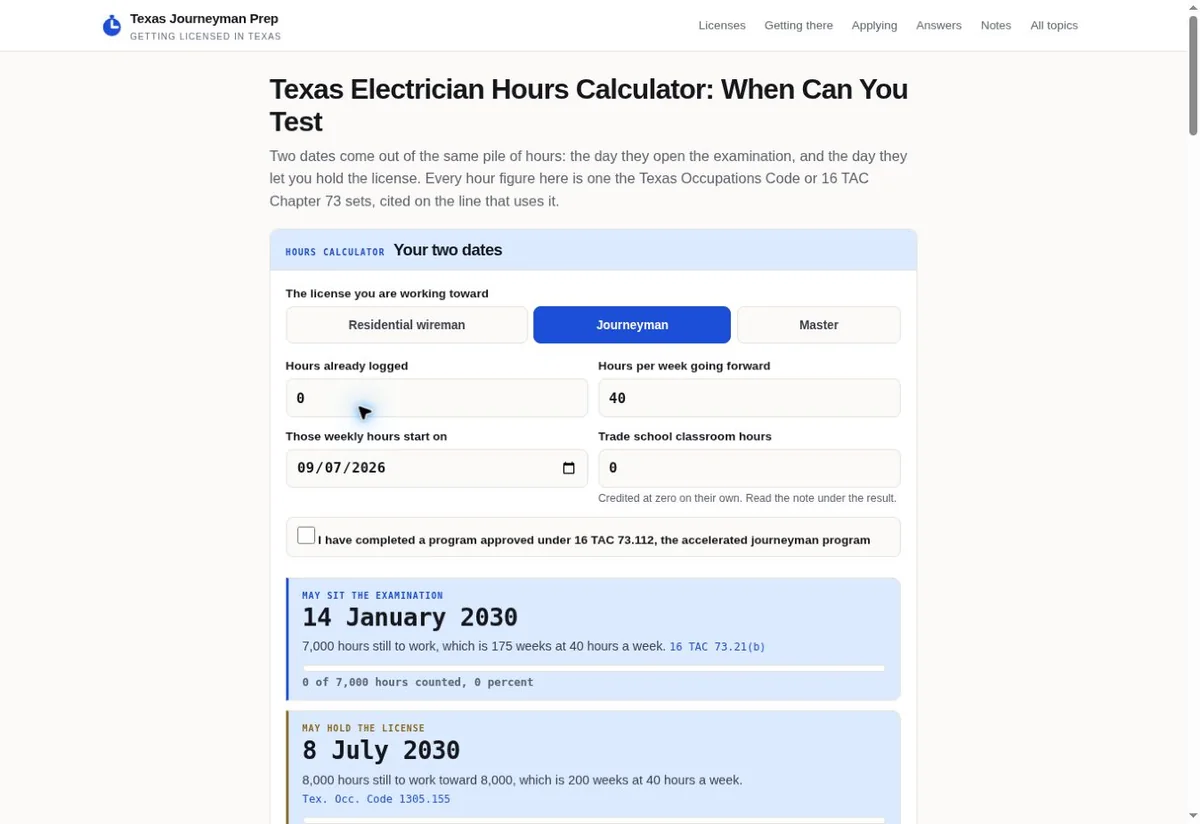
Texas Journeyman Prep calculator with labeled fields
Request interface: Texas calculator distinguishes logged hours from weekly plans. View the project
Hypothetical example An unnamed Indianapolis, Indiana homeowner asks about a visible concern

Before

  • In this invented example, a homeowner describes a door that has become harder to close. They attach an older room photo and ask whether the company can assess the concern. The form's service list requires a repair method, so the person chooses one they don't understand. The office receives that label without the uncertainty.
  • The confirmation also says the visit is booked, though no staff member has accepted a date. We would flag the chosen method and the booking message as separate problems. Neither one can be solved by treating the attached photograph as a diagnosis. The homeowner's original question remains the useful starting point.

After

  • The proposed form offers a path for an unsure homeowner and preserves their own description. The photo record identifies its reported age. We can then test whether staff receive that context and understand that the request still needs a response. A corrected acknowledgement describes the provider's approved next step without claiming a booked visit.
  • A later appointment or professional finding would belong in the real business process. Our sample stops at the checked handoff. It contains no client, diagnosis or repair result. The owner can assess whether the proposed interface preserves the details needed for staff to continue the conversation.

The Texas Journeyman Prep screenshot shows a planning interface with labeled choices and fields. It provides a separate real example of inputs that can be discussed one by one. We aren't presenting it as a foundation form. For your own project, name the purpose of each choice and test what the homeowner's response becomes in the staff view.

  • Label the sample as a test before staff see it. We suggest keeping that label in the received record so it can be excluded from customer totals.
  • Inspect the description and the service choice together. Our check should reveal whether the form strengthened the homeowner's words without a basis.
  • Keep the actual page version with the result. If a field changes later, the earlier sample should remain understandable as a test of that earlier version.

Keep the first reply useful and true to the request

The first staff reply should address the homeowner's question and state the action actually agreed. Preserve any unanswered detail instead of replacing it with a repair promise.

What should the response record contain?
Record what the business told the homeowner and which task remains open. We suggest enough detail that another staff member can continue if the original contact is unavailable. A status saying contacted may conceal that the office still needs a location clarification. The useful record shows what happened in the conversation.
How do we handle an unclear service match?
Let the company ask the missing question and record its answer. Our form and page work can support that task without claiming every submitted concern fits the offer. If the request belongs elsewhere under the provider's rule, preserve that outcome. It can help identify a confusing label or an inaccurate service explanation.
Can the reply include a repair estimate?
Only the foundation business can decide what its available information supports. We can discuss how approved cost information is presented on the website. We don't invent a repair figure from an unassessed description. Keep a website-project quote separate from any price the contractor later gives for work at the property.
What should we send Trojan Digital Marketing first?
Send the homeowner question your current form handles poorly and the staff action you want it to support. An anonymized example can make that problem clear. We can discuss the intake work with you from Indianapolis, Indiana. Your assessor supplies the professional process and the facts behind any service commitment.

After a correction, have the receiving owner inspect a fresh marked request. Ask them to explain what they would do next from the information shown. We can use that result to discuss whether the agreed website change is complete. Keep an unresolved system issue separate from a promised commercial result. The assessment business still determines what happened to the real inquiry afterward.

A corrected message can also reduce confusion about what staff still need. Ask the office which question it would ask next for an unsure request. We can discuss whether the page can answer part of that question honestly. Keep a required business check in place when the website lacks the facts to resolve it. Clear language should make that open task easier to understand.

Sources

Read more on this