Need help?Jamie

Market service plans

Plainfield Website Design for Firms That Run on Quote Requests

Your quote requests show up missing the address or a callback number, and driver and applicant emails land in the same inbox as your buyers.

Trojan Digital Marketing designs websites for Plainfield, Indiana businesses that run on quote requests, so each request reaches the right person with what's needed to answer it. It's for owners who say, 'Half our web forms arrive without a site address.' Plainfield's 46168 ZIP also lists Cartersburg as a mailing city, so address fields should accept either name.

Send one recent quote request that arrived missing details, with names removed. The first strategy call is free, and during business hours we aim to reply within five minutes.

  • Quote forms that ask what your estimator asks first
  • A separate route for every kind of visitor
  • Address and phone fields that accept Cartersburg and 463

Jeff Clerisier took his first freelance web jobs in 2016. For a Plainfield firm that runs on quote requests, that experience goes into the dull part most buyers never see: sending test requests from a phone and checking that each one lands in the right inbox before launch.

Illustrative business scene: warehouse loading dock with a truck and pallet handling
IllustrationThis page drawn as a wireframeThe headline, highlights and button from this page, redrawn in desktop and phone layouts. It’s an illustration of page structure and isn’t a client site.PAGE WIREFRAMEtrojandigitalmarketing.com/plainfield-w…Plainfield WebsiteDesign for Firms ThatRun on Quote RequestsQuote forms that ask what your estimator…A separate route for every kind of visitorAddress and phone fields that accept…Book a free website strategy…010203PlainfieldWebsiteDesign forFirms That…Quote forms…A separate…Address and…Book a free…

YOUR WORKING BRIEF

Choose where to start

Select the parts you want to discuss. Your choices carry into the inquiry form.

Discuss this service0 priorities selected

See how I'd approach this

Choose a question
to look at with me.

A website built around the next customer decisionMESSAGE · EVIDENCE · ACTION
  1. A clear offer
  2. Evidence for the customer
  3. An action that works on mobile
A website built around the next customer decision

Questions about website design in Plainfield, Indiana

  • The Plainfield EID describes an industrial and logistics district. Commercial procurement, workforce inquiries and local shopping need distinct website journeys. Plainfield Economic Improvement District

How much does a new website cost for a Plainfield business?

A new quote form or a few service pages on your current site is priced after the free strategy call. A complete rebuild usually goes through the Marketing Startup Kit, which is $7,997 or three monthly payments of $2,799 and pairs a custom 15 page website with profile work, blog posts and three months of consulting. Portals and file uploads get scoped on the call.

Can the quote form go live before the full site is done?

Often, yes, if your current site can take a new form. We build and test the quote form first, then carry it into the new design when that launches. Full timing is set after the scope review, since it depends on your content, access and feedback; in the Startup Kit's example schedule, design and build sit in weeks two to four.

What should a Plainfield quote form ask?

Only what your estimator asks on the first call. For a commercial service that's often the site address, the kind of building, the problem, a photo and a callback number. Address fields should accept Plainfield or Cartersburg with the 46168 ZIP, and phone fields shouldn't assume 317, since 463 numbers are local too. Anything longer can wait for your reply.

Our Plainfield building gets buyers, drivers and applicants. Can one website route all three?

Yes, with one clear main route and quieter secondary ones. The quote request leads the page, while drivers, current customers and applicants each get a labeled link to their own page and inbox. The Plainfield Economic Improvement District says it supports businesses and workforce connectivity, so a local firm's site may hear from all of those groups in the same week.

What if buyers still send half-finished requests?

Then we look at the requests before touching the design again. We can tag each form entry with the page it came from, so a run of incomplete requests points to one form or one page. Sometimes the fix is a required photo field or a clearer note about the buildings you serve, and sometimes the form is fine and the traffic is the problem.

Are there live sites we can click through first?

Yes. We're based in Indianapolis and have more than 1,400 live websites. On the free call we can point you to a few whose request forms you can test from your own phone. We don't have a Plainfield site to show you yet, so the examples come from other places, and you can judge the forms for yourself.

“…drove a noticeable uptick in leads within just a few weeks…”
Mike BamosiGoogle review
“I had a great experience working with Jeff…”
Heather DoanGoogle review

Jeff Clerisier founded Trojan Digital Marketing in March 2018.

We have more than 1,400 live websites.

We work from Indianapolis and serve Plainfield, in Hendricks County, as part of central Indiana.

We also work with clients across the United States.

Read our Google reviews

Which Plainfield details should a quote form get right?

Website design for a Plainfield, Indiana business includes forms that accept local addresses and phone numbers, and these sourced facts decide what those fields must allow.

The ZIP and area code details come from a ZIP dataset and weren't checked with USPS tools, so confirm them before writing validation rules. None of our builds so far is in Plainfield, so none is described.

What order does a Plainfield quote website get built in?

A website design project for a Plainfield, Indiana business that runs on quote requests moves from your current inbox to routes, then forms, then tested submissions.

  1. Sort the inbox you have nowYou share a sample of recent requests, and we group them by who sent them: buyers, current customers, drivers, vendors or applicants.Week one in the Startup Kit exampleTogether
  2. Give each group one routeThe quote request leads the page, and every other group gets a labeled link to its own page and inbox.Our team
  3. Build the form from your estimator's questionsThe form asks only what's needed to reply, with address and phone fields that accept Cartersburg and 463 numbers.Weeks two to four in the Startup Kit exampleOur team
  4. Send test requests from a phoneEach form gets test submissions from mobile and desktop, including deliberate mistakes, and you confirm what arrived in each inbox.Together
  5. Read the first real requestsAfter launch we go through the first real requests with you and fix any field that keeps coming back empty.Together

Design around the people using the website

A logistics related website can receive visits from prospective customers, current customers, drivers, vendors and job applicants. A single contact button may send all of them into the same inbox. We start by listing those visitors and what each one came to do, then give each a visible route without burying the quote request under a pile of links.

The Plainfield EID explicitly supports businesses and workforce connectivity. That local context makes audience separation worth considering. It does not mean every business here is a logistics company or that your website needs every possible portal. The design brief follows your actual service and staffing model.

Establish a credible visual language for the work

Industrial and commercial sites do not need to look like interchangeable corporate brochures. A distinctive design can use real equipment, materials, people and environments to explain how the business works. An image showing a loading arrangement can be paired with a caption about the service it illustrates. A capability comparison can use precise labels and a restrained interaction that helps a buyer explore relevant details.

Read more

Trojan Digital Marketing proposes a visual hierarchy that keeps the offer and primary action visible. Secondary operational links can remain easy to find without competing for the same emphasis. We review the design with real content rather than filling it with temporary superlatives. The result should communicate the company's actual scope and give the owner a clear basis for approving the direction.

An illustrative freight inquiry and recruitment split

Imagine a Plainfield freight service whose current form receives both shipping requests and applications. This proposed scenario has two different information needs. A buyer needs to describe the shipment and ask about suitability. An applicant needs current role information and the approved application process. A role selector alone may not be enough if the page never explains the distinction.

VisitorPage taskDestination
Prospective shipping customer
Describe freight and handling needs
Commercial inquiry workflow
Existing customer
Find the approved service contact
Account support channel
Job applicant
Review current roles and application instructions
Recruitment workflow

A freight inquiry should request only details the business can use at that stage. Sensitive shipping documents or personal identification should not be collected through a general marketing form simply because an upload button is available.

Build forms around a real handoff

We ask who receives each submission, what they need to know and what happens when that person is unavailable. The form should explain whether it requests a quote, starts an account conversation or sends a support message. It should not label a submission as an accepted booking when staff have not reviewed it.

Read more

We can design conditional questions for genuinely different service types. A visitor should not have to complete irrelevant fields because another department might use them. We test error messages, file restrictions where uploads are justified and the message shown after a confirmed submission. The review includes the receiving system and the staff notification, because interface behavior and operational delivery are part of the same customer task.

Make documents and technical material usable on phones

Give useful pages a path from the siteHomeServiceGuideProject proofNext question
Home → service
Link the service to project proof.
Home → guide
Link the guide to the next useful question.
Give useful pages a path from the siteDescriptive internal links connect a discoverable page to supporting details and a next step.

Commercial buyers may need a capability sheet, service conditions or a preparation guide. We organize downloads with a short explanation of what each contains and when it is useful. Essential service information should also appear on the page so a visitor does not have to open a large document merely to decide whether the company handles the work.

Read more

For photographs, we plan responsive sizes and purposeful crops. For interaction, we avoid large libraries where a small component can perform the task. Google's Core Web Vitals reference provides experience metrics; the build still needs its own measurements. A proposal should identify what will be tested rather than advertise a speed result that has not been observed.

Give staff a maintainable publishing process

An operations oriented website often changes in specific places: roles open and close, contact responsibilities shift and service documentation is revised. We can define content fields and ownership for those updates. A dated document should have an identifiable replacement process, and an archived role should not continue to invite applications.

Read more

The client supplies approved capability information, brand assets, image rights and the destinations for each workflow. We document where a content editor can make a routine change and where an operational owner needs to approve it. This is also the point to decide whether a customer portal belongs inside the marketing scope or should link to an established system with its own authentication and support.

Review the website with realistic tasks

The final design review should include a purchasing task, an existing customer task and any recruitment task that remains in scope. We check whether the paths are apparent, whether the right information arrives and whether the page explains the next step accurately. Staff should participate because they know when a request lacks the details needed for a response.

Read more

Our website design service can be scoped around these workflows. The Plainfield SEO plan addresses how capability pages are organized for search. Bring examples of messages that currently reach the wrong team. They give the project a concrete problem to solve and a practical way to evaluate the proposed navigation and forms.

Sources & further reading

Talk with Trojan Digital Marketing

Begin with the document task an existing vendor brings

An existing vendor may visit for paperwork connected to a known relationship. We can design that task from the business's receiving process without treating it as a new shipment inquiry.

  • Ask the office to name one document question it receives from existing vendors. It may concern where to request a current public form or who handles an account document. We should use the staff's own distinction between those tasks. A label such as general contact leaves the vendor to guess whether the question belongs with sales or an existing account team.
  • Separate information anyone may read from information staff must assess before sharing. The business supplies that boundary. We can place a public answer directly on the page when authorized and identify a staff route for other requests. The website should not imply that every visitor who selects vendor has permission to receive account material.
  • Ask whether the vendor knows a department name or only the task it needs completed. We should write the route label for that person. An internal team code may work inside the office while leaving an outside contact unsure. The receiving department can approve wording that identifies the document question without exposing private account contents.
  • Keep an alternate route for a person who cannot find the right category. We can discuss a short explanation of what the route handles and where a different question belongs. A vendor trying to resolve paperwork should not have to pose as a prospective shipment buyer to reach staff. The business decides who handles an uncertain request and what context is needed.

For a Plainfield logistics website, the town name can help distinguish the business destination from another location in a vendor's records. Ask staff how that distinction appears in their public correspondence. We can use the approved location expression where it helps the document task. The page should not invent a depot or an office address to appear more local.

Begin with a public task description and a fictional question. There is no need to share a real vendor packet with us during the first conversation. We can inspect the current page and ask the receiving person to describe the next action. That keeps the proposed website work grounded in the actual process without collecting private relationship records.

Name what is public and what needs an authorized staff answer

A document route should explain its purpose before the visitor starts. We can separate an available public item from a request the receiving department must assess.

Texas Journeyman Prep homepage with two choices
Document request: Texas homepage shows distinct visitor task choices. View the project
Vendor request route acceptance checks
Question or recordBusiness inputAcceptance check
Public informationThe business identifies which document explanation or file is approved for anyone visiting the website.A visitor can find that item without claiming an account identity. We check that its label describes the actual public material.
Account questionThe account team states which broad reference helps it recognize a relationship question and where that question should arrive.The marked request keeps the reference visible to the chosen recipient without treating it as proof of the requester's authority.
Document requestThe responsible department defines which document task needs staff attention and the permitted initial contact details.The route description and receipt agree with the department's actual next action. No automatic release is implied by submission.
Wrong taskStaff name the destination for a visitor who selected the vendor route but needs an employment or new shipment answer.The visitor can change tasks without receiving a misleading success message for a request that has not been sent.

The Texas Journeyman Prep homepage image shows choices that distinguish visitor tasks. We can discuss that visible separation when naming a public document route and a staff request. The subject of your logistics page is different. Your receiving team supplies the task names and the action that follows each choice. The picture does not establish how your paperwork should be released.

A public document link may be the quickest answer when the business has authorized the file. A request form makes sense when a person needs staff assistance. We should not add a form merely to collect a contact before showing information the business intends to publish openly. The design should follow the document's approved status and the user's actual task.

Can every document name be listed publicly?
The business decides what may be named and published. We can ask the department to supply approved titles and short explanations. A private account item might need a general task label rather than an exposed filename. The website should let the visitor recognize where to ask without announcing information the business has not approved for public presentation.
What should the first request ask for?
Ask the recipient which facts are needed to route the question. A business name and a broad document description may be enough to begin. We can make those fields clear without promising that their answers authenticate the requester. Staff apply their actual access process before sharing material. That process is separate from a public form's initial routing task.
Does a receipt mean the document is on its way?
Only say what the system has actually done. If it submitted a question for staff attention, the message should describe that action. We can ask the business for any approved response expectation it wants included. A public request should not announce release of a file when the department still needs to assess the question.

Collect a reference that helps staff locate the question

An account reference can give a recipient context without proving who is asking. We should choose the smallest approved identifier that supports your department's initial task.

Should a vendor number be required?
Ask the receiving department whether ordinary outside contacts know that number. If many legitimate questions come without it, a required field may block the task. We can discuss another way to state the relationship. The business decides which information is enough to begin looking up the question and what further checks belong in its staff process.
Can a typed account code establish permission?
It can help identify the subject of a request when staff recognize it. Possession of the code does not by itself show that a person may receive the requested material. We should keep the public form's language limited to its routing function. Your team determines the authorized process for checking a requester and deciding what may be shared.
What if the vendor uses a different company name?
A parent company or trading name may differ from the name in the office's records. We can ask which public field label helps the visitor explain that relationship. Staff should name what they need for the first check. A short optional note may be clearer than forcing the visitor to choose a company from a list they do not recognize.
Should the page ask for shipment details?
Only if those details belong to the document task being described and the business approves their initial collection. A general vendor question should not inherit every field from the freight inquiry form. We can compare the two tasks with the recipients. Each required field needs a reason connected to the action that staff can actually take.
  1. Choose a permitted sample reference Have the account team supply a fictional value or another safe test detail. We can use it to check the proposed route without bringing a real vendor record into the design task. The sample should exercise the expected format without appearing to identify a genuine relationship.
  2. Write the label and its explanation Describe the reference in words the outside contact uses. We should show where to find it when the business has an approved public example. If the value is optional, explain that clearly. A required marker should reflect the department's actual need rather than the designer's preference.
  3. Inspect the receiving context Ask the staff member to find the marked reference in the test destination. We can compare it with the visitor's selection and note. The field is useful when the recipient can understand why it was supplied, rather than seeing an isolated number with no task attached.

A reference field needs enough space for the formats your department actually receives. Ask staff for a safe representative length and any characters that matter. We can inspect how the value appears after submission as well as during entry. A neat narrow field can conceal a suffix that staff need to distinguish two records.

Keep explanatory text close to the reference field. The visitor should not have to leave the form to learn what the label means. We can check whether the instruction remains visible after typing. If a person has no reference, the page should explain the approved next option without encouraging them to invent a value merely to get through.

Give a mistaken task choice an understandable way back

A visitor may select the vendor task while looking for another department. We can design the correction so the person understands where the question belongs and whether anything was submitted.

Hypothetical example A fictional Plainfield logistics business distinguishes a vendor document question from a job application.

Before

  • In this hypothetical situation, a person needs a vendor document but starts on the employment contact route. A generic form asks for a resume attachment and offers no task explanation. The visitor has to leave the page and find a different contact. This is an invented navigation problem. It represents neither a real applicant nor a vendor whose information has been sent.

After

  • The fictional business approves a short task explanation and a visible way to return to the document question route. We would ask a tester to make the mistaken choice intentionally, then recover using only the page instructions. The receiving department would inspect a marked vendor request at the end. The exercise checks navigation and context without claiming an improved response rate or an actual account outcome.
  • Explain what the current route handles before asking for detailed fields. We can use the department's approved task description. A person who needs another team should recognize the mismatch early, when little has been entered. The alternative link should name the relevant task rather than send the visitor to a general homepage.
  • State whether changing tasks keeps any unsent details when the proposed design supports that behavior. We should test the actual result before writing the instruction. A visitor may assume the first screen sent a message even when it only made a selection. The page needs clear language about the current state.
  • Keep a contact option for a person whose document question is not covered by the listed choices. Your business decides which department can handle that uncertainty. We can ask what broad description helps that person route the request. The visitor should not have to select an inaccurate document category to continue.
  • Check the end of the recovery task with the recipient. Our acceptance discussion should follow the marked message rather than stop at the correct-looking form. A successfully corrected task should arrive with its intended context. The test can also reveal an old department label that remains in the completion text.

The alternative route needs to be visible where the mistake becomes apparent. We can inspect a phone view with the form open and its instructions in place. A footer link may be too far from the field that reveals the mismatch. The design task is to give the visitor enough context to correct the choice at that point.

Use straightforward task names in the correction. A vendor asking for a document may not know the name of your internal department. We should describe the action they want to complete, then let the business map it to the correct recipient. Changing the wording can be enough when the underlying staff route already works.

Test a marked document question through the complete route

A screenshot can clarify a discussion about fields. We still need a direct task to learn whether the planned vendor request retains its context when it reaches staff.

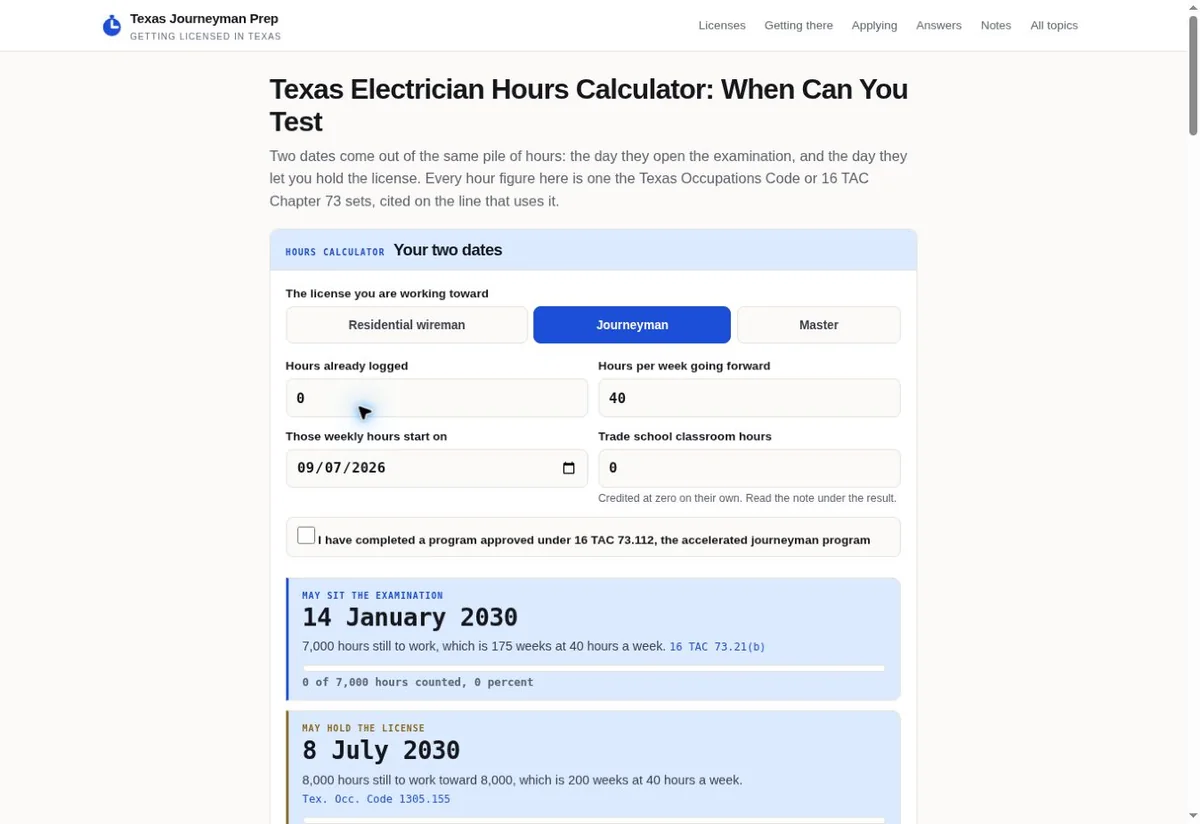
Texas Journeyman Prep calculator with labeled fields
Form task test: Texas calculator presents labeled planning inputs. View the project
What can the calculator picture show?
The Texas Journeyman Prep calculator displays planning fields with visible labels. We can examine the relationship between those labels and the controls. A vendor document form has a different purpose and recipient. Its task test needs the business's own approved sample. The picture alone does not prove message delivery or compliance with an accessibility standard.
Which test should happen before we assess receipt?
Use a marked question approved by the receiving department and make one required field incomplete. Check whether the page identifies the correction in plain terms. We can then complete the task and ask staff to locate the same sample. The test should preserve the intended document subject without using a real private vendor request.
How do we check the reference on a small screen?
Enter the safe sample on a phone-sized view and inspect the field text. We should be able to read the important characters and find the nearby explanation. Repeat the check at completion and in the receiving destination. A value that fits during typing may be shortened elsewhere in the route.
Is the test allowed to send a real document?
Use only material the business has authorized for the acceptance task. A fictional reference may exercise the route without an attachment. If an upload belongs in the proposed work, the business needs to approve a safe sample and the receiving destination. We should not turn a form check into an exchange of confidential vendor records.

W3C's labeling guidance supports a persistent description of each control. We can discuss that requirement beside the actual document question. Placeholder text disappears during entry and should not be the only explanation of the field. The proposed page needs labels that continue to identify the task as the person fills it out.

Choose a stopping point the staff member can demonstrate. It may be locating the marked request in the approved inbox with the document subject intact. We can compare that observation with the success text the visitor saw. If assignment occurs later, the page should not claim that a particular staff member has already accepted the question.

Update the task when its receiving department changes

A new recipient can leave an old department name in public instructions. We should ask the office to identify the related messages before a routine contact edit is treated as complete.

  1. Name the changed responsibility Ask which department now handles the document question and when the business wants the public route to use it. We should distinguish a new recipient from a change in what the route handles. The office supplies those facts before we prepare replacement wording.
  2. Inspect the public task labels Open the document page and the contact instruction reached from it. We can compare both with the approved change. Check the completion message too, because it may retain the previous department name after the form destination has changed.
  3. Try a marked question at the new destination Ask the authorized recipient to find the test and identify the document subject. Our check should follow the context into the staff route. A changed email address in a settings screen is only one part of the task; the recipient needs to recognize the question it now receives.
  4. Identify the next editor The business should name who can authorize another responsibility change and who edits the website. We can discuss how those roles communicate an approved update. The page remains connected to the actual task when its public words and recipient are checked together.

Keep a clear distinction between editing the website and altering an account system. We can inspect the public route and discuss the work it requires. A separate platform may have its own owner and access requirements. The first project conversation should identify those dependencies rather than assume every connected system belongs to the same task. We can ask the system owner to explain the separate access step.

Bring a public document question page and explain one handling problem you want addressed. We can discuss the task with the person who receives it. Pricing depends on the pages and interactions involved, along with any authorized system changes. Timing follows the agreed work and its required approvals, without a promised completion date for an unseen route.

What if the old department still receives some questions?
Ask the business how that transition is meant to work. We can write the approved public instruction and check a permitted older link. The office needs to decide what happens to messages that reach a retired destination. The website should state the current task route without promising how an untested former channel handles requests.
How can we assess this work before many vendors use it?
Use the approved public-file task and a marked staff-request task. We can observe whether the visitor recognizes the purpose and whether the recipient finds the intended context. Those direct checks establish behavior within the tested route. Later business records are needed to judge request quality or operational impact.

Sources

From the businesses we've worked with

“I love the way it scrolls better. Thank you so much, Jeff.”
Alexa MahaberRedefined Body skincare

Marketing help for Plainfield businesses

Based in Indianapolis, we serve central Indiana and clients across the United States.

Request a free strategy call

Plainfield, Indiana

Service area map

Explore Plainfield on OpenStreetMapArea reference; this is not an office pin. Map © OpenStreetMap contributors.