A PPC audit should explain what to change, what to keep and what the available data cannot tell you. We read a Google Ads account against what you sell and how your office turns calls into jobs. We rank what we find by how much it touches your calls, and we leave out the long lists of automated warnings.
Owners usually ask for a PPC audit when the dashboard and the office disagree about lead quality. It also helps before you hand the account to someone new or raise the budget. Start by telling us the decision you need the audit to support through the PPC audit inquiry.
Questions business owners ask
How much does a PPC audit cost?
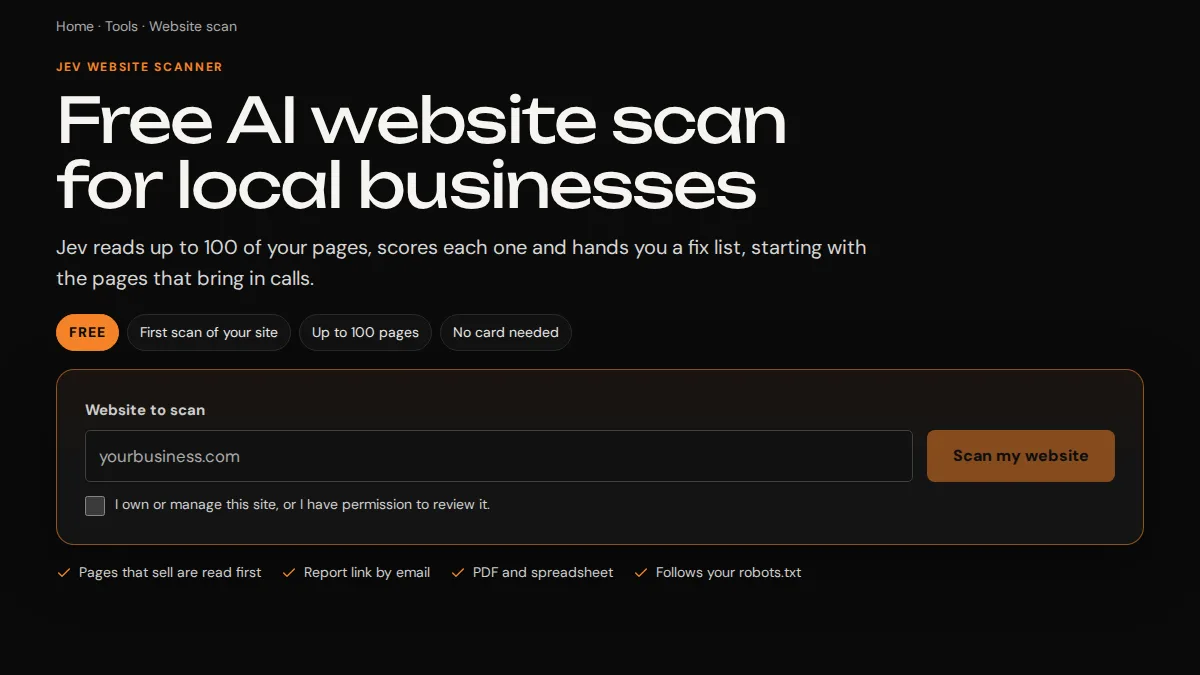
The ad account review is priced after the free strategy call, once we know how many campaigns and how much history there is to read. The landing page side can start for nothing: our free website scan reads up to 100 pages, and the $99 full audit covers every page up to 3,000, plus one rescan after your fixes.
Will the audit show how much money was wasted?
Only where the records support a real number. If calls weren't tracked or nobody logged which jobs came from ads, we'll say what can't be known and what to set up so future spending can answer the question. A number built on guesses would just move the argument somewhere else.
Is a PPC audit the same as ongoing management?
No. An audit answers a set list of questions about the account and says what we'd change. Ongoing management means someone makes those changes week to week, under its own scope and price.
Can you audit campaigns without changing them?
Yes. We ask for read access to Google Ads plus any call or job records you can export, and nothing in the account changes unless you give a separate go-ahead.
Can a PPC audit tell me if my agency is doing a bad job?
It can show where the account's numbers and your booked jobs disagree, which is usually the real question. We point to the settings and search terms behind each gap and leave the verdict to you.
Do you only look at clicks and keywords?
No, the review can also include conversion definitions, actual inquiry outcomes, geography, landing pages and handoffs. Confirm which systems and paths are included in the scope.
Should I pause all my campaigns while an audit happens?
Usually not, because the audit reads best on normal weeks of spending. We'd only suggest pausing a campaign that's clearly paying for searches you'd never want, like people looking for jobs at your company.
Do you need to change anything in my account to audit it?
No. Read access is enough for the review, and nothing gets edited or paused unless you ask for it. Keeping the audit apart from any changes means you can hand the findings to whoever runs the account now, or to your own team, without us touching a single bid.
What does the audit actually check?
It starts with what the account counts as a conversion, since a tap on a phone number or a form someone opened and abandoned can look like a lead when nobody called. Then we read the search terms beside the services you sell, compare ad locations with where your jobs were, and follow the click onto the landing page.
Why compare this year with last year instead of last month?
Because local calendars repeat and months don't match. The NHRA U.S. Nationals fill Labor Day weekend at the Brownsburg-area track every year, and a road closure like the one on E. County Road 700 N. can reshape a whole season. Setting the same weeks side by side keeps an event or a detour from being blamed on the ads.
What happens after the audit?
You decide what to do with it. You can hand the findings to whoever runs the account today, or ask us to take over management under a separate agreement. The audit doesn't depend on you signing up for anything more, and the findings are meant to be usable by anyone running the account.
Should I pause my campaigns during the audit?
Usually not. Pausing stops the very activity the audit needs to watch, and a live account shows how searches and calls behave right now. If the review turns up something costing money every day, like ads running in towns you don't serve, we'll flag it straight away so you can decide.
“I had a great experience working with Jeff…”
“…drove a noticeable uptick in leads within just a few weeks…”
Based in Indianapolis, we serve businesses across central Indiana, including Carmel, Fishers, Zionsville, Westfield, Noblesville, Greenwood, Avon and Plainfield.
We also work with clients across the United States.
What local events can skew a PPC audit near Indianapolis, Indiana?
A PPC audit for accounts running around Indianapolis, Indiana has to mark closures, big events and population shifts before judging any drop in calls.
Brownsburg, Greenwood and Indianapolis, Indiana
E. County Road 700 N. in Brownsburg was closed from March 2 through August 30, 2026 for the Bridge 28 replacement.
A closure that long can change which streets a crew reaches easily, so the audit notes it before blaming the campaign for a slow summer.
Town of Brownsburg Alert Center, Road Closures and RestrictionsChecked September 25, 2026The NHRA U.S. Nationals run every year through Labor Day weekend at Lucas Oil Indianapolis Raceway Park, the Brownsburg-area drag strip.
Compare that weekend with the same weekend a year earlier, since crowds in town can shift both searches and staffing.
Visit Hendricks County, NHRA U.S. NationalsChecked September 25, 2026In 2025 Johnson County added 3,239 residents while Marion County, with 992,196 people, added 1,983, its smallest annual gain since 2021.
When calls from Marion County flatten, check whether growth moved to a neighboring county before blaming the ads.
Indiana Capital Chronicle, New estimates show Indianapolis area continues as key for state's population growthChecked September 25, 2026
Public facts about the area around our Indianapolis base. They describe local conditions and don't come from any account we've audited.
Where does a PPC audit look first for the problem you're seeing?
A PPC audit from us for accounts run from Indianapolis, Indiana or anywhere else starts where your symptom points, then checks what the records can actually prove.
| What you're seeing | Where the audit looks first | What the records can show |
|---|---|---|
| Plenty of conversions, few booked jobs | How each conversion is counted | Whether counted leads were real inquiries |
| Calls dropped after a change | The account's change history for that week | What changed, when and who changed it |
| Clicks from towns you don't serve | Location settings and location reports | Which places got clicks and spend |
| Good calls for the wrong service | Search terms beside the ad text | Which searches triggered those ads |
What should you have ready for a PPC audit?
A PPC audit for a business near Indianapolis, Indiana or across the country goes faster when the sales side of the story arrives with the account access.
You send
- Read access to the Google Ads account
- The inquiries from the audit period, marked with which became paid jobs
- The services and towns you actually take work in
- Any price, staffing or service area changes during that period
We check
- Every counted conversion against real calls and forms
- Search terms sorted into services you sell and ones you don't
- Ad locations compared with the addresses of booked jobs
- Each landing page read the way a searcher would read it
- Findings ranked by cost and effort to fix
Define the audit question before opening reports
- Fit
- Explain the service scope.
- Trust
- Show supporting evidence.
- Next step
- Give a clear contact route.
An account with declining inquiry volume needs a different investigation from one receiving more inquiries but fewer accepted projects. A new service launch creates another question: whether the current campaign and page are suitable for that offer. Scope the review around the problem and the period that represents it.
We ask what changed in services, pricing, capacity, geography and follow up during that period. A campaign can remain technically unchanged while the business conditions around it change substantially. An audit that ignores those facts can recommend the wrong intervention.
Reconcile the events being counted
Begin with the conversion definitions. A submission event should represent a completed inquiry, not an attempt to open the form. A phone link click should retain its own label unless connected call data confirms a conversation. Review repeat submissions, test records and whether the same action appears through more than one measurement connection.
Read more
Compare a sample of platform events with actual business records. This establishes what the numbers mean before anyone interprets a cost per conversion. Google distinguishes qualified and converted lead stages; an audit should assess whether the selected goals reflect your own sales process.
The review can identify measurement gaps without claiming to reconstruct information that was never collected. Where history is incomplete, the finding should say what a future test or configuration change needs to establish.
Review search intent with actual service boundaries
Reported search terms can reveal supplier, job seeker, training or unrelated service intent. They can also show good opportunities being sent to a page that explains the wrong offer. Read terms beside the services you accept, geographic scope and resulting inquiries rather than judging a phrase in isolation.
Read more
Google's negative keyword guidance explains that exclusions use their own match rules. The audit should therefore examine the scope of a proposed exclusion, including whether it would block a useful service. A maintenance company could lose valid contract inquiries by excluding a broad word without context.
Not every unconverted search is waste. A small sample or a longer buying cycle may leave the answer unresolved. Our search terms review guide shows how to classify evidence before changing a list.
Check geography and campaign structure
- Question
- Identify what the customer needs to know.
- Answer
- Explain it clearly.
- Evidence
- Support the answer with a source.
Compare targeting settings with real delivery areas. Google supports targeting based on physical location and location interest. The right setting depends on the offer: a local service appointment differs from a destination business people research before travel.
For brands operating in several markets, assess whether separate campaigns represent meaningful differences in capacity, cost or service. Too much fragmentation can leave each segment with little useful evidence. Too little separation can hide a market that needs different messages or a different destination.
Inspect the full page and inquiry journey
The audit follows the destination a visitor actually reaches. Check whether the ad sets a service, promotion or response expectation that the page can fulfill. Confirm the inquiry path, important form errors, confirmation language and the people responsible for receiving the request.
Google offers a landing page performance report. Platform data can guide investigation, while page review addresses the real experience: mobile usability, meaningful content, credible evidence and a next step matched to the buyer's stage. These findings often belong with website design and development work as well as account management.
Give each finding a reason and a next action
| Example finding | Evidence to record | Useful next action |
|---|---|---|
| The same submission appears twice | Event names, record samples and collection paths | Review duplication before using the count for bidding decisions. |
| Queries request a service the business declines | Query examples and the confirmed service list | Assess exclusions and revise the ad or page where needed. |
| Many inquiries remain uncontacted | CRM status and attempted response records | Assign follow up responsibility and review office capacity. |
| A campaign reaches a poorly matched territory | Targeting settings and actual project locations | Review the geographic plan against delivery economics. |
These are illustrative findings, not issues we claim exist in your account. Every real recommendation should include an evidence reference, confidence level, responsible owner and a sensible way to verify the change. Separate urgent measurement failures from experiments that need time and a controlled comparison.
Keep account diagnosis separate from a sales pitch
- Domain and website
- Document ownership and access.
- Analytics and records
- Define access and the handover.
Audit scope should state which platforms, time periods, campaigns and website paths are included. Access should match the work being reviewed. A diagnostic conversation does not itself authorize spending changes, live campaign edits or a new advertising commitment.
Some findings may be handled by your existing team. Others may require a defined implementation project or ongoing Google Ads management. The next step should follow the evidence. Rebuilding a functioning account solely to make the work look more extensive does not improve the decision.
Prepare a focused PPC audit request
- Name the question: lead fit, budget allocation, tracking accuracy or a service launch.
- Describe the offer, accepted customers and actual service areas.
- Identify the account, analytics and CRM systems available for review.
- Note major changes during the period you want to assess.
- Explain who can approve and verify recommended improvements.
Discuss the audit scope with Trojan Digital Marketing. Bring a short description of what feels wrong and what evidence you currently have. That makes it easier to decide whether an account review, a measurement investigation or a destination page project is the most useful starting point.
Sources & further reading
Talk with Trojan Digital Marketing
Based in Indianapolis, we serve central Indiana and clients across the United States.