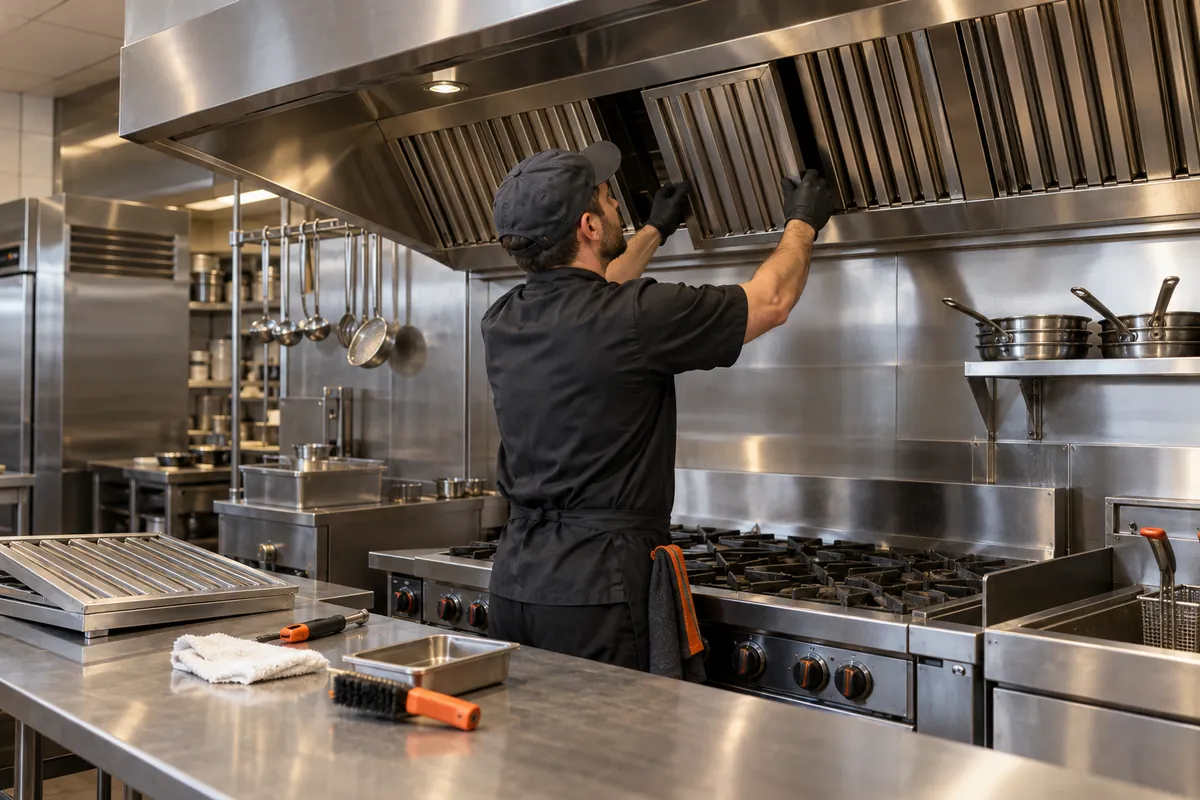
A commercial kitchen contact may be looking for a current service provider, planning a new project, or comparing companies for an ongoing relationship. The phrase “commercial kitchen services” can cover very different offers. Your website should make clear which work your company actually provides and how the right conversation begins.
Most of what we'd change sits on the contact path. The form asks for the equipment, the brand if they know it and whether the kitchen is open right now, so your dispatcher can sort urgent calls first.
Maintenance plans get their own page and form, so a planned service request never waits behind a dead fryer.
Commercial kitchen marketing FAQs
What does the initial scope include?
Usually your repair page, a page for each equipment type you service, the contact form and the ad account. Jeff Clerisier works out the scope with you, and nothing starts until you've agreed to it, dates included. On the Marketing Startup Kit's example schedule of 12 weeks, discovery takes week one and the site is built in weeks two to four. Blog posts and your Google Business Profile fill weeks five to eight, and launch comes after that.
Request a free commercial kitchen marketing audit to review the path from operator questions to suitable work. Or contact Trojan Digital Marketing to discuss your next service and account growth priority.
What does commercial kitchen service marketing cost?
It's priced after the free strategy call, since the number of equipment types you service and how far your vans travel decide how many pages and how much ad spend make sense. Two published prices help you compare. Our full website scan audit, powered by Jev, is $99 with a $19 rescan after fixes. The Marketing Startup Kit is $7,997 for a new company building its first site.
Can you market our specific kitchen service?
Yes. If your techs only do refrigeration, or only hood and exhaust work, the pages say so in the first line and the ads bid only on those searches. Listing services you don't offer just brings in calls you'll have to turn away.
Can we separate current service needs from planned projects?
Yes. The inquiry routes and measurement can reflect the different next steps. Availability and project timing should be communicated accurately, with the business making the relevant acceptance decisions.
What if our customers manage several locations?
The website can support an account conversation and collect useful property context. The business then determines which locations and services it can support. Marketing should not imply a comprehensive agreement before that review.
How can we reduce unrelated inquiries?
Ask your office to note in a word or two why each wrong call didn't fit, for about a month. We line those notes up against the searches that sent them. A pattern like ice machine sales calls points to one page or one ad group to change.
How do restaurant managers find a kitchen repair company?
Often on a phone in the middle of a shift, typing the equipment and the problem into Google or asking a map app for someone nearby. That's why your Google Business Profile and a fast repair page carry more weight than a long about page. That page should show the equipment you fix, the areas your techs cover and a number they can tap without scrolling.
Should we advertise after-hours or weekend repair?
Only for the hours you can staff. An ad promising round-the-clock service that sends a Friday night call to voicemail can cost you that restaurant for good. If your techs cover evenings on certain days, say which ones on the page and set the ad schedule to match, so you're not paying for clicks when nobody picks up.
How does Marion County's health inspection process fit into our marketing?
It gives operators a reason to book service before a problem turns up. Marion County Public Health Department licenses and inspects retail food establishments, so a maintenance page can explain how scheduled service on coolers and dish machines fits an operator's own inspection prep. Keep the wording careful, though, and never promise anyone a passing score.
What happens first if we hire Trojan Digital Marketing?
We start with your equipment list and a few months of calls sorted by job type. That shows which pages to build or fix first and which searches deserve ad money, and it gives us a baseline to measure against later. The first strategy call is free, and during business hours we aim to reply within five minutes.
What if the ads keep bringing in home appliance calls?
We'd add those searches as negative keywords and put a plain line on the site saying you service commercial equipment only. Home refrigerator and oven searches look close to yours in an ad account, so we'd check the search terms report often in the first weeks and keep trimming until the calls match the work your techs actually do.
Do you only work with kitchen service companies in Indianapolis?
No. We work from Indianapolis and take on kitchen service companies anywhere in central Indiana, including Fishers, Westfield, Zionsville and Greenwood, and companies in other states remotely. Wherever your vans run, the repair page lists only the areas a tech can reach the same day, so chefs don't call about kitchens you can't get to.
“…drove a noticeable uptick in leads within just a few weeks…”
“I had a great experience working with Jeff…”
We have more than 1,400 live websites.
Based in Indianapolis, we serve businesses across central Indiana, including Carmel, Fishers, Zionsville, Westfield, Noblesville, Greenwood, Avon and Plainfield.
We also work with clients across the United States.
A PRACTICAL MARKETING WORKSHOPHelp the operator find the right kitchen service contact
Open this walkthroughClose this walkthrough
A restaurant operator, institutional kitchen manager, and hospitality property contact can search similar phrases while requesting different work. We would make the company’s approved equipment and service scope visible, including whether it accepts current service requests, planned projects, or ongoing relationships. The page should help an operator reach a person with useful context. It should not promise a repair outcome, an available part, or a dispatch time that the service team has not confirmed.
Worked example · hypothetical planning scenario
Suppose a hypothetical kitchen service business supports selected commercial equipment but receives household appliance calls from broad advertising. We would build commercial capability pages that identify the actual equipment categories and accepted engagements. A service introduction could capture business type, location, equipment identification if available, and the request description. A restaurant group planning a broader relationship gets a multi location route instead of repeating the same form for each kitchen. A project story can describe the company’s role and coordination with the operator using approved non sensitive photographs. The business then reviews supported requests, service conversations accepted, project opportunities, and unsupported household inquiries separately to improve targeting.
| Operator’s need | Useful destination | Context the office uses |
|---|---|---|
| Current equipment service | Supported equipment and contact route | Location, identification if known, and request |
| Planned kitchen project | Verified project capability | Project stage and responsible contact |
| Several kitchens or properties | Account introduction | Property group and intended engagement |
Collect operationally useful page material
- Ask the service lead to verify equipment categories, manufacturer relationships, and any wording about hours or supported response arrangements.
- Create a short explanation of how operators provide equipment information and what happens after the office receives a request.
- Show actual work with the company’s role identified; a commercial kitchen photograph alone does not establish which equipment the business serviced.
- Keep a record of calls concerning unsupported appliances, parts only purchasing, employment, or services outside the actual offer.
Reduce the wrong kitchen service calls
Bring the equipment categories you support and examples of requests that repeatedly need redirecting. Trojan Digital Marketing can make the capability and contact journey more precise, then connect commercial search demand with the right service conversation.
Where are the commercial kitchens around Indianapolis?
Commercial kitchen services marketing in Indianapolis, Indiana starts with where kitchens are opening and running hardest, from a new downtown convention hotel to dining space going up in Fishers.
Indianapolis and Fishers, Indiana
Hilton is taking reservations at the 800-room Signia by Hilton Indianapolis, the Indiana Convention Center's newest headquarters hotel, for stays from February 2027, and the hotel plans seven dining and bar concepts.
A convention hotel with several restaurants and banquet kitchens is one buyer with many pieces of equipment, worth a page aimed at hotel engineering and food and beverage teams.
Stories From Hilton, Signia by Hilton Indianapolis Now Accepting Reservations for February 2027Checked September 26, 2026Downtown planners listed the 2026 NCAA Men's Final Four and the December 2025 Big Ten Football Championship at Lucas Oil Stadium among the major events they were preparing for.
Maintenance offers can be timed ahead of dates like these, when downtown kitchens expect their longest shifts.
FOX59, 2025 State of Downtown Indy report lists Mile Square progressChecked September 25, 2026Marion County Public Health Department's Department of Food and Consumer Safety licenses and inspects retail and temporary food establishments and responds to consumer complaints.
A maintenance page can tie scheduled cooler and dish machine service to an operator's own inspection prep, without promising any result.
Marion County Public Health Department, Food and Consumer SafetyChecked September 26, 2026The Crossing at Fishers District is a 62-acre mixed-use expansion near the historic Fishers Depot, and Thompson Thrift announced Chicken N Pickle, a restaurant with pickleball courts, as a tenant.
New restaurant space in Hamilton County can mean kitchens still being fitted out, so a Fishers page can speak to install work if you do it.
Thompson Thrift, The Crossing at Fishers DistrictChecked September 25, 2026
Every fact above is public information about downtown Indianapolis and Fishers, and none of it describes one of our clients. Name only the areas and equipment your own techs cover.
What should a kitchen service company gather before new pages go live?
Before we build commercial kitchen services pages for the Indianapolis, Indiana area, the service company pulls together the proof and limits only its own techs know.
Your office pulls together
- The equipment categories and brands your techs repair, plus any you turn down
- The hours you really answer repair calls, written out day by day
- Three recent repairs described in a sentence each, with no restaurant named unless it agrees
- The areas where a tech can usually reach a kitchen the same day
- Photos from your own jobs, cleared with the restaurant first
We build from it
- A repair page with a tap-to-call number at the top
- A maintenance plan page written for owners and kitchen managers
- Ad schedules that match your staffed hours
- Negative keywords that keep home appliance searches out
- Call tracking that tags each call by page and ad
Define the commercial kitchen service you sell
Begin with the company's approved service categories. Equipment related service, planned installation work, selected cleaning or maintenance offers, and other kitchen services are not interchangeable. The website should identify which of them belong to your business and which do not.
Read more
A broad list can create the impression that one provider handles every request connected with a kitchen. That may produce more contacts while making qualification harder. Clear service boundaries help the buyer recognize fit and help your office choose the next action.
Technical, product, authorization, and compliance related statements require review by the business. Marketing should explain approved capabilities and contact processes rather than improvise operating or safety advice for a customer's facility.
Support the operator and the project buyer differently
- Fit
- Explain the service scope.
- Trust
- Show supporting evidence.
- Next step
- Give a clear contact route.
A restaurant operator with a current need may want to reach the appropriate person and understand the response process. A buyer planning work may need capability evidence, a scope discussion, and a way to share project context. Both deserve a clear route.
| Buyer situation | Useful starting information | Next business conversation |
|---|---|---|
| Current service need | Location, requested service, account status, and relevant equipment or property context | Whether the business can accept and review the request |
| Planned project | Project goal, stage, decision contact, and available information | A scope fit project review |
| Ongoing account interest | Property or account context and the relationship objective | A discussion of the actual services available |
| Existing customer | Account identity and the new request | A continuation through the established process |
A commercial kitchen website project can organize these routes within one coherent business identity. The user should not need to decode internal department names to find the relevant next step.
Ask for context the customer can reasonably provide
An inquiry can identify the business, contact role, location, requested service, and preferred way to continue. Equipment category or identifying information may help when the customer knows it and your team uses it for routing. Planned work may need a separate description of the project stage.
Do not require a customer to diagnose a technical issue to complete a marketing form. The form gathers a request; qualified people assess the work. Optional files or photographs should follow an approved handling process and should not be presented as a substitute for review.
The confirmation message should state what has actually happened. A received request is not automatically a confirmed visit, accepted project, or completed estimate. If the office must check fit and availability first, explain that next step clearly.
A hypothetical service inquiry
A restaurant contact asks whether the company can review a service need at one location. The record captures the requested category, available context, account status, and preferred contact. The assigned owner decides whether to continue, ask for more information, or explain that the request falls outside the offer.
The marketing improvement is a clearer handoff, not an automatic technical decision. The customer receives an accurate explanation of the process, and the business can see where the request stands.
Make operating expectations part of the offer
Commercial customers may need to coordinate a conversation or visit with their own operating schedule. The website can explain how your company discusses that coordination without promising a time or availability that has not been approved.
Read more
If your service model includes defined answering hours or a separate route for existing accounts, describe the actual arrangement. Do not borrow a round the clock promise from a competitor. Public availability should have a named business owner who keeps it current.
For planned projects, distinguish the date a buyer wants to discuss scope from the date they hope work can happen. Recording those separately can prevent the first inquiry from becoming a mistaken production commitment.
Use evidence that identifies the company's role
A photograph of a kitchen can show many services and products. Project descriptions should explain what your company actually provided. Approved captions and short stories help the next buyer understand the relevant capability.
Read more
Customer names, property images, equipment claims, and project details should be used only at the level the business can substantiate and approve. If an account cannot be named, use a truthful description rather than inventing a case study or an unsupported result.
Related offers need clear boundaries. Industrial equipment repair marketing focuses on equipment and service model fit. Fire protection services marketing requires its own approved capability language and account process. A shared facility audience does not mean the services are the same.
Commercial kitchen SEO, AEO, and GEO
Search content can answer the business questions that precede a useful inquiry: which services are provided, what locations are covered, how a current request is reviewed, and what information helps a planned project conversation. Your team should approve the answers from its actual process.
Read more
Our SEO, AEO, GEO, and AI SEO services connect those answers with service pages and relevant evidence. We distinguish operator and project intent from products, training, employment, or unrelated consumer searches when those do not match the objective.
Google connects generative search with foundational SEO. We focus on accurate, useful information and observed visibility. We cannot guarantee that AI Overviews or another answer system will recommend a particular company.
Explain genuine local and account coverage
A service territory should reflect where the business is prepared to accept the relevant work. Some service categories or account arrangements may have different boundaries. The website can explain those differences without suggesting a physical office in every market.
Read more
Local content is useful when it adds real coverage information or approved project evidence. If several pages only substitute a town name, review whether a substantive regional service page would be clearer. Expansion should be described as it actually exists.
For customers discussing several properties, the inquiry route can gather enough context for an account conversation. The business should decide which locations and services it can support before marketing implies a comprehensive agreement.
Paid campaigns need a specific service objective
Commercial kitchen PPC should connect the advertised service with a destination that explains it. A campaign for a current service request needs a different handling plan from one inviting a planned project discussion.
Google's search terms report can support review of available search evidence. We combine that with office feedback about accepted and unsuitable requests so campaign decisions reflect the actual offer.
A paid advertising scope can identify the audience, geography, exclusions, schedule, budget, and business outcome. Media, management, and page work should remain clear in the proposal. Availability changes need an approved route back to the campaign team.
Make follow up reliable across service and sales
An inquiry should have a responsible person and a visible next action. Service requests may need one route, planned projects another, and existing accounts a continuation of their established process. The handoff should preserve the information already collected.
Read more
Automation can help assign tasks, send accurate acknowledgments, and flag unresolved requests. The workflow should show failures and avoid making technical or acceptance decisions without the appropriate human review.
Test a labeled inquiry from submission through delivery, record creation, assignment, and response. The business should be able to identify the request in the correct queue and explain what will happen next. A successful form screen alone does not establish that the handoff works.
Compare lead sources by the work they create
The exclusive versus shared lead guide helps evaluate distribution and charge rules. Those terms are separate from whether a request fits the kitchen services the business actually offers.
The lead fit framework distinguishes valid contact from a useful opportunity. An inquiry can be exclusive while asking for an unsupported equipment or service category.
Use the booked work comparison to connect acquisition costs with business outcomes. Keep handling effort, project mix, and open opportunities visible. A low price per contact does not establish a low cost for suitable work.
Measure relationships, opportunities, and accepted work separately
Report new account inquiries, accepted service requests, planned project opportunities, booked work, and activity within existing accounts. Add the service category and property context where they affect the business decision.
In a hypothetical review, twelve contacts include several returning customers, a few suitable new service requests, and two planned projects still under discussion. Calling all twelve new customers would misrepresent the pipeline. The useful report shows what each group needs next.
Keep quoted value separate from accepted and completed work. Do not estimate a customer's production loss or future account value without business evidence. Marketing should report what it can substantiate and label planning assumptions clearly.
A hypothetical first 90 days
Days 1 to 30: define the actual service offer, buyer routes, genuine territory, and availability process. Review public claims and project evidence. Test the inquiry handoff and establish reporting stages.
Days 31 to 60: publish priority service explanations, improve operator and project inquiry routes, and implement useful assignment visibility. Begin a focused campaign where the offer, budget, and response capacity support it.
Days 61 to 90: review accepted requests, project progression, account context, and the workload created. Choose the next service or market priority from those findings. This is an example plan, not a forecast of calls, jobs, or rankings.
Sources & further reading
Talk with Trojan Digital Marketing
Based in Indianapolis, we serve central Indiana and clients across the United States.