Questions about website design in Greenfield, Indiana
Local context
- Hancock EDC identifies Greenfield as its county seat and describes Depot Street Park. Plans connect business specific information with verifiable local context. Hancock EDC Greenfield community profile
What does a new website cost for a Greenfield repair business?
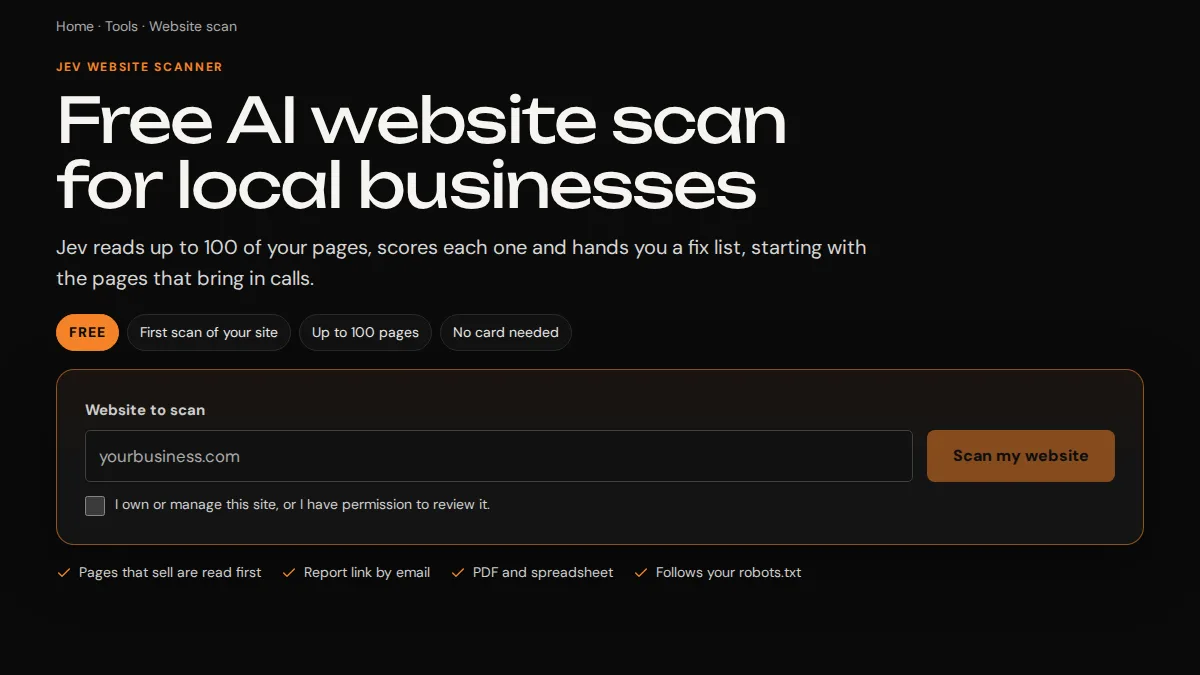
If your repair shop needs the whole site rebuilt, the Marketing Startup Kit covers it at $7,997, or three monthly payments of $2,799, with a custom 15 page website and Google Business Profile optimization included. We price smaller jobs, like a new request form and service pages on your current site, after the free strategy call. If you'd rather see where the current site stands first, the website scan is free.
Should customers be able to pick an appointment time on the form?
Only if the slot is truly held when they pick it. If staff still confirm by phone, we label the field 'preferred time' and have the thank-you screen say when someone will call back to confirm. A calendar that looks like a booking and then gets changed is one of the fastest ways to lose a repair customer's trust.
How do customers describe a problem they can't name?
We give them a short box that asks what they're noticing, with a couple of plain examples above it, and let staff choose the service. Making someone pick from a list of technical repair names tends to put requests in the wrong category. A photo upload helps too, and we add a line beside it saying who'll see the photo.
Our customers come from all over Hancock County. How should the form handle that?
We ask for the town or ZIP code near the top. The Census Bureau's 2024 estimates count 26,268 people in Greenfield out of 88,810 in Hancock County, so most of the county lives outside city limits. If you only travel to certain towns, or customers have to bring the item in, the form says so before anyone types a description.
How long does a website project take?
About nine to twelve weeks in the Startup Kit's example schedule, which gives weeks two to four to design and build, then holds launch for weeks nine to twelve so content and profile work can finish. We agree the actual schedule after scope review, and it moves fastest when your staff can test the request form early.
What if the new form still brings in messy requests?
Then we read a batch of real submissions with your staff and mark which fields got skipped or misread, which points to the prompts that need rewriting. Sometimes the fix is moving the town field higher, and sometimes it's adding a separate route for customers checking on a repair that's already in progress.
Where do a Greenfield repair shop's customers live?
Website design for a Greenfield, Indiana repair business starts with who's asking, and most Hancock County residents live outside Greenfield's city limits.
Greenfield, Hancock County, Indiana
Greenfield had an estimated 26,268 residents on July 1, 2024, out of 88,810 in Hancock County, which puts roughly 3 in 10 county residents inside the city.
Ask for the town or ZIP early on the form, because many requests may come from elsewhere in the county.
U.S. Census Bureau, vintage 2024 city and town population estimates for Indiana (GitHub copy)Checked September 25, 2026
Population figures don't show how your own customers book. That comes from your staff and past requests, and no Greenfield client work appears on this page.
How does a Greenfield repair site get built and tested?
Website design for a Greenfield, Indiana repair business follows the Startup Kit's example schedule, with your own staff testing the request form before launch.
- Read your recent requestsWe go through real submissions and call notes with you to see which details staff always have to chase by phone.
- Design the request pathWe open the form with the problem in the customer's words, ask where the job is, and mark any chosen time as a preference until staff confirm.
- Test from staff phonesYour staff send test requests from their own phones, and we confirm each one lands in the inbox they actually watch, photo attached.
- Read the first real requestsAfter launch, we read the first batch with you to see which prompts confused people, and those get reworded first.
Let the customer describe the problem without guessing the service
A person needing a repair may know the symptom but not the technical name of the work. A website that forces them to choose a precise service too early can create confusion. Trojan's Greenfield website design work gives visitors a clear way to describe what they need while preserving the role of staff in assessing the request.
The Greenfield community profile from Hancock EDC provides verified local context. It does not tell us how your customers book repairs. We use staff interviews, existing inquiries and the actual appointment process to decide which choices and information belong in the design.
Build visual credibility from the service itself
A repair business can establish a recognizable style through its premises, tools, approved work photographs and clear explanations. Trojan can design a homepage that shows the kind of work offered and lets a visitor choose a relevant route. The visual sequence should not depend on exaggerated claims or a gallery of stock technicians who have no connection to the business.
Read more
Useful interaction might include a service selector with plain language descriptions or a preparation checklist that expands when needed. It should not pretend to diagnose equipment from a few clicks. We design movement to support attention and test that essential information remains available to keyboard users and people who prefer reduced motion.
An illustrative auto service appointment journey
Imagine a Greenfield auto service business that reviews appointment requests before confirming a time. This is a proposed website scenario. A customer may want routine maintenance, help describing a symptom or information about an existing job. Those tasks need different wording and may need different destinations.
| Customer task | Information the page should explain | Accurate next step |
|---|---|---|
| Request routine service | The services accepted and scheduling process | Submit an appointment request |
| Describe a vehicle concern | What details staff need for review | Send a description without implying a diagnosis |
| Ask about current work | The approved customer support contact | Reach the team handling the job |
The website should not tell someone a vehicle is safe to drive based on a form response. Technical or safety advice belongs with an appropriate professional assessment, not a decorative interactive feature.
Make the form useful to both sides
Trojan maps fields to the decisions staff make. For the auto service example, the business might need contact details, vehicle identification information it considers appropriate and a description of the request. We ask which fields are essential and which can wait for a later conversation. The form should not demand information the customer cannot reasonably know.
Read more
Clear labels, accessible validation and an accurate completion message are part of the scope. If staff must review availability, the message should not say the appointment is booked. We test failed submissions as well as successful ones and confirm that the receiving team gets the information. An alternative contact route should be available when a visitor cannot complete the form.
Keep important content lightweight and readable
- Service A
- Planned coverage: fit and next step.
- Service B
- Planned coverage: proof and next step.
- Service C
- Planned coverage: fit and proof.
Service details should not live only in a large promotional image. Trojan plans readable text, appropriate photographs and a layout that lets a phone user find the relevant action without unnecessary scrolling. We create responsive image versions and consider which image deserves early loading and which can wait until the visitor reaches that section.
Google's Core Web Vitals reference provides metrics for experience review. We measure the actual build, including booking components and analytics, before describing its performance. A visually engaging service page can use restrained effects and still provide depth through examples, process details and practical preparation information.
Put service updates under a clear owner
A service website changes when the business accepts new work, changes hours or revises its booking process. Trojan can define CMS fields for those routine updates and identify who approves technical content. A page should not continue offering a service that staff no longer accept because its description was difficult to find in the editor.
The client supplies approved service information, photographs, contact destinations and appointment rules. We document the handoff from inquiry to staff review. If an automated message is used, its wording must reflect the actual status. The website can acknowledge a received request without suggesting that a repair, appointment or price has already been confirmed.
Review the design through realistic service tasks
The review should ask a new visitor to identify a relevant service, send a request and understand what happens next. An existing customer should be able to find the appropriate support contact without entering the sales flow again. Staff then review whether the requests contain useful context and reach the correct destination.
Our website design service can be scoped around these tasks. The Greenfield SEO plan addresses service discovery, while the image converter can help prepare approved photographs. Bring examples of confusing appointment requests or messages that reach the wrong person. They give the design a real operating problem to solve and a practical basis for evaluating the result.
Related projects

Westfield Roofer
A Westfield, Indiana roofing website that pairs call and inspection routes with five before-and-after project comparisons.

Redefined Body
A skincare shop redesign with clear product pages that show benefits and ingredients alongside a purchase button.

Moto Supreme
A cabin retreat website that connects the stay and guest activities with a practical route to booking.
Sources & further reading
YOUR NEXT MOVE