Questions, answered.
Will it read every search query for my website?
That isn't a claim we make from a Search Console API export. Google's query reference describes internal limits and top-row results. Nova should identify the date range and filters used, then explain the conclusion within that view. More data may require a different report or another approved comparison.
How soon will my website appear in AI answers?
We haven't supplied a fixed citation or indexing timeline. The setup schedule depends on agreed access, source quality and approvals. External search systems determine whether they use a page. We can define the workflow's testing and launch conditions while keeping those external outcomes outside a timing promise.
What happens on the first phone call?
Tell us the search decision your team repeats, the pages involved and the person who would assess an output. We'll match the plan to that task and explain which sources it needs. The first strategy call is free. We confirm the scope and payment before onboarding; the call itself doesn't activate an account connection.
Buy a search analysis workflow your team can use.
Open this walkthroughClose this walkthrough
Nova is Trojan's configured SEO and AEO agent service. We set it up around your approved website information and authorized search data. It can prepare source-backed search reviews, content briefs and a work list for your team to approve. Choose a plan, call us to agree the work, and arrange payment before onboarding begins.
| Plan | Setup and monthly support | Included operating allowances |
|---|---|---|
| Focus | 249 dollars per month for support; setup costs 1,497 dollars. | Monthly capacity: 1,000 workflow runs, with one support hour. Configure one agent and one workflow, using up to two connected business accounts. |
| Team | 449 dollars each month for support; setup costs 2,997 dollars. | Monthly capacity: 3,000 runs, with two support hours. Configure up to two agents and three workflows, using up to four account connections. |
| Operations | From 699 dollars each month for support; setup from 4,997 dollars. | Monthly capacity: 7,500 runs, with three support hours. Configure up to three agents and five workflows, using up to six account connections. |
For Nova, Focus could connect an approved site inventory and Search Console review to one clear output. Team can separate search triage, a content brief and a team handoff. Your purchase covers the agreed setup and bounded care. AI usage, hosting, platform subscriptions and separately approved implementation cost extra.
The first strategy call is free. During business hours, we aim to reply within five minutes. Call (317) 981-2386 or request a Nova callback. We'll review access, tasks and provider limits before taking setup payment. A conversation with Jamie on this website can help you prepare that request; it doesn't purchase or activate Nova.
We bring the website experience behind more than 1,400 live websites to the discussion. That company-wide fact supports our understanding of site delivery. It doesn't establish a past Nova installation or a search result for your business. Our starting question is simple: which search decision would become easier if its sources and next action arrived together?
Give Nova a bounded job before connecting more tools.
Open this walkthroughClose this walkthrough
A search agent worth buying has a defined question and a receiving person. We can configure Nova to examine an approved group of pages, compare agreed search periods and prepare recommendations with references. Your staff should be able to see which page, query or business fact led to each recommendation.
Start with a recurring decision you already make. Perhaps a service page attracts impressions while callers still ask whether you provide that service. Perhaps several pages cover the same question and nobody knows which one to update. Those situations call for different inputs. We help turn the problem into one workflow that can be tested with your actual information.
A workflow in the plan means one agreed trigger with a defined output and handoff. Its action limit is five, and it includes one approval step. A scheduled review of an approved page group may be one workflow. A separate request that produces a new content brief is another. We count the work by its agreed behavior, rather than assuming every idea fits inside the first setup.
The first instruction should explain what Nova may read, what it should produce and where uncertainty belongs. We can ask it to identify a missing source, or return a question for your team, when the available data doesn't support a conclusion. This makes an incomplete analysis visible instead of encouraging a confident answer about facts nobody supplied.
Separate a recommendation from a website change.
Nova's base offer supports analysis and drafts. A recommendation to improve a title doesn't itself edit a published page. The receiving staff member reviews the proposed wording and its evidence. Development, content implementation and publishing receive their own agreement and permissions. We discuss those services through our SEO and AI search work or website design and development.
Your reviewer should know the business well enough to spot a service you don't provide. Search data may suggest interest in emergency work, but only your team can confirm whether you accept it. We can encode that restriction in the approved facts. We also need an owner for correcting those facts when availability or coverage changes.
There is no standard list of apps that every Nova purchase must include. Existing exports may be adequate for a focused audit. A supported account connection can reduce repeated handling, but its permissions and maintenance need to earn their place in the plan. We prefer the simplest source arrangement that supports the question you actually need answered.
Build the source list around your business's real boundaries.
Open this walkthroughClose this walkthrough
We need approved facts before we ask an agent to explain your offer. Start with the service list, accepted work, contact route and actual coverage. Add the pages your team wants reviewed. Search Console access belongs to a property your business controls, with authorization for the data included in the workflow.
| Source | What it can support | What your team needs to confirm |
|---|---|---|
| Approved service pages | Published descriptions, contact choices and customer questions | Whether the wording reflects work you currently accept |
| Search Console data | Observed queries, page activity and defined comparisons | Correct property, date range and filters |
| Business fact sheet | Coverage, conditions, ownership and approved claims | A named person responsible for updates |
| Customer question notes | Real language and points where an inquiry gets stuck | Permission to use the material and removal of private details |
| Technical review findings | Known page, navigation or delivery defects | Which findings remain open and who can repair them |
We don't need a customer's name to learn that people repeatedly ask about financing or appointment availability. A short, approved description of the question may be enough. Remove account numbers and details unrelated to search planning. Your team decides which private material may enter the chosen AI provider, and we record that boundary in the configuration.
The plan's initial source allowance applies to pages and text-ready files. Focus includes up to 25, Team up to 75 and Operations up to 150. We accept a text-ready file up to 5 MB as one source. A scanned archive needing transcription, a large document library or extensive cleanup receives a separate quote. We examine source quality before deciding whether quantity helps.
Each included connection covers a single business app account that your company has authorized. Two different analytics properties can require separate consideration even when a staff member views them through the same login. The AI provider and hosting can create additional metered charges. We identify those charges during the planning call, so the account allowance doesn't hide the operating cost.
For each source, save a recognizable name, the business owner and a last-reviewed date. An expired offer should be easy to locate and retire. If Nova receives conflicting service descriptions, its report should show the conflict and request a decision. Repeating whichever document happened to arrive last would make a fragile basis for public copy.
We can begin with a small approved set and test it before adding another department's information. A restricted service team may need different instructions from the wider company. Those distinctions belong in the source register and routing rules, where your staff can inspect them, rather than remaining a verbal exception everyone must remember.
Turn search activity into a question worth investigating.
Open this walkthroughClose this walkthrough
Search numbers help when the comparison is clear. Nova can prepare a report that states the property, date range, search type and filters before it describes a change. We want your staff to understand what was counted. A brief should carry enough context that someone can revisit its source without guessing how the chart was assembled.
Google's Search Console API lets an authorized user query data with filters and a selected date range. Its official reference says the response doesn't guarantee every row; the system returns top rows within its internal limits. We carry that limitation into the report. A query table can show a pattern worth checking while leaving some activity outside the exported view.
Choose a comparison that fits the business question. If a holiday changed your opening hours, an earlier period with ordinary hours may explain less than you hoped. If a page was launched partway through the period, include that date. We can configure Nova to ask for the missing context instead of presenting any larger number as progress caused by a content change.
Keep impressions, visits and inquiries separate in the report.
An impression tells you something about visibility in the selected report. A click is a different event. Neither tells the agent that your office spoke with a suitable customer. When the team wants to discuss inquiries, we need a separately approved record and a clear definition of an inquiry. We can make the report show where the evidence ends.
Average position can change because the mix of searches changes. A broader set of questions may produce more impressions with a different average. Nova should explain which query group it examined before suggesting that a business-wide position improved or worsened. This helps your team decide what to inspect, while avoiding an unsupported explanation of Google's decisions.
Your staff can group queries by the customer problem they describe. Requests for a repair, a planned replacement and information about an unusual symptom may need separate destinations. Nova can propose a grouping, with examples for staff to check. We ask your team to confirm ambiguous wording so the next brief reflects the work you can actually sell.
The readout should end with a bounded next action. That could be checking a contact button, asking your staff about an unclear service condition or drafting a section that answers a recurring question. Include an owner and the evidence to inspect. A long list of keywords becomes easier to use when the receiving person knows what decision is waiting.
You can try the search opportunity finder with your own Search Console information before discussing a connected setup. It provides a direct way to see the type of questions a search-data report can raise. Nova is a scoped service around your sources and team workflow; the public tool remains a separate starting point.
Send technical findings to the person who can repair them.
Open this walkthroughClose this walkthrough
A good recommendation can be blocked by a simple site defect. We can configure Nova to organize approved technical findings beside their affected URLs and receiving owners. The agent's role is to make the issue easier to inspect. A developer still needs to confirm the cause and implement an appropriate repair.
For example, a customer may reach a service page through a menu while search crawlers encounter a different link path. Or a page may show important text in a way that depends on a delayed script. We can include findings from a defined site audit, with the observed condition and the method used to observe it. That is stronger than an unexplained score.
Google recommends crawlable links and clear internal linking. Its documentation describes links that use an anchor element with an href attribute as the usual crawlable pattern. Nova can flag an observed navigation concern in a supplied audit, but a screenshot alone doesn't establish the site's underlying link markup. We keep the evidence appropriate to the claim being made.
Keep indexing observations dated.
The URL Inspection API reports the inspection data available for an authorized property. Its reference describes the inspected URL as belonging under that property. We can include supported inspection results in the agreed task, recording when the check ran and which URL it concerned. That observation doesn't guarantee a future indexing decision or mean every URL on the site was inspected.
If your team has a known canonical or redirect problem, put its affected addresses in the issue log. Nova can help compare the intended destination with the supplied finding. A site migration deserves its own implementation plan and test coverage. We won't imply that connecting an analysis agent repairs server routing or changes a platform's crawl schedule.
Priorities should reflect the visitor's problem as well as the technical label. A broken inquiry route on a current service page may deserve attention before a cosmetic improvement on an old article. We can ask Nova to state that reasoning. Your staff can then decide whether the proposed order fits capacity and the business's present priorities.
Our Jev Website Scanner is an existing Trojan product that can start a website discussion. The published build log explains that separate project. Its screenshot below shows the actual scanner input screen. It is a reference for our website analysis work, rather than a picture of a completed Nova interface.
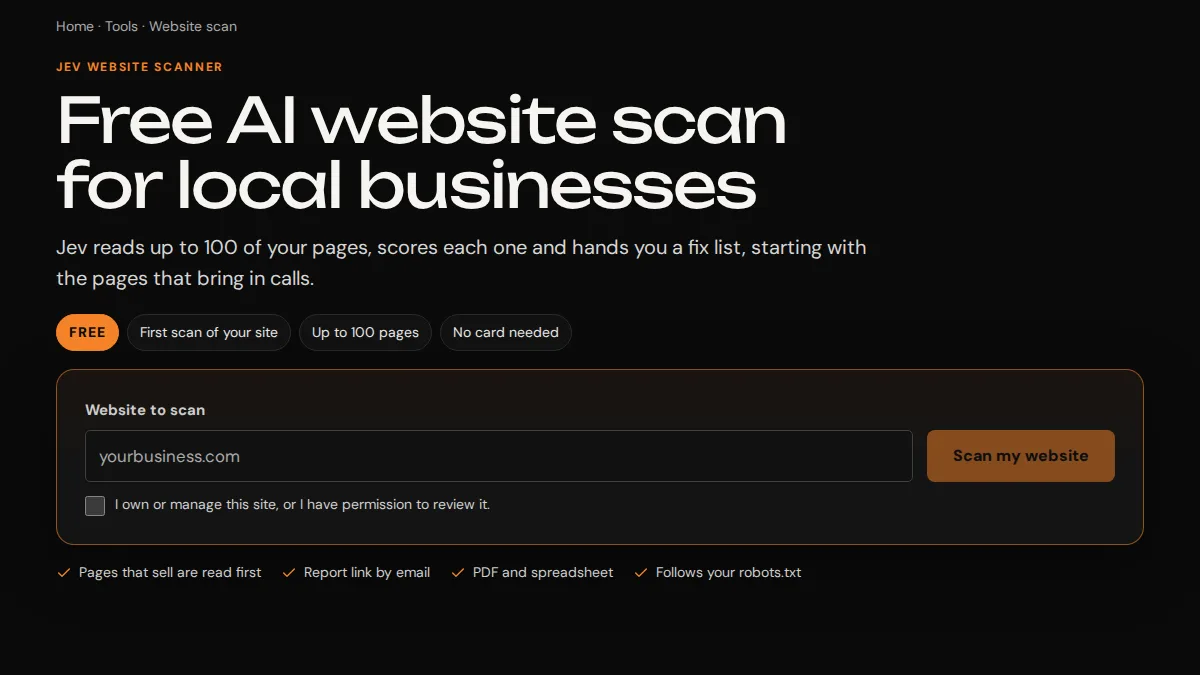
If a scan raises a question about mobile use, bring the actual page and device experience to the call. We can discuss a website audit alongside Nova. Fixing the customer's path may require web work, content work or both. Choosing the right receiving team is part of making the search report relevant.
Give a content brief the facts a writer would otherwise chase.
Open this walkthroughClose this walkthrough
A Nova content brief can connect a customer question with the approved offer, source pages and a proposed place to answer it. We configure the output around the person writing or reviewing the page. The brief should make clear what the business can support, where evidence is missing and which claims require an owner's decision.
Start with one reader and one decision. A person comparing appointment types needs different information from someone checking whether you serve their town. Put that distinction at the top of the brief. We can have Nova identify the existing page that fits the question before recommending another page be created.
Useful brief fields include the intended reader, the specific question, approved facts and the proposed answer. Add links to source material and any required wording. Your writer should also see the contact route and important conditions. If a price is subject to a planning call, the brief must retain that condition when it suggests copy.
| Brief field | Example of the expected content | Reviewer decision |
|---|---|---|
| Customer question | Does the business accept a named type of repair? | Confirm accepted work and exclusions. |
| Existing destination | The current service page with the relevant inquiry button. | Decide whether that page should carry the answer. |
| Source-backed wording | A proposed paragraph tied to approved operating facts. | Check accuracy and whether the customer can understand it. |
| Missing evidence | An unsupplied warranty or capacity detail. | Provide an approved answer or omit the claim. |
| Success check | Confirm the answer and contact route after an approved edit. | Assign the implementation and follow-up check. |
We ask the writer to keep their own judgment. Search data can reveal a question without supplying the answer. A model can draft a clear sentence while misunderstanding a service boundary. Reviewing the source alongside the proposed wording is a practical defense against turning an uncertain inference into a public business promise.
Google's people-first content guidance emphasizes useful information for people and clear attention to who created it. Its spam policies address scaled content created primarily to manipulate rankings. A large output count is therefore a weak purchasing goal. We would rather configure Nova to make a small set of worthwhile decisions easier to inspect.
A brief can recommend improving a relevant page that already exists. It can also identify why another page needs a distinct purpose. Replacing a town name while keeping the same unsupported claims would leave the customer with little reason to read it. The business needs real coverage information and a helpful answer for that particular visit.
Start a do-it-yourself fact register with our AI answer kit. The customer language miner can help you examine customer wording you have permission to use. These tools can support your preparation without implying that an agent or a writer has validated every input for you.
Approach AI answers with the same factual discipline as search.
Open this walkthroughClose this walkthrough
AEO work helps you consider the questions a person wants answered and how clearly your website supports an answer. Nova can organize those questions and draft answer briefs from approved facts. We keep the distinction between improving a page and receiving a citation visible, because an external search or answer service decides what to display.
Google says established SEO practices also apply to its AI Overviews and AI Mode features. It describes no additional requirements or special optimizations for appearing in those experiences. A supporting link needs an indexed page that can appear with a search snippet. Meeting the requirements still doesn't guarantee that Google will crawl, index or serve it.
This changes what we ask Nova to investigate. We focus on whether your information is accessible, accurate and internally connected. The agent can identify questions the approved page leaves unanswered. It can help prepare wording that defines the service and states its conditions. A reviewer then confirms whether the answer reflects the business.
Keep the promise close to the work you control.
We can agree a fact register, answer briefs and a reporting workflow. We can't assign a guaranteed citation to a search product we don't operate. The same applies to a number-one ranking or a fixed indexing date. Nova's usefulness should be assessed through the quality and usability of the agreed outputs, alongside later observed search and business data.
Google also says special AI text files and additional special structured data aren't needed to appear in its AI search features. Structured data should match the page's visible text. That gives your team a clear inspection question: does the page support the entity, service and conditions described by its markup? Nova may help identify a mismatch for a technical check.
A strong answer can be brief while the supporting page remains substantial. Put the direct answer near the opening and use the rest of the page to explain choices and boundaries. We don't want the customer to scroll through a long introduction before learning whether you can help. A content brief can preserve that ordering for the writer.
Google reports traffic from its AI search features within overall Web search traffic in Search Console. We won't present a standard Web export as an independent count of every AI mention. If your team wants a wider citation study, we discuss the measurement method and limits separately. Screenshots and repeated manual searches also need their date and context recorded.
Read our AI Overviews service explanation and SEO, AEO and GEO service scope if implementation is your immediate need. Nova fits teams that also want a repeatable way to inspect approved inputs and prepare the next report. We can discuss the combination without treating every search task as included automatically.
Worked example: review a confusing service destination.
Open this walkthroughClose this walkthrough
This is a hypothetical example for explaining a Nova workflow. It describes no Trojan client result. Imagine a business has an approved repair page and a separate replacement page. Its team keeps receiving the same question about a repair type, but the website's answer is difficult to locate.
The business approves both URLs and a 28-day Search Console export. A query group has 1,200 impressions and 24 clicks in that period, giving a two percent click-through rate. These figures are invented teaching inputs. They don't establish an expected rate or prove that the page caused the question to recur.
| Observed input | What Nova could propose | What the team confirms |
|---|---|---|
| Repair questions reach the replacement page. | Inspect the destination and the site's related service links. | Which page should explain accepted repairs? |
| The business accepts the repair under defined conditions. | Draft a short answer with those conditions. | Whether the conditions remain current and complete. |
| An inquiry button uses a vague label. | Suggest a label that names the intended conversation. | Whether the receiving team can handle that inquiry. |
| The export includes only selected query rows. | Record its filters and avoid claiming complete coverage. | Whether another view is needed before changing priorities. |
We could configure one workflow to package that report for the service owner. It would include the source links, the proposed answer and the unresolved question. The owner can approve the facts or ask for a revision. A content implementation task would follow only under the separately agreed publishing scope.
After an approved edit, the team can check the actual page and its inquiry route. A later comparison should record the new period and other changes that might affect it. If a paid promotion started at the same time, keep that context. Even a favorable search change doesn't let the agent assign all subsequent business activity to one paragraph.
The practical outcome to look for first is a report somebody can use. Did the packet identify the right service owner? Could the writer find every supplied fact? Was the original question answered clearly after the approved edit? Those checks can reveal a workable task while the team waits for enough real search data to evaluate a wider result.
We can make a test case from an approved question your staff already understands. Ask them to judge the output before connecting a larger source set. This reveals whether Nova's instructions are suitable for your team. If it misunderstands the service, we fix the source or scope before asking the workflow to handle more pages.
Review local search through the places you actually serve.
Open this walkthroughClose this walkthrough
Nova can include approved territory information in its briefs. Your business supplies the coverage and service restrictions. We won't infer a local office, local customer history or unrestricted coverage from a town appearing in a query. A location-based question still needs an accurate answer about what your business can do there.
For a contractor, a territory list can distinguish ordinary planned work from urgent requests. A staff member may approve one county for a service and a narrower set of places for another. We can record those boundaries as facts the brief must use. If the team changes its capacity, the source owner updates the list before another public recommendation is approved.
The plan defines each service-area unit as an approved list capped at 10 ZIP codes or one county. Focus covers one business and one service area. Team allows up to two areas for the same business; Operations up to three. A broader national or multi-business setup needs its own agreement. We discuss the geography before payment so the purchase reflects the work.
A local brief can begin with the customer question: can this business serve this address for this requested work? It can then identify the right service information and contact route. A new page needs useful content for that situation, backed by the business's approved offer. Repeated place-name pages don't establish local experience or help a customer assess the actual choice.
If your Business Profile is part of the discussion, we review the authorized access and intended task separately. A Search Console connection doesn't grant access to every business listing. Recommendations about profile information should rely on the approved business facts and the relevant account information included in the scope.
Our business is based in Indianapolis, Indiana. That is a statement about Trojan's location. It isn't a reason to add an Indianapolis address to your company or imply your team works from our office. Nova's public wording should represent the receiving business correctly, including whether it has a customer-facing location or a service-area model.
A weather-related team workflow is a different purchasing need. The contractor weather-response guide explains how to approach notices and approvals. We can discuss the wider agent lineup if your team needs both search planning and an operating response. Each approved workflow retains its own sources and receiving owner.
Create a work queue that explains why an item comes first.
Open this walkthroughClose this walkthrough
A search review becomes more useful when its proposed order is visible. We can configure Nova to group tasks by the customer problem and the evidence behind it. Your reviewer should see why an item matters, who can act and what is still unknown. We discuss the priority rules with your business before relying on the queue.
Start with a problem that prevents a willing visitor from completing the intended next step. An inquiry form that fails under the supplied test has a concrete affected route. A suggested new article needs a different level of judgment about usefulness and demand. The workflow can make those differences visible without turning every task into an emergency.
Give each item a concise label and an affected URL. Add the source of the observation, a proposed next action and the person who owns that action. When a task depends on business approval, mark that dependency. When a developer needs to reproduce the finding, include the relevant test context rather than an unsupported diagnosis.
We can also include reasons to defer work. Your business may be unable to accept a service that a query suggests. An old seasonal page may have little role in the current offer. Nova can propose leaving an item on hold and state the reason. The reviewer can change that decision when the underlying business condition changes.
Keep the queue small enough for the receiving team to inspect. The number of sources in a plan doesn't mean every page needs a new task each month. A few clear decisions can be more usable than a large collection of similar suggestions. We set the output limit and escalation behavior during setup, along with the trigger that creates another run.
A staff member's final choice should remain visible in the handoff. If they decline a recommendation because the business doesn't accept the work, preserve that approved restriction in the source facts. If they request more evidence, make it the next inspection question. We want the instructions to learn from approved corrections through a deliberate configuration change.
This work queue can support an existing writer or developer. It doesn't require your business to replace its present team. We can discuss which outputs they would find useful and what format they can inspect. A defined handoff helps avoid sending a technically detailed recommendation to someone who has no authority to act on it.
Agree the operating costs and care before launch.
Open this walkthroughClose this walkthrough
Nova's monthly fee covers the support allowance and operating check described in your plan. It doesn't include every charge made by an AI provider or connected platform. We prefer business-owned accounts billed directly where practical. When we cover an authorized provider bill for your business, we pass through the documented cost without adding a markup.
We agree the provider, account and monthly usage allowance during scoping. We configure available usage controls. Spending that reaches 80 percent of your approved provider allowance triggers a warning. If the allowance is exhausted, optional work can pause or go to your assigned staff contact. Provider reporting can lag, so we allow a safety buffer and avoid promising a universal exact spending stop.
We count a processed event or requested task as a workflow run, and count its retries too. A failed run can still use provider resources. Polling that finds no matching event is outside the run count while remaining within the approved API budget. The plan's run allowance is therefore a limit on the scoped operating workload, with provider charges accounted for separately.
Our support allowance can cover operating checks, corrections and small changes to existing workflows. Focus includes one hour per month, Team two and Operations three. Unused time expires at the end of that month. Additional work requires approval at 150 dollars per hour or a separate project quote. New workflows, migrations and bespoke API development receive a fresh quote.
Before onboarding, we confirm payment through Trojan's existing phone-based process. The scope should say when monthly support begins, how renewal works and what cancellation changes. Recommended terms start monthly support when the approved workflows go live. Your final agreement needs the exact terms; a conversation with the website assistant doesn't accept a contract.
Handoff matters even when the workflow is small. We include representative testing, setup instructions and one team training session within the plan's team allowance. Focus covers up to three people, Team five and Operations ten. Your receiving staff should understand how to spot a failed analysis, request a correction and revoke access when an account connection is no longer needed.
If you end managed support, the account and configuration handoff should explain what remains and what stops. Continued managed scheduling and maintenance end with that service. We discuss any hosting dependency before purchase. Owning a provider account doesn't by itself make every scheduled workflow keep running without the hosting and permissions it uses.
Questions to settle before you buy Nova.
Open this walkthroughClose this walkthrough
Can Nova guarantee a number-one search position?
No ranking guarantee is part of this setup. We configure an analysis and reporting workflow using approved information. Google and other services decide what they display. We assess the agreed outputs and observed changes with their actual evidence, and we leave a promised position out of the scope.
Does Nova publish articles automatically?
The service described here prepares analysis, briefs and prioritized tasks. Publishing or implementation needs a separately agreed scope and authorized permissions. Your staff reviews the facts before anything becomes public. If you want an implementation service alongside Nova, bring the current content system and approval process to our call.
Can I start without granting a live account connection?
We can discuss a focused setup using approved exports and page information. The chosen inputs must support the question you want answered. A supported connection may be useful later, but we check its purpose and access before adding it. The setup scope records the arrangement you actually approve.
Will it read every search query for my website?
That isn't a claim we make from a Search Console API export. Google's query reference describes internal limits and top-row results. Nova should identify the date range and filters used, then explain the conclusion within that view. More data may require a different report or another approved comparison.
Is AI usage included in the monthly care price?
AI and API usage are separate provider charges. The monthly service fee covers the stated support time and operating checks. We agree the selected accounts and allowance with you, then configure supported controls. Run counts and provider billing need separate attention because retries and failed work can still incur charges.
Can my existing SEO team use the output?
Yes, if the configured brief and handoff fit their process. We can prepare recommendations for your current writer, developer or search specialist. Your business still owns the decision about who may publish or repair the page. Tell us what they need to inspect so we can scope a useful output.
Do you need confidential customer files?
Many search questions can be discussed with approved service information and summarized customer questions. We request only inputs needed for the agreed workflow. Your team approves the material and provider destination. If private data is required, its handling and access controls need approval before we connect it.
What if the agent makes a wrong recommendation?
The receiving reviewer checks the output before approving a business action. We use representative tests and an instruction that can show missing evidence. Report an incorrect recommendation with its input context so we can inspect the source or rule involved. A correction to an existing workflow uses the agreed support allowance.
How many sources can the first setup use?
The listed plans allow up to 25, 75 or 150 initial pages and text-ready files. Each file is limited to 5 MB. We still check whether those sources fit the question and have an owner. Larger libraries, transcription and substantial cleanup need a separate quote before you pay for that work.
How soon will my website appear in AI answers?
We haven't supplied a fixed citation or indexing timeline. The setup schedule depends on agreed access, source quality and approvals. External search systems determine whether they use a page. We can define the workflow's testing and launch conditions while keeping those external outcomes outside a timing promise.
Can I build something similar myself?
You can start with a manual audit or use the business agent DIY guide to understand sources and permissions. Consider who will maintain the connections and inspect mistakes. Buying Nova means paying Trojan to configure and support the agreed workflow, with those responsibilities and costs discussed first.
What happens on the first phone call?
Tell us the search decision your team repeats, the pages involved and the person who would assess an output. We'll match the plan to that task and explain which sources it needs. The first strategy call is free. We confirm the scope and payment before onboarding; the call itself doesn't activate an account connection.
Bring one search decision to the call.
Open this walkthroughClose this walkthrough
You don't need to arrive with a list of agent features. Bring a question your staff can describe, such as which service page needs attention or why a useful answer is hard to locate. We can examine the source requirements and the person who will use the report, then decide whether Nova fits.
Choose a small test your team can judge. An approved page and a known customer question often reveal more about the workflow than a broad request to improve every search result. We want the purchase to have an understandable scope, provider allowance and next step before your business pays.
Explore the agent setup services if another operating task is your priority. For campaign planning, Mercury serves a different decision process. If you're preparing your own setup, the business AI agent guide explains the source and approval questions behind it.
Prefer a callback? Use our existing contact form with a short description of the search task. We settle the search workflow by phone, then arrange payment. Your onboarding starts after payment is confirmed. Keep account credentials out of the message; we agree the authorized connection process with you.
Sources & further reading
- Google Search Central: AI features and your website, checked October 2, 2026
- Google Search Central: SEO Starter Guide, checked October 2, 2026
- Google Search Central: creating helpful content, checked October 2, 2026
- Google Search Central: crawlable links, checked October 2, 2026
- Google Search spam policies, checked October 2, 2026
- Official Google Search Console API query reference, checked October 2, 2026
- Official Google Search Console URL Inspection reference, checked October 2, 2026
YOUR NEXT MOVE
Make the next step count.
Based in Indianapolis, we serve businesses across central Indiana, including Carmel, Fishers, Zionsville, Westfield, Noblesville, Greenwood, Avon and Plainfield, and clients across the United States.