
Need help?Jamie

Market service plans

Fishers SEO Strategy: Which Pages Your Site Needs

Maybe your site has one generic Fishers page and a stack of blog posts that never lead to a call.

If it was written before 2025, it may also leave out the subdivisions east of Florida Road that the city annexed that year. Trojan Digital Marketing plans SEO for Fishers, Indiana businesses by deciding which service and area pages to fix, merge or add, in what order, before anyone writes a word.

Bring your service list and the parts of Fishers you want more work from. The first strategy call is free, and during business hours we aim to reply within five minutes.

  • Area pages only where the buyer really changes
  • Existing Fishers URLs reviewed before new ones
  • Page order set by the jobs you want most

Jeff Clerisier founded Trojan Digital Marketing in March 2018 and still works out each SEO scope with the owner. Our first look is at what you already have: which pages bring visits, which ones repeat each other, and which services have no page at all.

Illustrative business scene: a tutor helps a teenager with a geometry exercise at a learning center table.
IllustrationSearch snippet preview for “seo fishers”A preview built from this page’s title tag and meta description for that search. It isn’t a live search result and shows no ranking.SNIPPET PREVIEWseo fishers|Trojan Digital Marketingtrojandigitalmarketing.com › fishers-seo-st…Fishers SEO Strategy for DistinctCustomer JourneysSEO strategy for Fishers, Indiana from anowner-run shop with 1,400+ live websites:which service and area pages to build…

YOUR WORKING BRIEF

Choose where to start

Select the parts you want to discuss. Your choices carry into the inquiry form.

Discuss this service0 priorities selected

See how I'd approach this

Choose a question
to look at with me.

From a useful page to a relevant searchUseful websiteRelevant discoveryCRAWL · UNDERSTAND · CONNECT
  1. Useful website
  2. Crawl and understand the page
  3. Connect it to a relevant search
From a useful page to a relevant search

Fishers buyers aren't one crowd. In 2024, 76.2% of Fishers homes were owner-occupied, so a home service company's pages speak to people deciding about their own house. A downtown restaurant's pages speak to someone choosing where to eat tonight. We give each page one buyer and one job, such as a quote request or a booking, and decide which page answers which search. That keeps two of your pages from chasing the same search.

Questions about local SEO in Fishers, Indiana

How much does an SEO strategy cost for a Fishers business?

The strategy is priced after the free strategy call, because a five-page site and one with years of blog posts are very different jobs. If you'd like numbers before that, the free website scan scores up to 100 pages. The $99 audit reads up to 3,000 pages and scores up to three competitors you name, and it comes with one rescan after your fixes, with more at $19.

Does every part of Fishers need its own page?

No, only the areas where the buyer or the service really changes. A restaurant in the Nickel Plate District and a home service company working the subdivisions east of Florida Road that joined the city in 2025 have different reasons to name a place. When the service is the same everywhere, one strong Fishers page listing where you work usually does better than five thin copies Google may treat as doorway pages.

Does the 2025 annexation change anything on our website?

It can, if your pages say where Fishers ends. The city finished annexing about 994 acres of southeastern Hamilton County in June 2025, mostly housing subdivisions east of Florida Road, and about 3,000 residents came with them. A service page that still treats that area as outside the city, or skips it entirely, is a quick fix worth making early.

How soon will an SEO strategy bring in more leads?

Nobody can honestly put a date on rankings, because Google decides when pages move. What we can control is the order of work: pages you already have get fixed before new ones, since they've already built some search history. Mike Bamosi's Google review of Trojan Digital Marketing mentions 'a noticeable uptick in leads within just a few weeks', which is one client's experience. Yours may move faster or slower.

What happens on the free strategy call?

You tell us which services earn the most and where in Fishers you'd like more of them, and we look at the site together. If the site has Google Search Console, bring access to it. If SEO isn't the right first move for your business, we'll say so on the call.

Can our own staff write the pages?

Yes, and some owners prefer it. The strategy can give your team a brief for each page listing the questions it has to answer and the Fishers details worth using, such as which district a location sits in. We can also write the drafts or just review what your staff send, and that choice gets settled before any work starts.

“I had a great experience working with Jeff…”
Heather DoanGoogle review
“…drove a noticeable uptick in leads within just a few weeks…”
Mike BamosiGoogle review

We have more than 1,400 live websites.

We work from Indianapolis and serve Fishers, in Hamilton County, as part of central Indiana.

We also work with clients across the United States.

Read our Google reviews

Which local facts change the plan for your pages?

These public facts about Fishers, Indiana decide how an SEO strategy describes the city's edges and which district pages are worth building at all.

None of these describes a past job by Trojan Digital Marketing in Fishers. Several sources were read through a search index because their sites block direct visits.

Does each part of Fishers need its own page?

When we plan SEO for a Fishers business, an area gets its own page only if the buyer or the service changes there. Otherwise it's a line on the main page.

Part of FishersWorth its own page whenOtherwise, mention it as
Nickel Plate District, downtown
Customers come to you there, on foot or off the trail
A line on your location or contact page
Fishers District near I-69 and 116th Street
You're a tenant there and visitors need directions to your door
A landmark that tells people roughly where you are
Around Geist Reservoir
Your service or your customers there differ from the rest of the city
A named part of your Fishers coverage
Southeast area annexed in 2025
You take many jobs in those subdivisions and answer questions only they ask
Part of your Fishers service area, described by its road boundaries

What do you bring to the strategy, and what do we check?

Planning SEO for your Fishers business takes a few things only you know, plus a review we run on the pages your site already has.

  • The services you sell today, with the ones you want more of marked
  • Which parts of Fishers your customers come from, as best you know
  • Search Console access, if the site has it
  • Any page you know is out of date or promises something you've dropped
  • Every indexed URL, its purpose and any search history you share
  • Pages that compete with each other for the same question
  • Area wording that still stops at the city line from before 2025
  • Internal links that lead nowhere useful
  • Pages missing local detail or a clear way to reach you

Separate the audience before choosing the phrase

Start with the decisionYour serviceFitTrustNext stepScopeEvidenceContact
Fit
Explain the service scope.
Trust
Show supporting evidence.
Next step
Give a clear contact route.
Start with the decisionOne service can lead to different questions about fit, evidence and the next step.

A restaurant selling group dining, an education provider enrolling students and a firm selling business services do not need the same search journey. Even within one company, new customers may ask different questions from returning customers. We identify the audience, decision stage and relevant offer for each proposed page. That prevents a broad traffic topic from becoming a priority simply because it sounds popular. The first deliverable is an intent map tied to the business, with uncertainty recorded where the evidence is incomplete.

Recognize the different Fishers settings

The City of Fishers attraction guide distinguishes the Nickel Plate District, Fishers District and Geist District. Our inference for content planning is that a visitor arranging an outing and a resident choosing a recurring service may need different answers. We confirm whether those settings are actually relevant to your business. Geography belongs in a page when it explains where customers visit, how a service is delivered or which arrangements they need to understand. It is not a substitute for an original offer.

A proposed education provider page structure

Imagine an independent learning center serving families who compare after school programs around the Nickel Plate District. The center might offer tutoring, group enrichment and school break activities. Its proposed search structure would separate those offers because parents need different information for each. A tutoring page could explain subject coverage, assessment and scheduling. An enrichment page could explain age ranges and program format. A preparation guide could help a parent gather the information needed for an introductory discussion.

Read more

We would ask the operator which programs are currently offered and which inquiries the team can accommodate. The content would avoid implying guaranteed educational outcomes or affiliations with nearby schools. Each page would direct the parent to the relevant inquiry type, and the form would identify the program being discussed. This illustrative plan creates different reasons for the pages to exist; it is not a recommendation to publish every possible program and city combination.

Review the current website before expanding it

Give each part of the page a jobOfferEvidenceAction
Offer
Explain what the customer can get.
Evidence
Support the offer.
Action
Make the next step easy to use.
Give each part of the page a jobThe offer, evidence and contact route should work together on a small screen.

We examine the pages already linked from navigation, their titles, internal links and available search history. An older URL may still serve a useful purpose even when the content needs attention. We look for repeated offers, missing explanations and pages that promise a program the business no longer supplies. The Fishers SEO agency page remains the broader service introduction. The strategy engagement defines how the underlying pages fit together and where additional depth is justified.

Turn the findings into a practical work sequence

  1. Inventory current services and the customer groups each service is intended to help.
  2. Match existing pages to those services and flag overlaps or missing destinations.
  3. Address crawl and navigation problems that obstruct important content.
  4. Rewrite priority pages with current details, reviewed examples and clear inquiry routes.
  5. Add supporting guides where a distinct question remains unanswered.

The handoff includes page briefs, source requirements and approval responsibilities. Google's guidance on crawlable links supports using accessible, descriptive links. Our proposed structure also gives people a reason to follow them: the linked page should answer the next useful question instead of repeating the previous introduction.

Bring operational information into the editorial process

Your team supplies program or service details, current intake arrangements, approved imagery and redacted customer questions. We ask which claims require a specialist reviewer and which facts change frequently. An education schedule, a booking rule or a product availability statement needs a maintenance owner. We can turn those inputs into an editorial calendar, but publishing should follow the availability of accurate material. A page that attracts requests for something unavailable can create unnecessary work rather than useful opportunity.

Evaluate inquiry fit alongside search visibility

Keep the outcome definitions separateRelevant visitInquiryQualified leadBooked job
Relevant visit
A person reaches the page.
Inquiry
The person contacts the business.
Qualified lead
The inquiry meets the agreed rules.
Booked job
The customer chooses to proceed.
Keep the outcome definitions separateTrack visits, inquiries and booked jobs separately. The widths illustrate stages without showing measured totals.

We define how to group the relevant search queries and landing pages, then connect them with the inquiry categories your team can record. The learning center example might distinguish tutoring requests from holiday activity requests. Those are different business signals, even if both arrive through organic search. We avoid comparing periods without noting major program or website changes. When there is little data, the report should say so and identify what the next observation might clarify.

Scope the service your business needs now

Share the website, current offers and the customer decision you want to explain more clearly. We can prepare an SEO work plan based on that scope. If visitors find the page but struggle to inquire, Fishers website design addresses the experience. If your business facts need a stronger editorial reference, see Fishers AI SEO, AEO and GEO. The Fishers market hub connects those options without treating every problem as a need for more pages.

Sources & further reading

Talk with Trojan Digital Marketing

Add a branded lead source to your search plan.

For contractor growth beyond Indiana, we can scope an exclusive Garrison network alongside your existing search work.

Roofing and water restoration offers serve eligible markets outside Indiana. We confirm territory and routing before you commit.

Explore branded exclusive roofing leads or branded exclusive water restoration leads for your service area.

Ask about window replacement lead options when that’s the trade your team serves.

Discuss your trade and service area.

Start with the background question a learner actually has

A prerequisite page should let someone describe their background without deciding their place in a program. We plan that explanation with the operator who sets the requirements.

  1. Choose one entry question We ask your team for a question people raise before discussing a program. It might concern an earlier course or experience outside a classroom. We keep the question in the learner's words so our draft addresses the point they need settled. We also ask which staff member can answer it and whether the answer depends on details the learner has not supplied.
  2. Find the approved requirement We need the operator's current requirement for that program, including any condition that affects its meaning. Our writer can make the wording easier to follow, but the provider determines the requirement. If two versions differ, we identify who can settle the difference. An old flyer should not become the authority simply because it contains the clearest sentence.
  3. Plan the unresolved route We write an explanation for someone who cannot tell how their background fits. That route should say what question they can ask and who will respond. It need not force the person to select a level they do not understand. Our proposed contact wording carries the uncertainty forward so the provider can assess it.

For example, a learner may know that they completed a course but be unsure which level it covered. We would ask the provider how to explain that situation. The page could invite a description of the course while leaving its relevance open. We wouldn't turn a familiar course name into automatic program entry. That choice belongs to the operator and any applicable assessment.

You can commission this writing as part of the Fishers SEO plan. The deliverable would connect a prerequisite answer with the relevant program page. It would include the unanswered background questions your team still needs to settle. Our work can improve the public explanation without supplying admissions rules or predicting what a learner will achieve.

Put each requirement beside the program it belongs to

A requirement means little when the reader cannot tell which offer it describes. We write the program name and the approved condition together, with a route for questions.

Texas Journeyman Prep homepage with two choices
Program prerequisite answer checks: Texas homepage with task choices. View the project

The Texas Journeyman Prep homepage names its first action Get my exam date. Beside it, Check my application gives the visitor another task to choose. We can use that separation when planning your learning page. One route could invite a background question; another could lead to the approved program description. Our sketch would explain what each route opens before the person chooses it. The provider can review those labels alongside the actual requirements for each offer.

Your provider's own rule must do the factual work. We ask whether it applies to the entire program or only one part. A broad page introduction can accidentally extend a requirement to an offer the operator meant to describe separately. Our draft names the offer at that point so a reader doesn't have to guess.

What if a requirement has an exception?
We ask the provider how the exception can be explained publicly. It may call for a staff conversation rather than a list of alternative routes. We write the approved condition and that next conversation close together. We don't promise the exception applies to a particular learner. A heading such as 'Ask about your earlier course' can remain open until the operator has the details. Your team approves the final meaning before we publish the page.
Should every course page carry the same prerequisite sentence?
Only where the provider confirms that the condition applies to each course. We would compare the offers individually during planning. A repeated sentence can hide a difference that matters, such as whether prior study is expected or simply helpful. Our briefs record the requirement for each offer. When several pages refer to one shared explanation, we also check that the link clearly names the subject the learner will reach.
What information can stay off the public page?
The first explanation need not collect a person's whole learning history. We ask the operator what background detail is needed for an initial discussion and which details belong in a later exchange. Our copy can tell the learner what to describe without inviting private records into a general website message. The provider chooses the appropriate handling route. We would quote any system work needed for that route separately from the page writing.

Make room for an answer the applicant does not know

An unknown course level is a real answer to a form question. We plan wording that preserves that gap so staff can help the learner clarify it.

How should the page treat an unfamiliar course title?
We can invite the learner to use the title they know and explain that the provider will ask about its content. A title alone may not settle the prerequisite. Our draft should show what happens next without assigning a match. We also ask your team how to respond if the learner cannot locate the old description. The public sentence can offer that conversation without promising that a missing record will be accepted.
What if someone learned through work?
We leave the value of that experience for the program operator to assess. The page can ask what the learner wants to discuss and let them describe their experience in ordinary words. We won't equate a job title with a completed course. Your team can approve a short explanation of the kinds of questions it can consider. Our writer makes that explanation understandable while keeping the answer open for the individual.
Can we let a reader say they're unsure?
Yes, if the agreed contact route can handle that answer. We can write a named option and a short note explaining what staff will ask next. Requiring a level can lead someone to pick the closest label even when it does not fit. Our plan avoids using that guess as a confirmed qualification. We also identify the wording needed if the form cannot be sent, so the learner knows how to try again.

We distinguish the learner's statement from the provider's finding throughout the draft. A form might record 'I think this was introductory study.' The receipt can repeat that as the submitted description. It should leave the program match unresolved until the operator assesses it. We keep that distinction in the public wording as well as any staff guidance.

The Census Indiana place table identifies Fishers as a city. A separate part entry connects the city with Hamilton County. That fact identifies the market for this plan. It doesn't identify the provider's location, define a program boundary or tell us who meets an entry requirement. We ask your operator for those business details directly.

Show a learning path without deciding admission

An example can explain how to ask about a prerequisite. We keep the learner background and the provider response hypothetical so the path stays an explanation.

Hypothetical example A proposed Fishers course inquiry from a learner with an older course record

Before

  • Imagine a learner who took a course several years ago and remembers its name but not its level. A provider's page asks readers to select a current level before they can ask a question. The learner chooses a level by guesswork. This situation is invented to examine wording. It describes no provider we serve, no application already handled and no actual entry rule.
  • The page then labels the request as ready to join. That sentence gives the guessed selection a meaning the provider has not confirmed. The learner may reasonably think their earlier study was accepted. The form's wording is the problem being discussed; the example makes no finding about a real program.

After

  • We'd propose an option for an unknown level and ask for the course title as the learner remembers it. The provider would approve what detail is needed next. The page would explain that staff will ask about the course before saying how it relates to the chosen program. Our draft leaves room for the answer to remain open.
  • A receipt would identify the selected program and the background question received. It would describe the next contact in the operator's approved terms. It would avoid assigning a place or an entry level. If the provider later gives a specific answer, that answer belongs to the individual exchange and should not silently become a broad website rule.

This proposed path also gives us a writing check. We can read the heading, option and receipt as one short conversation. At each point we ask what the learner would believe has been agreed. A friendly tone is welcome, but the meaning needs to hold when a person reads only the message that follows their request.

Your team supplies the actual requirements and handling arrangements. We supply the writing and page plan. We can show alternative wording for the unknown background route when the operator needs to choose how much detail to request.

Label background questions without turning them into a score

A clear input label helps a person explain what they know. We can plan labels for a prerequisite inquiry while keeping the provider's assessment outside the form.

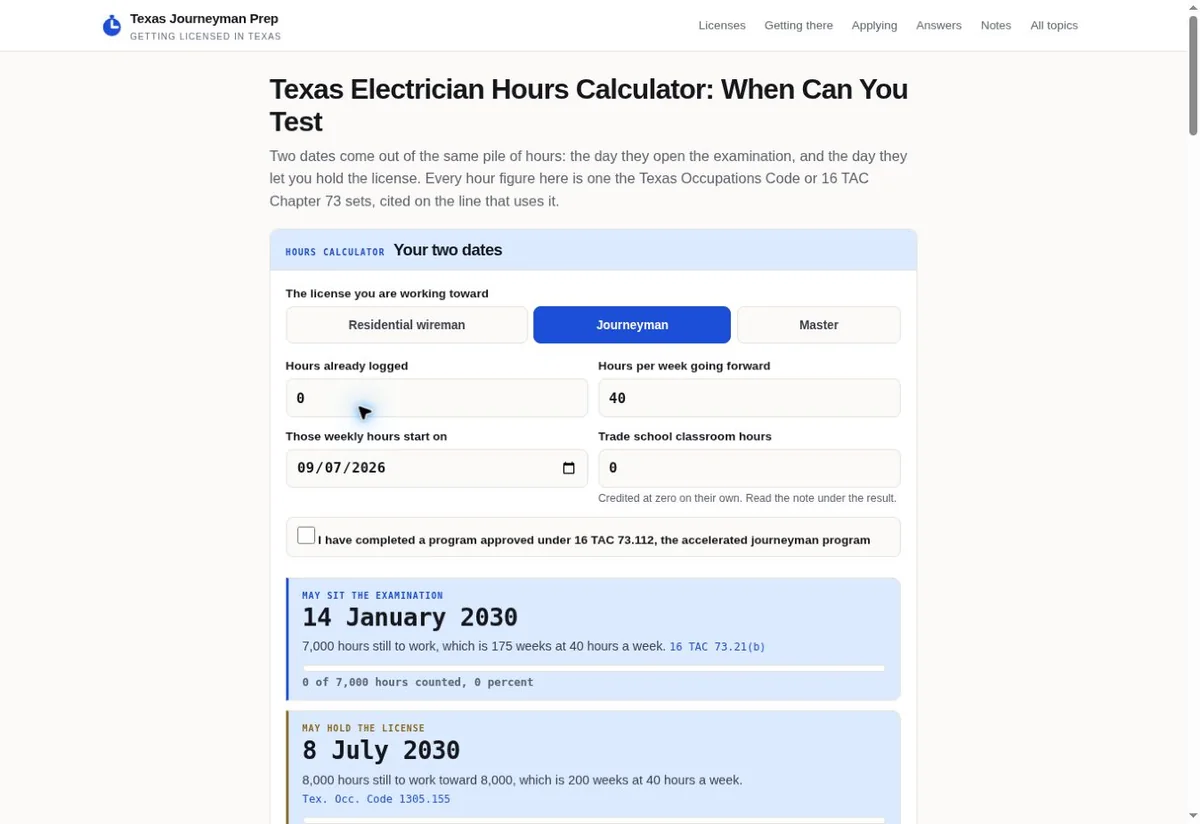
Texas Journeyman Prep calculator with labeled fields
Program prerequisite answer checks: Texas planning inputs with labels. View the project
Questions before a program match
Learner detailProvider clarificationPublic wording to prepare
An older course nameWhat would staff need to understand that course?A course description request with room for an unknown level.
Experience through workCan the operator discuss this route, and who answers?A background question that carries no automatic equivalence.
A missing recordHow can someone begin the conversation without it?A route to ask about the gap before sending further material.
A program choiceWhich current offer does the person mean?The operator's exact program title beside the inquiry action.

The Texas Journeyman Prep calculator labels one field Hours already logged. Its Hours per week going forward field asks about a different part of the plan. We use that distinction to separate known background from a question the learner still needs to discuss. Our proposed labels would name each subject and explain which details can remain open. The provider assesses the learner's own situation. We write the route for that conversation alongside the fields your operator has approved.

W3C recommends a label that tells the reader what a form control does. Our background questions each receive a clear name, with help placed alongside unfamiliar terms. A question such as 'Course title, if known' tells the reader more than 'Previous details.' Your operator still decides whether that is the right detail to request.

Would you build a prerequisite calculator?
Only after a separate discussion of the actual rules and whether calculation fits them. This writing brief does not assume a fixed formula. A learner's background may need an individual conversation. We would start by making that route clear. If the provider later commissions a tool, its requirements and checks would need their own plan. The pictured calculator is a layout reference for this page, not a promise that your assessment will be automated.
What should an error message explain?
We plan the missing detail the learner can actually correct. If a program title was required, the message can name that field and ask the person to choose the offer. It should not say their background failed an assessment when the problem is an empty field. We include proposed feedback wording in the handoff. Any claim that the form works for different users needs actual checks of the implemented page.
Could a person ask about more than one program?
We can plan a route for that question if the provider handles it. The form might let someone name the offers they want to compare and leave the starting point undecided. We would avoid making the person select a preferred course just to send the question. Your operator can tell us what response is appropriate and whether the inquiry goes to one staff member. Our page brief would also explain where the reader can compare the approved program descriptions. Each description needs its own requirement where the rules differ. A shared contact route can serve those questions without implying that all the programs have identical entry conditions.
What if the learner asks about a family member's background?
We ask the provider how it wants that initial question phrased. A person may be gathering general information before the prospective learner joins the conversation. Our proposed message can describe that role without collecting a full personal record. We also make clear which next step the sender is taking: asking for information or beginning an individual assessment. The provider sets who can participate in that later exchange. We don't infer consent or authority from a family relationship. The writing can still be welcoming by explaining the general route and letting the sender leave a question they are comfortable sharing.
Can one question page support several ways of learning?
It can explain a shared background question if the operator confirms that the answer applies across those offers. We would ask how the requirement differs for each way of learning before combining the explanation. The public page may need a short choice that points to a separate answer. We write that choice around the offer's actual title and format, then carry the selected subject into the proposed inquiry. That keeps a person from receiving an answer meant for a different course. We would also mark any incomplete format detail in the draft so the provider can settle it before the page is approved.

Approve the explanation at the point it could imply a place

Your operator should check the program rule and the meaning of the next step. We prepare both together so a question remains clearly distinct from a confirmed place.

Which parts of the copy need the program operator's approval?
The operator should check every prerequisite statement and any description of how staff assess a background question. We also ask them to read the button and receipt. Those short messages can imply a program match even when the longer paragraph stays careful. Our handoff names the unresolved points so approval doesn't rely on a reader overlooking them. We can revise the language after your team settles the actual rule.
What if the provider changes the requirement?
We would identify the public answers that depend on it and prepare updates if you commission them. The change may affect a course page and the initial background question. It may also affect a response sent after an inquiry. We ask the operator how earlier requests should be handled before writing that explanation. A new rule does not tell us what happened to an individual already in contact with the provider.
How can you assess the page after it goes live?
We can examine the actual background questions the provider chooses to share, with private details removed. We look for a point the explanation left unclear, such as which course title the learner should use. That can inform another writing task. A contact count alone does not show that the page explained a prerequisite well. We don't claim admissions, learning progress or other outcomes from a website interaction.
Which prerequisite question should our initial call address?
Bring one current program description and an unanswered prerequisite question your staff can discuss. If the program has several entry routes, indicate which one you want explained first. We can propose a limited set of page and message drafts around that route. Our quote follows the writing needed and the approvals it depends on. You keep responsibility for the program rule; we make the approved explanation easier for a prospective learner to follow.
  • We can deliver a program answer with the approved condition beside the claim it limits.
  • Our proposed inquiry labels let a person describe an uncertain background without choosing a qualification by guesswork.
  • The handoff includes the receipt wording and any unanswered prerequisite point requiring the provider's response.

Sources

From the businesses we've worked with

“They are amazing. Working with them makes life so easy when it comes to SEO and web design”
George B.Google review

Marketing help for Fishers businesses

Based in Indianapolis, we serve central Indiana and clients across the United States.

Request a free strategy call

Fishers, Indiana

Service area map

Explore Fishers on OpenStreetMapArea reference; this is not an office pin. Map © OpenStreetMap contributors.