
Need help?Jamie

Market service plans

Franklin SEO Strategy for Makers and Local Services

You make or fix things in Franklin, and your website either buries the work you want most or pulls in requests you'd never take on.

Trojan Digital Marketing plans SEO for Franklin, Indiana makers and local service businesses. We start from the jobs you want more of and give each kind of buyer its own page. Maybe your custom work page keeps pulling in repair requests you don't take. Franklin is growing, too, with Census estimates putting it at 26,743 residents in 2025, up 514 from 2024.

Jot down the two kinds of jobs you'd like more of and bring them to the call. The first strategy call is free, and during business hours we aim to reply within five minutes.

  • A page for each kind of buyer you want
  • Capability pages for buyers near I-65 Exit 90
  • Old URLs kept wherever they still earn visits

Jeff Clerisier founded the company in March 2018 and still runs it, so the scope gets set with the owner. A Franklin SEO plan can stay as small as your inquiries justify, even two or three well-built pages for the work you want most.

Illustrative business scene: craftsperson fitting oak planks into a new wood floor
IllustrationSearch snippet preview for “seo franklin”A preview built from this page’s title tag and meta description for that search. It isn’t a live search result and shows no ranking.SNIPPET PREVIEWseo franklin|Trojan Digital Marketingtrojandigitalmarketing.com › franklin-seo-s…Franklin SEO Strategy for Makers andLocal ServicesSEO strategy for Franklin, Indiana makers andservice businesses from an owner-run agencyfounded in 2018: one page per kind of buyer…

YOUR WORKING BRIEF

Choose where to start

Select the parts you want to discuss. Your choices carry into the inquiry form.

Discuss this service0 priorities selected

See how I'd approach this

Choose a question
to look at with me.

From a useful page to a relevant searchUseful websiteRelevant discoveryCRAWL · UNDERSTAND · CONNECT
  1. Useful website
  2. Crawl and understand the page
  3. Connect it to a relevant search
From a useful page to a relevant search

Questions about local SEO in Franklin, Indiana

  • Franklin Chamber describes a business mix that includes manufacturing and downtown shops. Service plans distinguish technical buying from visits and appointments. Franklin Chamber business community

What will an SEO strategy cost a Franklin maker or service business?

Strategy work by itself gets priced after the free strategy call, since forty product pages take more planning than six. When the whole site needs rebuilding as well, look at the Marketing Startup Kit: $7,997, or three monthly payments of $2,799, with twenty SEO blog posts of 1,200 to 1,800 words each. Anyone wanting every page read before deciding can order the $99 Jev audit, which handles sites up to 3,000 pages.

Do suppliers near I-65 Exit 90 need different pages from businesses serving Franklin households?

Yes, because they're answering different questions. A buyer at a plant in Franklin Tech Park, the 345-acre park southeast of I-65 and State Road 44, wants to know your capabilities and lead times. A homeowner wants to know whether you'll come out and roughly what it costs. One page trying to serve both usually leaves each reader hunting, so they get separate pages that link to each other.

Should our Franklin site also go after Greenwood and Bargersville searches?

Only where you really take work, and only with something true to say about each town. Census estimates show Greenwood and Bargersville both added more residents than Franklin between 2024 and 2025, so the pull is understandable. A town page that swaps in a name and nothing else rarely helps anyone, and Google's spam policies specifically warn against doorway pages built that way.

I run a small workshop out of my Franklin home. Should the street address go on my website?

Not until you've checked Franklin's Home Occupation Standards in Section 7.7 of the city's Zoning Ordinance, because a street address on your site invites people to drive over. The Department of Planning and Engineering handles zoning, so ask it what the section allows at your address. Meanwhile SEO for a home workshop can lean on the work you make and the towns you serve.

How long before an SEO strategy shows results in Franklin?

Several months is realistic, since Google recrawls every changed page on its own schedule. The early weeks go to deciding which pages stay and which get written, and to fixing the ones already bringing inquiries. Franklin's calendar matters as well: a July with the Johnson County Fair in town doesn't compare fairly with a quiet February, so every month is measured against that same month a year earlier.

What if the rewritten pages attract jobs we don't want?

Then that page gets another rewrite until it screens better. Your team tags each inquiry as a job you'd take or one you'd turn down, and the misses get traced back to the page they came from. A custom work page that keeps drawing repair calls usually needs one plain line saying what you don't do, plus a referral if you're happy to give one.

Can we read what Trojan Digital Marketing's clients say before booking a call?

Yes, our Google reviews are public, though none come from Franklin. One reviewer, Mike Bamosi, says the work 'drove a noticeable uptick in leads within just a few weeks.' Since there's no Franklin client to point to, the fair test is the free scan of your own site, powered by Jev, which shows what we'd find on your pages before you commit to anything.

“…drove a noticeable uptick in leads within just a few weeks…”
Mike BamosiGoogle review
“I had a great experience working with Jeff…”
Heather DoanGoogle review

We have more than 1,400 live websites.

We work from Indianapolis and serve Franklin, in Johnson County, as part of central Indiana.

We also work with clients across the United States.

In Franklin, a new or moved sign needs a city sign permit first. Source, checked September 25, 2026.

Read our Google reviews

Which Franklin facts shape an SEO plan for makers and service businesses?

SEO strategy in Franklin, Indiana has to account for two groups of searchers: households in a growing city and commercial buyers around the I-65 interchange.

  • Census estimates put Franklin at 26,743 residents in 2025, about 514 more people than in 2024, a gain of roughly 2%.

    Newcomers search for local services without knowing any names yet, so service pages should answer a first-time customer's questions.

    Daily Journal, 'Census: Greenwood ranks 8th for population growth'Checked September 25, 2026
  • Ranked by residents added from 2024 to 2025, Greenwood led Johnson County communities, Bargersville came second and Franklin third.

    A page for a neighboring town earns its place only when you really take jobs there and can describe local work.

    Daily Journal, 'Census: Greenwood ranks 8th for population growth'Checked September 25, 2026
  • Franklin Tech Park covers 345 acres on the southeast side of the I-65 and State Road 44 interchange; Denison Properties broke ground in 2001, which is when industrial building at the interchange largely got going.

    A supplier serving the park can name it on capability pages when describing where it delivers or has worked.

    Indianapolis Business Journal, 'Warehouse growth heads south to Franklin'Checked September 25, 2026
  • KYB Americas, which makes shocks and struts for automakers and the aftermarket, is headquartered in Franklin, and the company puts its Franklin plant workforce at more than 700.

    Some Franklin buyers search like purchasing staff, checking capabilities and lead times before they ever ask about price.

    KYB Americas LLC, 'KYB Americas' and Careers pagesChecked September 25, 2026

Population figures are Census estimates and weren't re-read on the source page. We have no Franklin client, so none is shown.

Which page should each Franklin buyer land on?

An SEO strategy for a Franklin, Indiana maker or service business gives each type of search its own page, and every page says what it covers and what it doesn't.

What the buyer is afterPage that should answerWhat you supply
A one-off custom piece
A custom work page with your process and usual lead time
Photos of finished pieces you're allowed to show
A repair or alteration
A repair page stating what you accept and what you refer out
The repairs you'll take and the ones you won't
Repeat parts or a supply contract
A capability page written for purchasing staff
Materials and the details you need before quoting
A household service visit
A service page naming the towns you actually cover
Where you travel and how you book visits

What happens first in a Franklin SEO strategy?

A Franklin, Indiana SEO strategy starts from what your site already has, and nothing gets rewritten until the work you want more of is written down.

  1. Free scan of your current siteJev reads as many as 100 of your pages for free and emails a report link, all before any planning starts.Our team
  2. Your work inventoryYou list the jobs you want more of and the ones you always turn away, in your own words.Your team
  3. A decision for every URLEach existing page gets a keep-or-change decision, with the reason noted beside it.Our team
  4. Page briefsEach new or rewritten page gets a short brief naming its buyer and the question it has to answer.Together
  5. Inquiry taggingYour team marks each inquiry as work you'd take or pass on, and pages drawing the wrong requests get another pass.Together

Explain the kind of work a buyer can request

Start with the decisionYour serviceFitTrustNext stepScopeEvidenceContact
Fit
Explain the service scope.
Trust
Show supporting evidence.
Next step
Give a clear contact route.
Start with the decisionOne service can lead to different questions about fit, evidence and the next step.

A business that makes or adapts something for a customer needs to explain more than the finished product. The buyer may need to understand materials, design inputs, review stages and the difference between a standard item and a custom project. Trojan Digital Marketing's Franklin SEO strategy gives those decisions a clear place in the website so a prospective customer can assess the offer before contacting the team.

The Franklin Chamber's business profile describes manufacturing alongside downtown shops. That mix supports considering both commercial and consumer buying journeys. It does not establish demand for a particular custom service. We select content priorities using the business's actual capabilities, customer questions and available search evidence.

Inventory the work before choosing keywords

We ask which projects the business wants to discuss, which it can handle only under certain conditions and which it does not offer. The content inventory then connects those distinctions to existing pages. A gallery may show excellent work while leaving its scope unexplained. A product category may attract visitors whose needs actually belong with a custom service inquiry.

Read more

We review the purpose of each page and whether its search language matches that purpose. Terms such as custom, repair, restoration and reproduction can describe different work. They should not be mixed simply because they appear related in a keyword list. The first deliverable is a set of page decisions with reasons, not a promise to publish as many variations as possible.

An illustrative custom cabinetry search journey

Consider a Franklin woodworking business offering custom cabinetry and selected modifications. This is an example of a proposed SEO brief. A homeowner comparing materials needs different information from a commercial buyer requesting a repeatable specification. Someone asking about a damaged cabinet may need to know whether repair work is accepted at all.

Project decisionUseful page contentInformation for the next conversation
Plan a custom installation
Design inputs, material options and scope
Room use, dimensions and project goals
Discuss commercial fabrication
Capabilities and approved specification process
Drawings, quantities and requirements for review
Ask about an alteration
What modifications the business considers
Photographs and a description of the current item

We would ask the owner to verify those services. The example should not become a claim about structural work, product certification or delivery timing unless the business has approved evidence for that statement.

Turn a portfolio into useful explanations

Connect an observation to a decisionEventRecordMeaningDecisionCheck definitions at every step
Event → record
Define the event and check the record.
Meaning → decision
Review the business meaning before acting.
Connect an observation to a decisionDefine the event, check the record, review its business meaning and choose the next action.

A photograph can show workmanship, but a buyer also needs to understand the decision behind it. We can help write approved project descriptions that explain the scope, the client's stated problem and the work performed. We do not add revenue figures or customer results that were never measured. Where a project cannot be identified publicly, the owner can provide a process explanation instead.

Read more

For custom work, an annotated detail can show why a material or configuration was selected. A preparation guide can explain the information required for a design discussion. Those assets create a reason to read the page beyond the city name. We request image rights and factual approval before using customer work in public content.

Connect educational pages with commercial pages

A materials guide should help a reader understand options, while the service page should explain how to engage the business. We review the links between those roles and the route to a useful inquiry. Google's SEO guidance covers how content is discovered. We apply that foundation through a practical review of navigation, contextual links, titles and indexing choices.

Read more

Existing URLs deserve deliberate treatment. An older article may retain useful links or search history even if the examples need updating. A gallery page may need explanatory text rather than a new address. We document proposed revisions and consolidations so the owner can understand what changes and why, without casually discarding content that still serves a customer decision.

Measure whether the website attracts suitable work

The reporting plan should distinguish interest in a craft from interest in commissioning a project. Search queries and page visits describe discovery. A form submission shows a request. Staff review shows whether the project fits the business and whether the customer supplied enough information to begin a conversation.

Read more

We can propose simple inquiry categories such as custom work, modification, repair request and unrelated product interest. If a guide attracts requests for work the business does not perform, its wording may need clearer boundaries. If qualified visitors cannot find the project request route, navigation may be the issue. Changes in capacity, product range and promotional activity belong in the interpretation rather than being ignored when attributing results.

Start with a project type and a content decision

Map questions to the right pageQuestionFitProofNextService AService BService C
Service A
Planned coverage: fit and next step.
Service B
Planned coverage: proof and next step.
Service C
Planned coverage: fit and proof.
Map questions to the right pageFilled cells show which buyer questions each service page would cover. Performance needs separate measurement.

A Franklin SEO engagement can begin with a priority project type, a review of its existing pages and a set of evidence based content briefs. We identify the staff member who can approve technical explanations and the materials required before drafting. The scope should make it clear what will be reviewed and implemented, while leaving search outcomes to observation.

Our SEO service covers the broader work. The Franklin website design plan addresses how visitors request an appointment or project discussion. Bring an example of work you want the website to explain better. It is a practical starting point for selecting topics that connect discovery with a relevant commercial conversation.

Sources & further reading

Talk with Trojan Digital Marketing

Add a branded lead source to your search plan.

For contractor growth beyond Indiana, we can scope an exclusive Garrison network alongside your existing search work.

Roofing and water restoration offers serve eligible markets outside Indiana. We confirm territory and routing before you commit.

Explore branded exclusive roofing leads or branded exclusive water restoration leads for your service area.

Ask about window replacement lead options when that’s the trade your team serves.

Discuss your trade and service area.

Start with the repair question staff are allowed to answer publicly

A repair page should explain the questions the shop can discuss before seeing the item. We ask staff which parts of the answer need inspection and make those limits clear from the opening.

Which customer question should we work on first?
Choose one that staff repeatedly explain after someone reads the current page. The question may concern which repair options can be discussed from a description and which require the item itself. We can write around that distinction once the shop names its actual process. The public answer should give the visitor a useful next question without assuming a technical finding.
What should staff supply before we write?
Bring the approved service description and explain the point at which staff need to inspect an item. We ask which words customers use for the concern and what those words leave unclear. A fictional description can help us discuss the answer safely. The person responsible for the repair work supplies the facts and approves its public meaning.
Should the page list every possible repair?
List only the work the shop can support and describe accurately. We can ask which option deserves a fuller answer and which should remain a question for staff. A broad list can imply that the business accepts work it has never assessed. The shop needs to approve the terms used for each offered task and any relevant limit.

For a Franklin, Indiana business, a repair-content discussion can stay focused on the item question a reader needs answered before contacting staff. We can compare the existing public wording with the shop's approved explanation. The goal is a page that makes the inspection-dependent part understandable. A customer's private repair history is unnecessary for that first conversation.

Put the inspection limit beside the option it qualifies

A public repair explanation needs its conditions near the relevant option. We organize those words so a reader can understand what the shop may discuss before an individual item is checked.

Georgetown Market bilingual functional beverages department sign
Paired category wording offers a label reference from Jeff's Georgetown Market employment work. View the project
Inspection-dependent repair explanations
Repair option wordingShop-approved informationLimit before inspection
Described concernStaff explain which broad customer description helps them identify the repair question. We ask what remains unknown from those words alone.The opening answer should preserve that uncertainty. A reader can find the next staff question without treating their own description as a diagnosis.
Offered optionThe repair lead supplies the public meaning of an option and the work the shop is prepared to consider under that label.Read the option title apart from its paragraph. We should avoid a heading that promises a result beyond the approved service.
Inspection stepThe business states when it needs to see the item and what the customer may ask beforehand. Any visit instruction needs its own operator approval.The condition stays beside the answer it affects. Our page should explain the next enquiry stage without announcing that an item has been accepted.
Public sampleThe shop approves the purpose and wording of any fictional example used to clarify the question.The teaching label remains visible. We check that the example supplies no real repair finding or promised outcome for the reader's item.

The Georgetown Market functional-beverages sign presents category wording in English and Spanish. We can examine the paired wording when discussing how a repair label introduces its subject to the reader. Jeff's Georgetown Market work was part of his employment there. We can apply the label question to your repair page by asking what each option actually covers and which part still depends on inspection.

A repair option needs words the customer can use while staff retain their own technical meaning. We can ask the repair lead to read the title and explain what it would invite someone to request. If the label covers several different tasks, add the approved distinction near it. The public explanation should leave each inspection-dependent issue attached to the option that needs it.

Explain why staff need the item without making the customer diagnose it

An inspection requirement should describe a useful next step in the shop's process. We can explain what staff still need to learn while keeping technical judgment with the person who performs that check.

  1. Name the unresolved fact Ask staff which fact cannot be established from the customer's short description. We can put that dependency in plain words. Avoid a long technical list that the visitor must solve before reaching the shop. The first answer should explain why another step is needed and how to ask about it.
  2. Choose the approved first question The receiver states which detail helps staff begin. It may concern the item and the broad change the customer wants to discuss. We can explain where to supply that context. The shop approves any further request for photos or a visit rather than having the page assume those actions are always appropriate.
  3. Describe the point reached by enquiry Ask what happens after the first message arrives. We should name that stage in the public answer and the receipt. A request for an inspection discussion does not establish that the shop has accepted a repair. Its later service commitments follow the business's own process.
  4. Check the exception with staff Use a fictional description that lacks the detail staff need. We can ask the receiver what question they would ask next. Compare that reply with the page wording. The exercise can reveal an explanation gap without using a real item or claiming the shop found a fault.
Can a photograph replace inspection?
The shop decides what its staff can establish from the supplied image. We can describe that approved role without treating every picture as enough to answer a repair question. The page may need to explain which issue remains unresolved and how to ask about seeing the item. Staff approve the next step and any visit arrangements.
Should we mention an inspection charge?
Use only terms the business has approved for the service being described. We can ask where the customer learns which charge applies and what still requires discussion. Avoid borrowing a figure from another repair business. The public answer needs to preserve the shop's own terms and the stage at which they are agreed.

Make a teaching example show the pending repair question

A fictional repair description can clarify why a public answer has limits. We label that purpose and keep the example's proposed next step distinct from any work the shop has actually accepted.

Hypothetical example An unnamed Franklin shop considers a repair question that cannot be settled from a brief description

Before

  • In this invented example, a customer names a broad problem with an item and asks which repair option applies. The public page describes a possible service but leaves out the point where staff need to see the item. The visitor could read the option as an answer for their own situation. No real item, defect or repair outcome appears in this exercise.

After

  • The proposed explanation describes the question the option addresses and the inspection condition approved by the fictional shop. A reader can ask staff about the item through the stated enquiry route. We would test whether a marked sample retains the unresolved concern. Staff still decide which service, if any, is appropriate after their own check. The example supplies no technical recommendation or accepted repair.

Choose sample wording that exposes the content question without pretending to inspect an item. We can describe what the invented customer knows and what they want to ask. The business approves the meaning of the response and the stage it represents. The example becomes useful when a reader can identify the next question from it.

A sample saved outside its original page should retain its teaching purpose. We can ask whether the label remains visible if the shop uses the text in a preparation handout. A fictional repair description should not gain the appearance of completed work because its introduction was left behind. The business supplies any actual project evidence it later chooses to publish.

Use exact control labels to discuss the meaning of a repair option

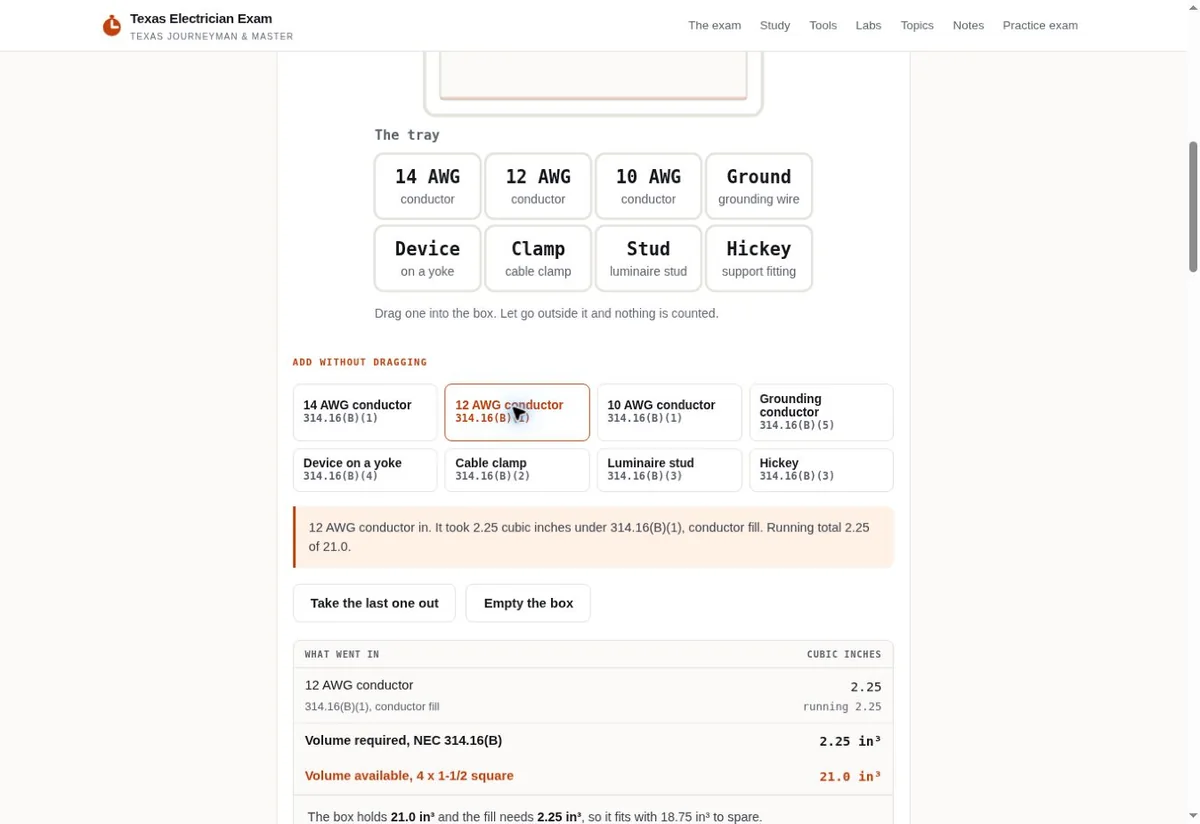
A technical interface can show how named choices sit beside their result area. We use the exam-tool image for label discussion while your shop approves every substantive repair statement.

Texas Electrician Exam box fill calculator controls
Named exam controls help us discuss how a repair option introduces its subject. View the project

Named controls and calculation information appear on the Texas Electrician Exam box-fill screen. We can examine the way those visible labels introduce a task before discussing your repair enquiry. A proposed repair option needs the shop's own description of what can be assessed. We can help place that description near the customer's choice while preserving any condition the inspection has yet to settle.

A public option label should agree with the words used in its answer. We can ask a reader to state what they expect the option to do, then compare that expectation with the shop's approved meaning. A broader interpretation may call for a clearer title. The answer should retain the inspection requirement without relying on the visitor to recognize a technical distinction.

  • Write the option's purpose in plain words before choosing its visual treatment. We need the repair lead to approve that meaning. A short label should help the customer find the relevant question rather than imply a finding about their item.
  • Keep the unresolved condition visible beside the option. Our proposed layout can give the qualification enough room on a small screen. A strong heading followed by a distant note may leave the reader with a different expectation.
  • Test an unfamiliar description against the page labels. We can use invented wording and ask where a person would go next. Staff should confirm that the selected route is prepared to receive that question.
  • Inspect the enquiry receipt if the option leads to a form. We should describe the action it completed accurately. The customer still needs the shop's later answer when an inspection or another staff step is pending.

Approve the repair explanation before studying its search activity

The repair lead should confirm what the public answer promises and what remains open. We can then assess available enquiries against that meaning without inventing technical results or a search position.

Which local identity can the page state?
The Census place records use Franklin city for the Johnson County community in Indiana. We can use that identity where it clarifies the business context. The records describe the place, while the shop supplies its repair services. No population figure tells us which repair questions people ask or which option their item needs.
Can a search phrase justify adding a repair option?
The option must follow the shop's actual work. We can consider a customer's phrase when naming a supported question, but staff approve its meaning. A related query may concern work the business does not offer. The content should make that distinction clear rather than broadening the service to include an unsupported task.
What should we compare with later enquiry records?
Ask the receiver which public option the customer mentioned and what they wanted to know. We can inspect the named statement with the repair lead. A question outside the offer may expose unclear wording or an older reference still being used. Keep the conclusion tied to what staff can substantiate about that enquiry.
Does Google's guidance guarantee the revised answer will appear?
Google's Search Starter Guide explains practices for understandable content and links. It gives no guarantee that a particular site enters its index. We can directly check the approved answer and the path to its next question. Search discovery requires its own later observations once the content is available.

A short content change can be accepted before a real repair follows it. Have the lead read the public answer and its fictional exception. We can ask what the page permits the customer to conclude. The shop should find its own approved inspection boundary, with the proposed question route still clear for someone whose item needs more attention.

Keep an older option answer from outliving the service it describes

Repair descriptions can persist in linked preparation pages after an offer changes. We ask the shop which statements depend on the revised option and inspect those named references within the agreed work.

  1. Start from the repair lead's change The lead supplies the altered option and explains which public sentence needs correction. We can use that instruction to inspect the relevant answer. A new date is helpful only when it accompanies a substantive check of the service meaning.
  2. Follow the supporting explanation Open the preparation page or public file linked from the repair option. We should find the same inspection condition where it affects the answer. Ask the owner whether an earlier sample remains useful and what label it needs if kept.
  3. Read the enquiry prompt The option may send a visitor to a question field with old service wording. We can check that field's purpose and the receipt when the route belongs in the job. Staff approve any changed input needed at the first stage.
  4. Give later changes an approver The shop names the person who may approve a new repair statement and the editor who publishes it. We can discuss how those roles communicate the change. The next content update should preserve the connection between the public words and the actual service.

A forwarded page excerpt can be read without its original context. We should examine the short answer a customer is likely to receive from the business. Keep the relevant condition attached when that answer is approved for reuse. The shop decides how to respond to someone who brings an older description, and our public explanation can point to the current question route.

Bring the question that inspection has yet to settle

The first writing discussion needs the public repair answer and its missing condition. We can define a content task around the shop's approved explanation and the staff route behind it.

What material helps us start?
Bring the current repair page and a broad question that staff find it fails to answer accurately. Name the repair lead who can approve the wording. We can use a fictional item description to discuss the gap. A real customer's record or an unverified technical finding is unnecessary for that first public-content conversation.
What determines the project scope?
We need to see the option answer and the supporting pages that depend on it. A paragraph correction differs from writing a longer guide or changing a connected enquiry field. Our discussion can identify those requirements and their owners. Project cost and timing follow the actual content and implementation once agreed.
What should the first acceptance check show?
A reader should understand which question the option answers and when staff need to see the item. We can test that meaning with approved fictional details. If the enquiry route is included, ask its receiver to locate the marked question. The check concerns the agreed page task and leaves actual repair decisions with the shop.

Our first strategy discussion is free. Tell us which public repair sentence gives customers more certainty than the shop can support before inspection. We can identify the condition that belongs beside it and the person who can approve that answer. That gives the Franklin SEO work a specific starting point for a useful, accurate explanation.

Sources

From the businesses we've worked with

“Getting help with search visibility made sense for my business. I'm glad I decided to work on it”

Marketing help for Franklin businesses

Based in Indianapolis, we serve central Indiana and clients across the United States.

Request a free strategy call

Franklin, Indiana

Service area map

Explore Franklin on OpenStreetMapArea reference; this is not an office pin. Map © OpenStreetMap contributors.