Need help?Jamie

National Home Services Marketing Agency

Home Services Marketing Agency for Calls Your Crews Can Take

If the phone rings for jobs you don't do, or from towns past your last route, your marketing is aimed at the wrong work. Trojan Digital Marketing is based in Indianapolis and offers SEO, Google Ads and websites to plumbing, pest control, landscaping and other home service companies in any U.S. state. We plan around the jobs you want and the towns you cover. Jeff Clerisier, our founder, sets the scope with you. The first strategy call is free. During business hours, we aim to reply within five minutes.

Trade specific SEO and paid strategy instead of one template execution
CSR booking rate optimization and speed to lead process design
Multi location rollout architecture for brands and franchises
Results judged by your own call and job records
Operator TruthWe look at your website, the calls it brings and how your office answers them, then fix the weakest step first.
Core FrameworkSeparate emergency, planned project, and recurring contract demand into distinct channels and KPIs
Scale ConstraintWhen your crews are booked solid, ad spend should drop, whatever the monthly budget says
Growth GoalWe compare what shared lead services cost you with what your own website brings in, using your job records.
“…drove a noticeable uptick in leads within just a few weeks…”
Mike BamosiGoogle review
“I had a great experience working with Jeff…”
Heather DoanGoogle review

Jeff Clerisier founded Trojan Digital Marketing in March 2018.

Based in Indianapolis, we serve businesses across central Indiana, including Carmel, Fishers, Zionsville, Westfield, Noblesville, Greenwood, Avon and Plainfield.

We also work with clients across the United States.

Read our Google reviews

What makes home services marketing different from general local marketing?

A lead only pays if someone answers, books the job and sends a crew that finishes it at a profit. Many calls are urgent, so a slow answer loses the job. A burst pipe and a new fence need different ads and pages, so we split campaigns by trade.

  • Build campaign lanes by demand class and service economics
  • Track booking, dispatch, completion, and margin by source
  • Adjust spend by capacity and season instead of habit

Why do so many contractor accounts waste spend even with strong traffic?

Usually the money leaks after the click: ads reach towns you don't serve, pages are vague, forms ask too much or nobody answers. We read your call and form records to find where inquiries drop before touching the budget.

  • Audit call answer rate and booking rate before scaling media
  • Use source level quality scoring in CRM workflows
  • Stop optimizing to raw lead count as a success metric

How should owners think about shared leads versus owned demand?

Judge shared leads and your own website by the same numbers: inquiries that fit, jobs won and cost. We'd keep some lead spend running while your own pages build, then move money as your records show where jobs came from.

  • Keep a bridge budget while owned channels mature
  • Shift allocation using qualified CAC and close outcomes
  • Preserve service capacity during channel migration

Which KPI should a home service business track first?

Start with how many answered calls become booked jobs. If that number is low, more ads only buy more missed bookings. After that, we check whether calls fit your services, how many estimates close and whether crews have room.

  • Score calls for script quality and booking attempts
  • Implement missed call text back and after hours routing
  • Tie CSR performance to booked and completed outcomes

How do multi location home service brands scale without cannibalizing themselves?

Give each location its own service area, page and matching Google Business Profile. Thin city pages that repeat each other end up competing. We run more than 1,400 live websites and add new markets a few at a time so each page gets checked.

  • Launch markets in cohorts with QA gates
  • Manage GBP categories/hours/services with centralized standards
  • Separate brand level authority pages from local conversion pages

Urgency spectrum

Emergency, planned project, and recurring contract demand need different systems.

What to build

  • Emergency lanes: call first, dayparted, dispatch aware, tight radius
  • Planned projects: education rich pages, financing context, estimate nurture
  • Recurring contracts: membership/maintenance lifecycle and retention automation
  • Different scripts and conversion goals by demand class
  • Separate KPI trees so teams stop blending unlike lead types

What breaks margin

  • Running every service in one broad campaign
  • Judging planned project channels by emergency call speed
  • Ignoring repeat revenue economics in recurring trades
  • No after hours process for urgent demand
  • Scaling lead volume without dispatch capacity alignment

Trade mechanics I

Plumbing, electrical, garage doors, and pest control each move differently.

Urgent + planned mix

Plumbing

Emergency no water and burst line calls need immediate call first pathways, while water heater replacement, repipe, sewer line, and hydro jetting require separate educational and financing aware funnels.

Safety + upgrade demand

Electrical

Panel upgrades, EV charger installs, standby generators, and rewires involve permit and trust friction. Content should explain scope variables and safety process, not just “same day electrician.”

Speed sensitive conversion

Garage doors

Make repair and replacement contact options easy to understand. Explain how scheduling is confirmed and avoid implying an appointment is immediate unless operations support it.

Recurring contract economics

Pest control

One time treatments matter, but margin compounds in recurring plans. Marketing should optimize for contract retention and re service quality, not just first appointment volume.

Trade mechanics II

Outdoor and envelope trades rely more on planned project demand quality.

Landscaping and hardscape

Project visuals and scope clarity drive estimate quality. Low friction forms still need budget and timeline qualifiers.

Lawn care

Route density and recurring packages drive profitability. Geo clustering often matters more than top of funnel volume.

Painting

Interior/exterior seasonality and prep expectations should be explained early to reduce estimate fallout.

Windows and doors

Longer decision cycles need financing and energy efficiency content plus strong follow up nurture.

Siding and gutters

Bundled project pathways can increase ticket size when messaging addresses lifecycle and weather protection together.

Fencing and decks

Permit/timeline constraints and material choice explainers improve lead qualification and close consistency.

Trade mechanics III

Heavy trades and specialty services require stricter qualification logic.

Concrete and asphalt

Season windows and crew scheduling pressure mean budget pacing should mirror production calendars.

Tree service

Safety urgency can spike after storms; certification/safety process content improves trust and close quality.

Junk removal

Fast conversion category with strong map pack dependence and high value in route optimized dispatch.

Cleaning services

Recurring contract and retention systems matter more than one off deep clean lead spikes.

Water/fire/mold restoration

24/7 response and insurance adjacent process clarity are central. IICRC standards context can support trust when presented accurately.

Foundation/waterproofing/chimney/septic/pools/solar

Higher consideration projects need diagnostic education, scope qualifiers, and financing context to avoid low fit appointments.

Google ecosystem

Platform controls that materially affect home service conversion efficiency.

AreaWhat to ConfigureRiskOperator Standard
GBP categories
Primary/secondary categories aligned to real service mix
Category stuffing can dilute relevance
Quarterly category review with service line reality checks
LSA / Google Guaranteed
Verify eligibility by trade and region before planning volume
Assuming eligibility creates forecast errors
Treat LSA as channel lane with separate quality KPIs
Service area setup
Define practical coverage by dispatch economics
Overbroad areas attract low margin jobs
Route time informed area constraints and exclusions
Review operations
Post job request cadence and response governance
Inconsistent reviews weaken trust compounding
Per tech or per crew review workflows with QA

Review gating, incentivized reviews, and fake reviews violate platform policy and can create legal exposure under the FTC’s 2024 consumer review rule.

Phone process reality

Most home service companies have a phone problem before a lead problem.

In many accounts, acquisition channels are blamed for poor revenue while inbound call handling is the actual leak. If your team answers slowly, doesn’t ask for the appointment, or punts urgent calls to voicemail, channel efficiency collapses regardless of CPC.

Run call recording review with a scoring rubric: greeting clarity, empathy, service qualification, booking ask, and objection handling. Coaching should be weekly during peak seasons, not quarterly.

Missed call text back and after hours answering can recover material demand, especially in plumbing, electrical, restoration, and tree service emergencies.

Tie marketing reports to booking and dispatch outcomes by source. Calls alone are activity. Booked, completed, profitable work is the metric.

Shared leads versus owned demand

How to transition off aggregators without a revenue gap.

StageAggregator RoleOwned Channel FocusDecision Trigger
Stabilize
Use Angi/Thumbtack/Networx/Modernize class sources as controlled bridge
Fix tracking, phone process, and landing page qualification
Move on when booking quality and attribution are reliable
Build
Cap shared lead spend to prevent dependency
Scale SEO + local profile ops + structured paid search lanes
Shift budget as qualified CAC improves in owned channels
Rebalance
Keep tactical aggregator allocation for specific gaps only
Invest in recurring authority content and retention systems
Cut channels that remain low margin after process fixes
Protect
Maintain source diversity for shock resilience
Strengthen brand/direct traffic and referral loops
Use margin and close rate data to govern all channels

Don’t shut off lead marketplaces overnight. Phase them down as owned channels prove replacement capacity.

Demand market types

National home service demand behaves differently by market environment.

Storm belt emergency markets

Restoration, roofing, tree, and electrical outage demand spikes with severe weather and requires dispatch first operations.

Freeze line plumbing/HVAC markets

Burst pipes and no heat urgency produce sharp call surges; after hours response quality drives win rate.

Sunbelt growth sprawl markets

New home and upgrade demand can be high, but ad competition and route sprawl pressure margins.

Dense urban retrofit markets

Permits, access constraints, and multi unit stakeholders lengthen cycle and increase qualification needs.

Rural service radius markets

Drive time economics can make distant jobs unprofitable unless geo controls are strict.

Affluent remodel markets

Higher ticket potential with longer decision cycles; trust content and financing clarity matter more than urgency language.

Contract subscription markets

Recurring pest/lawn/maintenance economics reward retention and operational consistency over one time lead spikes.

High turnover property manager markets

B2B relationship and response SLAs can outweigh map pack visibility for recurring job flow.

Multi location and multi brand scale

Acquisition growth after expansion depends on architecture discipline.

Location page systems

Use market aware templates with unique scope, proof, and service boundaries to avoid thin doorway page footprints.

GBP management at scale

Central standards with local operations input prevent profile drift in categories, hours, and service definitions.

Market cohort rollouts

Launch in waves with QA checkpoints instead of publishing dozens of locations at once.

Post acquisition brand decisions

Choose brand consolidation timelines carefully; abrupt renaming can disrupt local trust and branded demand.

PE consolidation reality

Independents can still win against roll ups, but not by pretending the market is unchanged.

Private equity backed platforms bring larger ad budgets, centralized SEO operations, and aggressive acquisition velocity. Independent operators feel this as CPC inflation and denser map pack competition.

Independents still have advantages: local trust, owner visibility, faster process changes, and specialization in narrow high fit service niches. Those strengths need to be explicit in content and calls.

Compete on response speed, quality of diagnosis, and reputation consistency, not on trying to outspend national consolidators in every keyword lane.

Owned content depth and local proof are the durable moat. Generic pages and borrowed leads are not.

In consolidated markets, speed plus trust plus specificity beats generic spend.

Franchise dynamics

Franchise home service growth requires clear corporate/local role boundaries.

Corporate responsibilities

Brand standards, core site architecture, compliance policy, and shared analytics frameworks.

Franchisee responsibilities

Local execution quality, review generation, phone process, and market specific offer adaptation.

Co op ad funds

Useful when governance is tight; wasteful when reporting and accountability are vague.

Territory conflicts

Overlapping service zones can cannibalize spend unless geo rules and page roles are explicit.

Template constraints

Brand consistency matters, but rigid templates can suppress local relevance and conversion performance.

Review management model

Centralized policy with local execution is usually strongest for trust and compliance.

Financing and ticket strategy

How financing presentation influences close behavior on larger projects.

Project TypeBuyer FrictionMessage FocusMeasurement Lens
Emergency repair
Urgency + trust
Immediate response, transparent process, realistic timeline
Booking and completion speed
Mid ticket replacement
Budget anxiety
Options and monthly payment context in plain language
Estimate to close conversion
High ticket improvements
Decision complexity
Scope clarity, financing path, lifecycle value explanation
Close rate and margin retention
Recurring contracts
Perceived value over time
Preventive value, convenience, and priority service framing
Attach rate and retention

Use your own close rate and gross margin math to decide how aggressive financing promotion should be by trade.

Execution rhythm

Monthly operating loop for multi trade home service marketing.

STEP 01

Segment demand by urgency class and trade

Review emergency/planned/recurring mix and reset campaign priorities by service line.

STEP 02

Audit phone and booking throughput

Score calls, track missed call recovery, and coach CSR scripts where booking leakage appears.

STEP 03

Optimize geo and keyword controls

Tune radius and negatives with dispatch economics and job fit outcomes in view.

STEP 04

Publish trade specific authority content

Ship cost explainers, diagnostics, and scope comparison pages for highest value services.

STEP 05

Sync CRM/job outcomes to channel reporting

Push booked, completed, and ticket data into source level performance analysis.

STEP 06

Reallocate spend by qualified CAC and capacity

Scale lanes that produce profitable throughput and throttle those that overwhelm operations.

KPI stack

Metrics that keep multi trade programs honest.

AR

Answer rate by demand class and time block.

BR

Booking rate by CSR, trade, and source.

QCR

Qualified conversion rate by channel lane.

CAC

Qualified customer acquisition cost, not raw lead CPL.

AT

Average ticket by service line and source mix.

RCR

Recurring contract attach and retention where applicable.

AEO · GEO · AIO

Cost and diagnostic content now influences both clicks and assistant answers.

Homeowners ask assistants cost and troubleshooting questions before they call. If your site does not answer clearly with qualifiers, another contractor’s content gets surfaced.

Build answer blocks around real prompts: ‘How much does a panel upgrade cost?’, ‘Why is my sewer backing up?’, ‘Should I repair or replace my water heater?’ Use variable based explanations instead of fake fixed prices.

Use comparison tables and explicit qualifiers to improve extractability. Keep schema and visible content aligned so machine systems can parse your intent clearly.

This is not about gaming AI. It is about publishing useful, citable, decision ready information.

Recruiting and capacity

Technician headcount is a marketing variable in every growth model.

Capacity aware budget pacing

Do not buy demand you cannot service well. Throttle by crew availability and backlog tolerance.

Careers content as search asset

Role specific hiring pages can reduce recruiting costs and improve candidate fit quality.

Employer trust signals

Training standards, advancement paths, and field support clarity improve retention and recruiting conversion.

Operational integration

Marketing, dispatch, and hiring should share one planning rhythm during growth periods.

Owner checklist

If these are true, your home service marketing can scale with control.

Demand classes are segmented.

Emergency, planned, and recurring lanes have separate campaigns and scripts.

Phone process is measured weekly.

Answer rate, booking rate, and missed call recovery are visible and owned.

Source level profitability is tracked.

You can compare qualified CAC and margin by channel.

Review operations are checked against the relevant platform policies.

No gating, incentives, or fabricated review practices.

Location architecture is non duplicative.

Pages and profiles avoid overlap and doorway behavior.

Capacity and recruiting are in planning.

Budget decisions reflect staffing and service delivery reality.

Method stance

What we promise in home service engagements.

We don’t promise easy leads. We build systems that turn demand into booked, completed, profitable work.
Trojan Digital Marketing operating standard

Related strategy pages

Keep channel decisions connected. Don’t optimize in silos.

FAQ

Questions we hear before kickoff. Direct answers, no guarantees.

What does a home services marketing agency actually do?

It should integrate SEO, paid media, local profile operations, call handling optimization, and source level profitability tracking across trades.

Can one template work for plumbing, electrical, and landscaping?

No. Demand urgency, ticket size, repeat potential, and buyer behavior differ materially by trade.

What’s the first metric we should fix?

Usually booking rate from inbound calls. More leads into weak booking processes increases waste.

How do we handle after hours emergency demand?

Use clear routing, after hours answering, and missed call text back workflows tied to dispatch capacity.

Are lead aggregators always bad?

Evaluate shared leads against your actual service fit, costs and recorded outcomes. Their usefulness depends on the offer and operating model.

How fast should we phase out shared leads?

Gradually, as owned channels prove replacement capacity and qualified CAC stability.

Do Local Services Ads work for every trade?

Eligibility and performance vary by trade and region, so they must be verified and managed as a distinct channel.

How should we think about Google review strategy?

Build consistent post job request workflows and policy safe responses; avoid gating, incentives, or fake reviews.

What is a service area business risk in local SEO?

Overbroad service areas can attract low margin jobs and create poor conversion trust when response times lag.

Can financing presentation affect close rates?

Yes, especially for planned high ticket projects where affordability framing reduces decision friction.

How do independents compete with PE backed roll ups?

By emphasizing local trust, response speed, specialization, and deeper owned content, then measuring rigorously.

What changes for franchise marketing?

Success depends on clear corporate local role boundaries, territory governance, and coordinated review management.

How do we prevent multi location cannibalization?

Use unique page roles, explicit service boundaries, and controlled market cohort rollouts.

What should we publish for AI answer visibility?

Cost variable explainers, diagnostic guides, and repair vs replace comparisons with explicit qualifiers.

How often should we rebalance budgets?

Monthly at minimum, and faster during weather events or capacity shifts.

Is recruiting really part of marketing?

Yes. Technician and crew capacity determines whether demand generation can be fulfilled profitably.

Do you guarantee rankings or lead volume?

No. Guarantees are not credible. We focus on disciplined execution, transparency, and adaptation.

How do we start?

Start with a full funnel audit: channel mix, phone throughput, CRM quality, and source level economics.

What does home services marketing cost?

SEO and ad management are priced after the free strategy call, since a one-truck shop and a multi-location brand need different work. Ad spend is paid separately. A new company can start with the Marketing Startup Kit at $7,997, or three monthly payments of $2,799, which includes a custom 15-page website.

What happens on the free strategy call?

Tell us which jobs you want more of and the towns your trucks will drive to. We'll point to the page, form or campaign we'd change first. The first strategy call is free, and during business hours we aim to reply within five minutes.

Start the conversation

Bring your trade mix, phone metrics, and capacity targets. We’ll map the fastest path to cleaner growth.

If you’re done renting demand and hoping for margin, we should talk. We scope from operations and economics, not vanity dashboards.

  • Trade specific strategy with operator level reporting discipline
  • No fabricated outcomes and no guarantee language
  • Monthly decisions based on qualified CAC and throughput reality

The first strategy call is free, and during business hours we aim to reply within five minutes.

Explore home services campaign plans by market

Local demand shapes the plan. Review the area resources below, then we'll discuss the services and customers your business wants to reach.

Define a useful inquiry separately for each trade

A home services business needs enough information to decide whether it can help and who should respond. A request for a planned landscape project needs a different conversation from a plumbing service call. Write those differences down before using one form, script, or follow up sequence for every service.

Start with the decision your team must make

For each trade, identify the details that establish service fit: the requested work, the property location, the customer’s preferred next step, and any information your team needs to assign the inquiry. Collect details that support that decision while keeping the initial contact manageable.

Use a simple internal set of outcomes:

  • Ready for the next step: the request matches your service and coverage, and a staff member can explain what happens next.
  • Needs clarification: a relevant detail is missing or the scope needs a conversation. Assign someone to ask for it.
  • Outside current scope: the request concerns a service, location, or availability your business cannot presently support. Respond clearly and record the reason.

Keep these outcomes separate from later stages such as an appointment, an estimate, approved work, or a completed job. A submitted form alone does not establish that the request was suitable or that work was booked. The person handling the customer conversation should be able to correct the record as more information becomes available.

Review a small set of anonymized inquiries with the office and delivery teams. Look for recurring misunderstandings about service coverage, preparation, or scheduling. A clearer page or better routing question may be the appropriate next change.

The guide to defining a qualified lead develops this process. Explore the dedicated plumbing and HVAC marketing pages for trade specific planning.

Build an inquiry definition for one trade. Tell us the work you want to accept, the area you cover, and the question your office needs answered before scheduling.

Choose a marketing route that fits the work you accept

A homeowner seeking a repair and a property manager planning a replacement need different information. A useful home services marketing plan begins with the work your team wants and can deliver. It then connects the relevant service page, contact route and office response. This hub helps you choose the specialty that matches that decision.

Find the service discussion that fits your trade
SpecialtyCustomer question to clarifyNext conversation
Plumbing marketing
Is this a repair request or planned installation?
Service type, property location and available response
HVAC marketing
Do I need service, maintenance or replacement information?
Equipment concern and the appropriate assessment
Roofing marketing
Should I ask about inspection, repair or replacement?
Property details and the inspection process
Electrical marketing
Does the business handle this kind of electrical project?
Work scope and the information needed for review
Pest control marketing
Is this an initial assessment or ongoing service request?
Property context and the next appropriate step
Landscaping marketing
Is the need design, installation or recurring care?
Project scope, coverage and planning availability

Connect the page to office capacity

Before changing a campaign, agree which services are available, where crews travel and when someone reviews new requests. A form can acknowledge receipt without promising that a technician is assigned. Any claims about urgent response or around the clock staffing need to match actual operations. The website, advertising and office script should describe the same next step.

For multiple trades, use a short service choice that helps route the inquiry. Avoid requiring a homeowner to diagnose a technical fault merely to make contact. Collect enough information to begin the conversation, then let the responsible team establish suitability, scheduling and any necessary assessment.

Use visible work as evidence of the design

The captured website image in our Westfield Roofer case study shows distinct call and callback controls. That is a concrete design choice: visitors can choose immediate contact or request a return call. The capture does not establish how many people used either route or whether more work was booked.

Review evidence this way when evaluating your own pages. A photograph may show the kind of project discussed. A service explanation may clarify preparation. A form can show which details a customer is asked to provide. Results such as accepted estimates or completed jobs require separate records. The marketing plan should identify what each piece of evidence can actually support.

Keep inquiry stages separate

Record a new inquiry first, then whether it is genuine, whether the service and location fit, and whether a next step is agreed. An appointment, an issued estimate, approved work and a completed job are later stages. A customer who fits your business but cannot be scheduled is a capacity issue worth seeing clearly.

When appropriate tracking exists, connect these stages using a consistent reference and avoid counting a repeated call and form as unrelated opportunities. Google's conversion tracking guidance distinguishes different actions a business can measure. Choosing an event does not make it equivalent to revenue or establish that every resulting job came from advertising.

Bring the trade and the bottleneck

Use our qualified lead guide to agree on the office definition. Then describe the trade, confirmed coverage and step that needs attention. A useful initial scope might address one service page, a confusing inquiry form or the handoff into estimates. The specialty pages provide deeper planning without requiring a separate offer for every city.

From the businesses we've worked with

“Oh my gosh! This is perfect! Thank you! You can always count on Trojan Digital Marketing!”
J. HollandSho.Lux Lifestyle Centre

Based in Indianapolis, we serve businesses across central Indiana, including Carmel, Fishers, Zionsville, Westfield, Noblesville, Greenwood, Avon and Plainfield, and clients across the United States.

Request a free strategy call

The first strategy call is free, and during business hours we aim to reply within five minutes.

Explore practical toolsRead related insights

Let one household message describe each requested task

A household enquiry may contain more than one kind of work. We can write a contact explanation that names each part while your provider decides which tasks it can accept.

Someone may ask about an outdoor task and an indoor repair in the same message. A broad home services page can receive that message without presenting every part as accepted work. We can plan the addition around how your office reads several requested tasks. The first goal is to preserve what the household asked, so staff can answer each part accurately.

  • Ask the visitor to describe each task in ordinary language. We can leave room for an uncertain service name rather than requiring a trade diagnosis.
  • Keep the household's own grouping visible. Our instructions can let staff distinguish work described for one visit from work the customer mentioned as a later possibility.
  • Allow the person to name which question they want answered first. We can help the office identify that preference without promising an urgent response.
  • Avoid treating the broad home services label as approval for every task. We can state the provider's confirmed handling route for work it hasn't yet assessed.
Does each task need its own form?
That depends on how your office handles a combined enquiry. We can begin with one message that keeps the tasks distinct. If different providers need separate contact, the page should explain that arrangement after your business approves it.
How do we avoid making visitors classify technical work?
Use the descriptions your office can understand from a first message. We can let someone say what they want discussed, then have staff clarify the trade or next step. The public enquiry shouldn't make the household decide technical suitability.

State the provider-approved work for each part

A combined enquiry needs an answer for each requested task. We can describe the work your provider confirms and leave other parts open until the responsible team replies.

Texas Journeyman Prep homepage with two choices
Two clearly named tasks on the homepage. View the project
What if one task fits and another is unresolved?
Our draft can explain how staff respond to each requested task. The provider may confirm a discussion for the first task while asking for context on the second. A page receipt should leave those answers open until the business actually gives them.
Can the business refer part of the enquiry elsewhere?
Only describe a referral arrangement the provider has approved. We can explain who makes that contact and whether the customer needs to act. A mention of another trade doesn't establish a partnership or permission to send the household's details.
  1. List the confirmed services Ask your business which work it actually offers. We can use that list when writing a combined-task explanation, while staff still assess the individual request.
  2. Identify a missing answer Show the office a fictional task it hasn't accepted. Our copy can explain how staff ask for more context or give the customer a clear response.
  3. Name the contact for each part The provider should choose who handles each task. We can keep those office responsibilities clear without presenting all recipients as one delivery team.

The Texas page gives its visitor two separately named tasks on one homepage. We can plan similarly clear names for the household questions your office receives. A person asking about several jobs can keep each description intact. Your provider confirms which task it handles and supplies the next contact for any part needing another answer.

Keep unresolved responsibility visible in the household reply

A task may still need a responsible provider, further context or a separate contact. We can keep that unknown visible so the household understands which part awaits an answer.

Multiple household-task boundaries
Household taskRouting detailTask status
Task descriptionThe household names the work it wants to discuss. We can preserve separate descriptions in the same message.The office has received several questions. Each requested task still needs its own answer.
Accepted partStaff confirm which task they can discuss and who handles it. Our explanation can follow that approved answer.Acceptance of one part doesn't settle the remaining household work.
Unassigned partThe business identifies a task it hasn't accepted or assigned. We can state the next contact it approves.The household can see that responsibility remains unresolved for that part.
Combined receiptKeep one reference for the enquiry and identify its distinct tasks. We can propose labels the office can use.Receipt describes the message. It doesn't create several new customers or booked jobs.
Hypothetical example A fictional household sends several tasks to an unnamed home services provider.

Before

  • The message asks about two kinds of work. The provider hasn't confirmed it can handle both.
  • A proposed receipt says the household's work is booked and counts each task as another acquired customer.

After

  • We can preserve both task descriptions under the same enquiry reference. The office can reply to each requested part.
  • The receipt acknowledges the household message. Provider acceptance and any later booking remain separate answers that haven't yet been given.

Describe an internal referral separately from an agreed visit

Passing a task to another person can begin a conversation. We can explain that handoff without suggesting the household already has an appointment or an accepted service arrangement.

  1. Choose the internal recipient Ask which staff member can assess the named task. We can use the provider's accepted office role in the public explanation when that helps the household.
  2. Preserve the other questions Keep the rest of the message beside the task being routed. Our proposed handoff can help staff see which parts still need someone to answer.
  3. Define the customer's next action Confirm whether the household waits for a reply or needs to contact another approved route. We can state that action without adding a response time.
  4. Record later agreement If a visit is eventually agreed, the provider can give it a separate status. We can keep the contact wording accurate before that agreement exists.

For a provider working around Indianapolis, different tasks may involve different service coverage. The household's address alone doesn't establish that every team can help there. We can ask your office which location question it needs for the combined message. Any coverage explanation must match the provider's actual services. There is no reason to create a separate combined-work promise for each town.

What if the household expects one visit for everything?
We can let the person state that preference. The office then needs to confirm whether it is possible. Our explanation should keep the preference distinguishable from an appointment the provider has actually offered.
Should a referral count as accepted work?
Give it the meaning the office has agreed for its own records. We can propose a handoff label that describes the transfer of the question. Accepted work needs the provider's later confirmation for the named task.

Use distinct visitor choices to explain household routing

A combined message can still have clear contact choices. We can write their names around what the household wants to ask and what the provider has approved to receive.

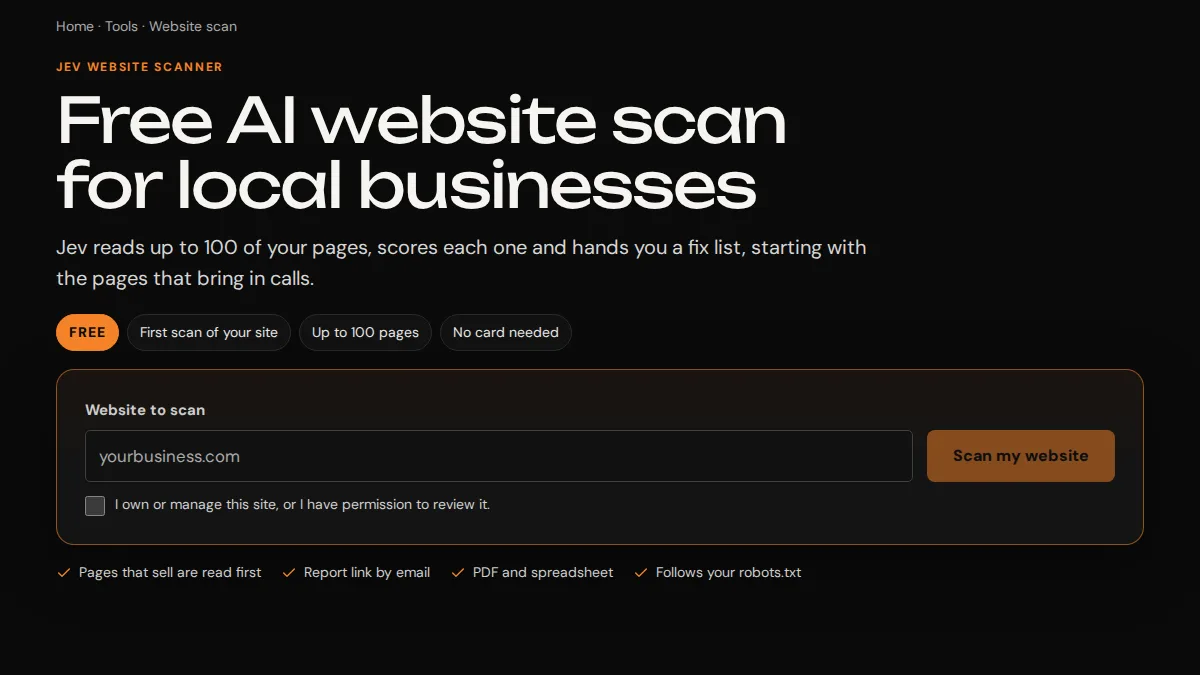
Jev scanner website input and scan action
Website input beside its matching scan action. View the project
  • Make the combined-message choice explicit if the office wants it. We can tell a household where to describe several tasks without guessing which team will accept them.
  • Keep any single-service choice accurately named. Our wording should make clear when that path concerns just one task in the household's broader message.
  • Explain which details staff need for routing. We can use the provider's approved fields and let a visitor state when a detail is unknown.
  • Keep the original task descriptions if staff ask for more information. We can include that requirement in the agreed enquiry checks.

The scanner screen keeps its website field close to the control that starts the named task. We can discuss that placement for a household enquiry, with the requested work described near its sending action. Your office supplies the recipient and the wording used for mixed requests. The visitor can keep the same household context while moving from the explanation to the contact area.

Acknowledge the whole message without multiplying acquired customers

One household message can contain several requested tasks. We can preserve that structure in the receipt while your records track any later provider answer, appointment or accepted work separately.

What should an owner read in the proposed receipt?
Check that it names the combined enquiry and leaves each task awaiting the right office answer. We can include a single message reference if your process supports one. The receipt should match the stage the household has actually reached.
How should repeated contact be handled?
Ask staff how they connect a later call to the household's original message. We can explain the reference the customer should use. A repeat contact about an unresolved part shouldn't automatically become another newly acquired household in your records.
What can we check before publishing the addition?
Use an invented household message with one accepted kind of work and one uncertain task. We can read the form and receipt with your office. Ask who answers each part and revise any wording that implies a shared booking.

Bring us the combination of tasks your office wants the page to receive. We'll ask which parts your business can discuss and where the unresolved parts go. That lets an owner choose a practical addition to the current home services page. Our proposed writing can support a clear household conversation. Actual acceptance and delivery remain with the providers who answer it.

Sources

Read more on this

Industry marketing plans