
Need help?Jamie

GARRISON · MICROSITE SOFTWARE BY TROJAN DIGITAL MARKETING

Garrison HVAC microsites.
Your brand. Your leads.

Your techs stay busy in July and January, but HVAC leads can dry up between peaks, and replacement shoppers may call whoever they find first.

With Garrison, the microsite software from Trojan Digital Marketing, we build HVAC websites for the towns you serve in any US state, each carrying your business name. A no-heat call rings your dispatcher, and a replacement request lands with your estimator. It's for the owner who says, "We lose replacement jobs to whoever ranks above us in July." Under DOE's 2023 standards, a new central AC's federal minimum still depends on its installation region, so each replacement page states the rule for yours.

List the equipment you service and your busiest months. The first strategy call is free, and during business hours we aim to reply within five minutes.

  • Built on request, with scope and timing agreed first
  • Repair calls and replacement requests routed apart
  • Replacement pages match your DOE region's rules

Jeff Clerisier founded Trojan Digital Marketing in March 2018 and still works out each network's scope with the contractor. We run more than 1,400 live websites. On an HVAC build, repair and replacement get separate pages and separate phone and form routes. Before launch we send test calls and form fills down each route, so a no-heat call doesn't sit in an estimator's inbox.

For local businesses, regional teams, and national brands. Scoped around your target markets and the work your team can deliver.

Illustration of heating and cooling equipment representing marketing for HVAC contractorsFocused websites. Direct inquiries. Your brand.
“I had a great experience working with Jeff…”
Heather DoanGoogle review

Jeff Clerisier founded Trojan Digital Marketing in March 2018.

We have more than 1,400 live websites.

Based in Indianapolis, we serve businesses across central Indiana, including Carmel, Fishers, Zionsville, Westfield, Noblesville, Greenwood, Avon and Plainfield.

We also work with clients across the United States.

Read our Google reviews

Want the domains registered to your business?

That’s the owned-network offer, which includes every inquiry the sites produce, with a one time build fee and annual site renewal. Compare owned-network prices, content tiers and ownership terms. Roofing, water restoration and window treatment networks are available in eligible markets outside Indiana.

FROM SEARCH TO YOUR TEAM

A customer has a question.
Your brand has a useful answer.

Repair the system, replace it, or plan ahead? A focused microsite connects that question to evidence, clear service information, and the right next step.

  1. 01

    The search

    Heating repair · AC replacement · maintenance plans

  2. 02

    The useful website

    Give each need its own useful path, with systems serviced, appointment expectations, and maintenance terms.

  3. 03

    The direct inquiry

    Route repair urgency separately from replacement consultations and recurring maintenance inquiries.

OWN YOUR LEAD SOURCE

Paid leads can be a channel.
Your website can be an asset.

Purchased leads depend on a provider’s terms. Paid advertising can send visitors to your own website. Organic microsite lead generation works by making useful pages discoverable for relevant searches. Each approach has costs and a role; an owned microsite can support paid and organic traffic together.

Maintain seasonal resources and system guides that continue helping buyers after a single campaign ends. That is the practical idea behind compounding organic growth: later improvements build on useful work already in place. It requires maintenance and does not guarantee rising lead volume or rankings.

Compare organic leads, paid leads, and ownership

THE HVAC MICROSITE PLAN

We build HVAC microsites for contractors who'd rather own the sites that bring in their calls than keep paying for leads on someone else's terms. Repair questions, replacement research, maintenance plans and commercial requests each get their own page. We're based in Indianapolis and take HVAC work in any state, and this site has its own HVAC pages for Atlanta, Charlotte, Dallas, Houston, Phoenix and Tampa. First we check what you already own, like your domain and tracking numbers.

A homeowner with no cooling, a household comparing replacement options, and a facilities manager seeking a maintenance proposal require different answers. We organize the program around those decisions before deciding how many pages or domains to build. Every page names your company as the contractor doing the work. We're the marketing agency behind the sites, and we plan and maintain them.

Which HVAC jobs should the sites ask for?

We settle that first: your territory, the equipment you work on, whether you take commercial jobs and who answers after hours. Skip that step and a vague HVAC page pulls in calls your techs can't take, like a boiler call to a shop that only services forced air.

A repair page should only promise the hours your phones are actually answered. Replacement shoppers want room to compare, so their pages explain your assessment and how you build a proposal. A maintenance page spells out the plan you really sell. Commercial pages ask who approves the purchase before an estimator drives out.

Inquiry typeUseful information before bookingAppropriate next step
Repair
Service address, symptom, equipment category, contact availability
Dispatcher confirms fit and available appointment
Replacement
Current equipment, comfort concerns, decision participants, planning window
Assessment or estimator conversation
Maintenance
System count, existing customer status, preferred scheduling period
Plan explanation and scheduling review
Commercial
Site use, equipment scope, access contact, purchasing authority
Technical qualification before proposal work

Who owns the HVAC domains and accounts?

On the owned-network offer the domains are registered to your business, and the scope says who holds the content and the intake forms. We identify who controls hosting, analytics, forms, tracking numbers, source files, and exports. Provider subscriptions can have separate licenses or portability limits; those details belong in the scope before the system depends on them.

Ownership is more useful when it can be demonstrated. A handover checklist should name the administrator for each account, recovery contacts, renewal responsibility, export format, and transition steps. Your office should be able to locate an inquiry and its source without asking someone to reconstruct an agency report.

A microsite may be suitable for a distinct service line with enough useful material and operational support. A section of your existing website may be the better starting point when it already serves the audience well. Our microsite networks service explains how focused destinations fit into the broader asset structure.

What pages does an HVAC network need?

We start by listing the questions your callers ask and the next step each one should lead to. A replacement planning page can explain what information to prepare for an assessment, how the contractor develops a proposal, and which factors require an onsite evaluation. It should not pretend a web form can diagnose an entire system or give every home the same recommendation.

A maintenance page can explain visit scope, plan exclusions, scheduling windows, and what happens when additional work is recommended. A repair page should clarify equipment and territory coverage without burying the contact method. Commercial pages can distinguish occupied office comfort systems from specialized process, refrigeration, controls, or other work the contractor may not support.

Each destination needs an independent reason to exist. Google identifies doorway abuse and manipulative link schemes in its search spam policies. So we won't build a town site that only swaps in a new town name. Adding domains doesn't create demand by itself.

Make qualification easier for the customer and office

Start with the decisionYour serviceFitTrustNext stepScopeEvidenceContact
Fit
Explain the service scope.
Trust
Show supporting evidence.
Next step
Give a clear contact route.
Start with the decisionOne service can lead to different questions about fit, evidence and the next step.

The first form should request only information needed for the next decision. Equipment photographs or a detailed site schedule may help after the office confirms fit, but requiring every detail upfront can turn a simple callback request into paperwork. Forms should work on a phone and offer a clear route when the visitor does not know the equipment model.

We define the meaning of each confirmation message. A submitted request is not a booked appointment unless your scheduling process truly reserves a slot. If a staffed response is unavailable, the page should state when the request will be reviewed. Claims about emergency coverage must match your actual operating agreement.

Qualification also includes exclusions. A company that handles residential furnaces and air conditioners should not imply that every commercial system is in scope. If you support commercial work, our commercial HVAC marketing service can frame a separate buyer journey around facilities requirements and proposal readiness.

Measure inquiries through to business outcomes

The reporting plan follows the inquiry beyond a click. We establish source, landing page, service request, accepted territory, first response, appointment status, and outcome fields that your office can maintain. Repair visits, replacement opportunities, and maintenance enrollments should remain distinguishable when one relationship produces several jobs.

Attribution has limits. A person may discover a guide on one device and call later from a saved number. Some contacts will have unknown sources. We preserve the evidence available instead of assigning every direct call to organic search. Reporting should show observed connections and clearly separate them from assumptions.

A hypothetical review might find that replacement guides attract suitable homeowners but appointments stall because assessment times are unavailable. The next action would be to adjust scheduling and expectations, then review results. Adding more acquisition pages would leave the operational bottleneck unresolved.

Expand only when the first destination works operationally

An initial microsite scope can include discovery, a market fit review, ownership documentation, a defined page set, inquiry routing, launch checks, and a review cadence. Consider a contractor with a replacement sales team and a separate commercial service manager. The replacement resource should help owners prepare for an assessment of their options; the commercial resource should establish equipment fit and purchasing responsibility. Staff can then compare which questions each site resolves and whether its inquiries reach the right decision maker. Expansion follows those operating findings alongside search and demand evidence.

Useful content, recognizable branding, maintained technology, and connected customer records can accumulate business value over time. That value depends on continued relevance and upkeep. No scope can guarantee leads, rankings, booked work, or automatic compounding. We can commit to defined deliverables, transparent access, and a measurement process that supports decisions.

Request an HVAC acquisition scope

Bring your website, service territory, desired job mix, scheduling constraints, and any existing lead reports. We will use those inputs to identify a manageable first asset and the responsibilities required to operate it. The HVAC marketing agency service covers broader channel planning when organic acquisition needs to coordinate with your existing marketing.

For preparation, read the owned HVAC lead generation guide, the ownership and attribution checklist, and the maintenance workflow. Then request a conversation with Trojan Digital Marketing about building a contractor owned system your team can operate and evaluate.

Plan the network around your brand’s next market

A market fit review is the first step toward a scoped microsite proposal. Bring the markets you want to pursue, the websites you already control, your approved service offer, and the capacity behind it. We use that brief to identify the first useful destination, the content and inquiry routes it needs, and the responsibilities that make the network maintainable. Discuss your hvac microsite plan or explore the owned lead generation approach.

For a multi trade group with a separate roofing offer, the roofing microsite plan shows how that audience needs its own offer and handoff. Separate the service responsibilities clearly when more than one trade shares a brand.

Questions about HVAC microsites.

How is an HVAC microsite network priced?

Your HVAC network price comes out of the free strategy call. Garrison builds HVAC on request, so scope and timing get agreed before any number does, and the price then follows the site count and content tier you pick. If you want the domains in your business name, the owned-network tiers on our owned lead generation page show the structure.

Why is HVAC a built-on-request trade?

Garrison's current offers cover roofing, water restoration, siding, window replacement, window treatments and radon, and HVAC sits on the built-on-request list beside remodeling and foundation repair. So we have no HVAC results to show you yet, and we won't dress up another trade's numbers as yours. What we can share is our Google reviews, where Heather Doan wrote that she "had a great experience working with Jeff."

Will my replacement pages cover DOE's regional rules?

Yes, for the region you install in. DOE sets central air standards for North, Southeast and Southwest regions, and in the Southeast and Southwest those standards turn on the installation date. Every metro with one of our HVAC market pages falls in those two regions: Phoenix in the Southwest, and Dallas, Houston, Tampa, Atlanta and Charlotte in the Southeast.

Can the sites mention my techs' EPA certification?

Yes, once your office confirms it. EPA requires Section 608 certification for technicians who maintain, service, repair or dispose of equipment that could release refrigerants, and those credentials don't expire. We name the certification type your techs actually hold, and pages stay quiet about any credential nobody on your team has.

How do repair calls and replacement requests stay apart?

Each gets its own page path and its own route. A no-heat call on a January night rings whoever dispatches, while a replacement request lands with the person who runs in-home estimates. Maintenance plan questions can use a separate form for the office. You tell us who owns each queue, and we test every route before launch.

What if HVAC leads come in slowly, or I stop renewing?

Nobody guarantees an HVAC call count, and stopping doesn't take an owned network offline. The published owned-network terms say "Your domains stay yours and the sites stay live on them." What ends is our managed work, including paying your domain renewals: "From then on you renew the domains at the registrar yourself." A quiet repair or replacement queue shows up in your own call records.

What happens after I ask for an HVAC scope?

A free strategy call, and during business hours we aim to reply within five minutes. Bring your service area and the months your phones get slammed, and we'll talk through whether a network fits now or your main site needs attention first. Building starts only after you've signed off on scope and timing.

Understand the model.
Then choose your next move.

Three connected guides explain the strategy, the lead economics, and the ongoing work behind your network.

YOUR BRAND. YOUR NEXT MARKET.

See your HVAC network take shape.

Explore a state, then connect the right territory, content and inquiry process. Each state survey highlights example markets to compare against your real service area.

TX

YOUR NEXT MARKET
Texas

Texas network illustration with a survey grid, schematic connections and a central lock.
Your brand at the center
Schematic connections, not site locations. We confirm your towns and service area before planning the network.

HVAC MICROSITES

Texas.
Start with a serviceable market.

One state. Separate metro decisions.

This trade is built on request. We confirm scope and timing before you purchase.

  1. Define the territory

    Choose real service areas and available capacity.

  2. Give each site a purpose

    Give each need its own useful path, with systems serviced, appointment expectations, and maintenance terms.

  3. Keep the inquiry connected

    Branded pages, direct delivery, and an agreed lead definition.

Price my network.Explore the national hvac offer

Explore a local microsite plan.

See how ownership, useful content, and direct inquiries fit together in a specific market.

LET’S MAKE IT YOURS

A HVAC network.
Built around your business.

Bring your website, target markets, and examples of the work you want to win. We will define the first useful destination, the ownership details, and the follow up plan.

Price my network.

The first strategy call is free, and during business hours we aim to reply within five minutes.

What may the HVAC request form ask your office to handle?

The request form should collect work your office can consider and leave acceptance with staff. We plan the questions around the next conversation your dispatcher needs to have.

Proposed HVAC request qualification before office acceptance
Caller situationInformation to requestWhat staff must confirm
No coolingAsk for the service address and a plain account of the problem. We leave equipment diagnosis to your qualified staff.Whether the company handles that equipment and can discuss an available visit. Receiving the request doesn't confirm an appointment.
Replacement researchAsk what the customer wants to discuss and whether the system is currently in use. Let them say they are unsure.Who handles that conversation and what assessment your business requires. We avoid asking the customer to choose a system from the form.
Planned maintenanceAsk whether the caller has an existing plan and which property needs attention. Keep detailed plan checks with the office.Which current terms apply and whether staff can offer an appointment. A past plan purchase may require a separate account check.
Business premisesAsk for the premises and a contact who can explain the request. We can offer a separate route when your commercial work needs one.Whether the equipment and requested work fit the commercial team. A business address alone doesn't establish that fit.
Address beyond regular routeCollect enough address information for your dispatcher to check coverage. Let the customer describe the request without implying service is accepted.Whether this particular job is within the company's operating boundary. We need an office answer before displaying a firm service promise.

Use language the caller can answer without opening a manual. A visitor may know that cooling has stopped but have no model number at hand. We can give that person an unsure option and let your office ask more later. Our first form should help staff begin a conversation. It shouldn't force the caller to make a technical judgment before contacting you.

How can the page reflect changing office capacity?

The page should describe the contact process your office can support today. We identify the person who updates availability language when staffing or appointment capacity changes.

  1. Name the receiving team Tell us who reads each request and what happens during an absence. A general inbox needs an assigned owner. We ask who notices a request when the usual dispatcher is busy with customers.
  2. Check the customer promise Read the contact wording beside the actual office process. If staff must confirm an appointment, say that plainly. Our page should avoid suggesting that choosing a date reserves a visit when the office still needs to approve it.
  3. Agree the update trigger Your team should tell us when the published process changes. A temporary backlog may affect what callers can reasonably expect. We clarify who can approve revised wording and which page paths need that change.
  4. Test the backup route Imagine the usual request recipient is unavailable. Walk through how the backup finds new contacts and knows which remain unanswered. We can check delivery paths, while your business confirms whether the staff arrangement actually works.

A marketing page can keep collecting requests while the office is full. That doesn't create more technician hours. We ask how you want to handle that situation before increasing the number of destinations. Your staff might offer a later discussion or explain that a request can't be accepted. Our wording should follow the process your business approves.

An after-hours form also needs an accurate expectation. The message can arrive while nobody is available to read it. We ask what the visitor should understand at that point. Any published response hours or availability claims require your confirmation. Our work on the page cannot supply an emergency service promise that the contractor hasn't agreed to honor.

Should we publish live appointment times?
Only if the system and office process can keep them accurate. We need to know whether the displayed time is a preference or a confirmed reservation. A simple callback request may suit the first launch better when staff still make the booking decision.
Can we keep a request when no visit is available?
That depends on your approved process and what you tell the caller. We should make the next contact clear, including whether staff will discuss later availability. Avoid leaving a customer with a confirmation message that implies an accepted visit.

Where should a customer go when they are unsure?

An unsure customer needs a neutral way to ask for help. We let the office classify the request after a conversation instead of forcing a repair or replacement choice.

What if the caller chooses the wrong service?
Staff should be able to reclassify the same request without making the customer start again. We ask which person receives an uncertain contact and how it reaches the right colleague. Keep the original wording so the next person understands what the customer meant.
Does the form need an equipment age?
Only when your office needs it to begin the conversation. A caller may guess or leave it unknown. We can mark an optional question as such and allow an unsure answer. Your technical team decides which later details are needed for the job.
Can a page recommend replacement from a symptom?
Our marketing intake should leave that assessment to your qualified team. A short description doesn't establish the condition of the system. We help customers state the concern, then explain how your business considers it. The page can introduce your approved assessment process without diagnosing the equipment.

Give uncertain requests a clear destination in the office. An inbox labeled replacement may lead staff to assume that every caller wants a new system. We ask whether a general service contact should receive the uncertain cases first. Our labels should describe what the person requested, including the possibility that they are still exploring the available options.

The page can explain what customers should prepare without demanding every detail upfront. They may have an old invoice or a photograph they can send later. We should tell them when staff will request more information. Our first contact path needs to work for someone who has only the address and a plain description of the concern.

  • Include a visible unsure choice when staff accept those conversations. We should explain which team receives it so the customer doesn't have to guess between technical labels.
  • Keep the customer's concern with the request when staff transfer it. Our intake can carry those notes, while your office determines who is qualified to respond.
  • Allow staff to update the request type without erasing the original selection. That helps us distinguish unclear page wording from an ordinary customer uncertainty.
  • Ask your technical approver to check any preparation instructions. We can write the process in plain language once your business confirms what the customer should do.

Why should dispatch check the full service address?

A city label gives context, while the actual address lets dispatch check a particular request. We keep coverage confirmation with your office when local boundaries or job conditions are unclear.

Hypothetical example An HVAC office reviewing two differently named Indianapolis-area addresses

Before

  • Imagine an Indianapolis-area office receiving one request from Fishers, Indiana and another from Lawrence, Indiana. The website lists nearby places without stating how coverage is confirmed. The caller assumes the listed name is enough to secure service. We haven't verified any contractor's territory for this example.
  • Staff receive the names but still need the actual addresses and requested work. One form confirmation sounds like a booking even though dispatch hasn't checked either request. The location list has given the customers an expectation the office may be unable to fulfill.

After

  • We'd ask for the address needed by dispatch and let the customer describe the service concern. The confirmation would say that the office must check the request. Staff would then consider territory and current capacity under the contractor's own rules, without treating the city label as acceptance.
  • If an address sits outside the approved route, staff would record that reason. Our page wording could then be checked for an overbroad promise. We would expand the public coverage language only after the business approves it, rather than using inquiries as proof that the area is served.

Local page content should help the caller understand the real service process in that place. We ask your business which differences it can substantiate. A changed city name doesn't add a new answer by itself. Google's doorway policy addresses similar destination pages built around search queries. Our page planning should give each destination a clear customer task and accurate provider identity.

What should happen after a form error or repeat submission?

The form should explain whether the request arrived and help the visitor correct a problem. We also need office rules for repeat messages so one concern doesn't become several counted requests.

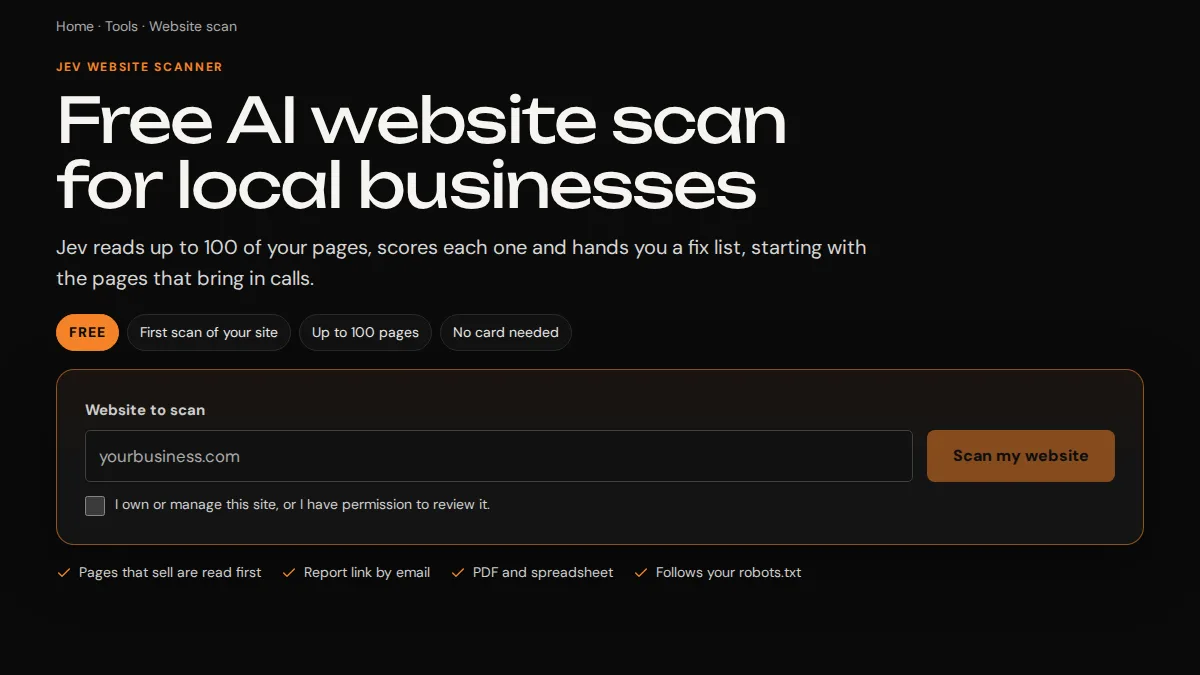
Jev scanner interface with a website input and scan action
The scanner screen has a visible starting input and action. Use it to discuss clarity in an inquiry interface. View the project
  1. Identify the field problem Show the visitor which entry needs attention and what correction is required. We check that the message remains understandable without relying on color alone. A generic failure message may leave the caller unsure where to start.
  2. Keep an uncertain submission honest If the system cannot confirm receipt, the page should avoid declaring success. We ask what alternative contact method your office approves. The visitor needs a way forward without being told that a request definitely arrived.
  3. Show the completed request state After a confirmed submission, explain what the office will do next. We should distinguish receipt from appointment acceptance. Any expected contact window comes from the process your business confirms.
  4. Resolve repeats with the office Staff should check whether two messages describe one customer concern or different jobs. We need that distinction in the record. Preserve the original requests until the office can classify them, rather than deleting a similar-looking contact automatically.

The existing Jev scanner screenshot shows a website input and a visible starting action. It offers a real interface for discussing a clear starting point. We don't use that screen as proof that an HVAC intake route has been built or tested. Your own form still needs checks using the fields and messages your office approves.

Test a missing required entry and a corrected attempt from a phone. Then have staff locate the received test message. We want to see both sides of the exchange. A visible confirmation cannot establish that the right colleague found the request. Our launch checks should reach the people responsible for responding, including the backup route.

Which responsibilities belong in the HVAC build agreement?

The agreement should connect each website asset with the people operating the request path. We discuss what your business receives and who keeps the published process accurate.

Westfield Roofer homepage with a local headline and call and quote choices
A real contractor website shows a location and contact choices. It supplies website context without establishing HVAC work. View the project
  • Name the contact who approves HVAC service wording. We need that person to verify the equipment categories and any terms before publication. Marketing access doesn't authorize us to invent a technical qualification.
  • List the page and form changes included in the build. Our proposal should identify the actual destinations covered. Additional request routes or later service categories can then be discussed as specific work.
  • Assign the destination for incoming messages and a backup contact. Your office should know where test messages appear. We also ask who tells us when a receiving address or telephone number changes.
  • Identify who can approve an intake edit after launch. A new required field changes the customer's task and the staff record. We should know whose approval is needed before adding it.
  • Clarify how your business obtains the material and records covered by the agreement. Account access, editable files, and provider subscriptions can carry separate terms. Our handoff discussion should use those actual terms.

The Westfield Roofer project screenshot has a local headline and visible contact choices. It provides contractor website context for this agreement conversation. It doesn't establish any HVAC work by us or credentials for your business. We use the pictured interface to discuss the page's contact task, then specify the different request handling your HVAC office needs.

Keep technical claims with someone authorized to verify them. The company must supply any license or manufacturer relationship it wants displayed. We can check the supplied wording before publishing it within the agreed work. Our service can't transfer another contractor's credentials to your business. When a fact remains unconfirmed, the page should use the supported service information.

Can office procedures be part of a website agreement?
We should identify the procedures the website depends on, including who responds and who approves changes. That doesn't make us the contractor's dispatcher. Our agreement can define the marketing and technical work while your business accepts responsibility for its customer service process.
What if we already own an HVAC website?
Bring it into the conversation with the request paths your office currently uses. We may discuss improving a destination before adding another one. Existing access and supplier terms affect which changes can be made. The first purchase should follow the actual gap your business wants to address.

Which sample requests should reach the office before launch?

Test requests should include situations that can break the handoff. We walk through the customer path with your staff and check that each case reaches a person who can classify it.

  1. Send an uncertain service request Use an ordinary concern with the unsure choice selected. We check where it arrives and whether the receiving colleague can direct it. Staff should see that the customer hasn't requested a technical recommendation yet.
  2. Try an address staff need to check Use an approved test address that prompts a coverage check. We inspect the confirmation wording. Your dispatcher determines whether the process gives them enough information without implying that the job has already been accepted.
  3. Submit with a missing field Leave one required entry blank, then correct it. We check that the visitor can find the problem and continue. Staff should receive only the completed request unless the agreed system deliberately handles partial contacts.
  4. Resend the same concern Make a clearly marked test repeat and ask staff how they would handle it. Our check should distinguish technical receipt from the office's customer record. A repeat can require attention without becoming a second accepted job.

Use fictional customer details that your office recognizes as a test. Agree the timing so staff don't mistake the message for a real household needing help. We ask who will remove or label those test records afterward. The campaign and inquiry totals should retain an accurate distinction between launch checks and genuine customer requests.

A failed test needs a specific correction before another page depends on that route. We identify whether the problem sits in the form, its destination, or the staff process. Your office may need to change a receiving rule, while our team changes the page. Repeating the same check after the correction confirms whether the request can move through that path.

Which request numbers should guide the next website purchase?

Use accepted requests and the work required to handle them when considering expansion. We keep incomplete records visible so a larger form count doesn't hide an office problem.

A request can arrive successfully and still fall outside your service. Have staff record the reason when they decline it. We can then ask whether the page overstated coverage or whether the person requested something the page clearly excludes. Those cases call for different changes. Our next website recommendation should follow the particular problem the customer record reveals.

Staff workload belongs in the discussion too. A destination that repeatedly collects incomplete addresses can consume time even when the contacts fit your service. We may propose a clearer field or a better explanation of why it is needed. Your office should judge whether the change helps it respond. Our work aims to support the handoff your staff can operate.

Should every received form count as an HVAC lead?
Label received forms as received requests until your office classifies them. We can keep counts for accepted work and unresolved contacts alongside that total. The distinction helps the owner understand both activity and fit. It also prevents launch tests or repeat messages from inflating accepted-request counts.
What if requests are suitable but remain unanswered?
Check the office handoff and capacity before adding more destinations. We need to know whether staff can find the messages and who is responsible for them. More pages may add workload without settling that gap. An intake correction may be the first purchase worth discussing.
Can we calculate a cost for every accepted request?
Only with the actual expenses and a consistent request definition. Keep the period and included costs clear. We won't assign an acquisition price from another trade's record. Your business can compare its own accepted requests once staff classifications and expense records support the calculation.
What should I bring to the HVAC conversation?
Bring your current website and examples of requests your office has trouble handling. Mark the service questions and address gaps your staff encounter. We can discuss a manageable first destination from those facts, along with the people needed to approve and operate it.

Sources

Read more on this