Need help?Jamie

Market service plans

Mass Ave AI Overviews: Fix Pages Google's Summary Skips

You searched for something you sell, Google put an AI summary on top, and it named two other places on the avenue but never yours.

Trojan Digital Marketing helps Mass Ave shops, galleries and studios in Indianapolis, Indiana with that problem. We keep a dated log of the AI summary Google shows for each question your customers type, along with the sites it quotes. Then we rework the page of yours that belongs in that list. Some of the people asking are out-of-town visitors who can't just ask a neighbor. Downtown hotels booked 1.8 million room nights in 2024, by the Downtown Indy Alliance's count.

Send the searches where you expected Google's summary to mention your shop. The first strategy call is free, and during business hours we aim to reply within five minutes.

  • A dated log of what Google's summaries say
  • Each visitor question matched to one page
  • Judged by the calls those pages bring

We set up call and form tracking before we change a single Mass Ave page, because a citation only matters if you can see the calls it brings. Jeff Clerisier founded Trojan Digital Marketing in March 2018 and has built websites since 2016.

Illustrative content research workspace.
IllustrationAnswer preview for Mass AveAn AI answer panel drawn with this page’s public and guidance references as source chips. It isn’t a real AI Overview and cites no business.ANSWER PREVIEWAsk about Mass AveAI ANSWERVisit Indy: Mass Ave · visitindy.comVisit Indy: Mass AveGoogle Search Central: AI features and your website · developers.google.comAI features and your website

YOUR WORKING BRIEF

Choose where to start

Select the parts you want to discuss. Your choices carry into the inquiry form.

Discuss this service0 priorities selected

See how I'd approach this

Choose a question
to look at with me.

A plan moving from scope to delivery and review01Define the scope02Build the work03Review the result
  1. Define the scope
  2. Build the work
  3. Review the result
A plan moving from scope to delivery and review

We'd skip broad questions like things to do downtown, since a summary names only a handful of places there. For a Mass Ave business, we track buying questions only you or a few nearby shops can answer well, then check whether your page helps the person who clicks through.

Visit Indy: Mass Ave: Visit Indy describes galleries, boutiques, restaurants, and bars along Mass Ave, with Bottleworks at the northern end. With that mix, a visitor's question might be about a painting, a dinner or a gift. We keep only the questions that match what you actually sell or host, and drop the rest.

Questions about AI Overviews in Mass Ave, Indianapolis, Indiana

What does AI Overviews work cost for a Mass Ave business?

It's priced after the free strategy call, since the number of questions worth tracking sets the size of the job. For a baseline you can check yourself, the Jev scan is free for up to 100 pages and looks at whether each page opens with an answer worth quoting. The $99 audit scores up to three competitors you name the same way.

Can you get my shop into Google's AI Overview?

Nobody can place a business in an AI Overview, because Google picks the sources on its own. What we can do is make sure the page that deserves the citation opens with a plain answer, sits in the server-rendered HTML and carries no nosnippet tag. Every summary then gets logged with its date, so you'll see whether your page starts appearing.

Which Mass Ave questions are worth tracking?

Start with what a visitor asks before walking over, such as which shops stay open late or what's on this weekend. Event days raise their own questions. Summerfest 2026 closed the 600 block of Massachusetts Avenue to traffic from 11 am to 5 pm on July 18, and a summary that misses a closure like that can send drivers down a street they can't use.

How long before a page change shows up in an AI Overview?

There's no set wait. Google has to recrawl the page first, and the summary for one question can shift from day to day even when nothing changed on your end. That's why every observation is logged with its date and the sources shown, so a real improvement doesn't get confused with ordinary day-to-day variation.

What if the summary is accurate but still leaves my business out?

Then chasing that summary is the wrong fight. We'd look for a narrower question it can't cover well, like a particular maker you carry or a service only you offer on the avenue, and make your page answer it in the opening lines. Those narrow questions are where a small shop has the best chance of being the cited source.

Does this replace my regular SEO work?

No, it sits on top of it. AI Overviews draw on pages Google has already crawled and indexed, so the technical and page fixes from ordinary SEO still come first. This service adds a watch list of real customer questions, and a page gets edited whenever the logged summaries show a gap your site could fill.

“…drove a noticeable uptick in leads within just a few weeks…”
Mike BamosiGoogle review
“I had a great experience working with Jeff…”
Heather DoanGoogle review

We have more than 1,400 live websites.

We’re based in Indianapolis, where the city and Marion County share one government, Unigov.

We also work with clients across the United States.

Read our Google reviews

Who's asking Google about downtown and Mass Ave?

Before choosing which questions to watch for a Mass Ave shop, it helps to know who's typing them, and these downtown figures describe that crowd.

  • Downtown Indianapolis hotels booked 1.8 million room nights in 2024, according to the Downtown Indy Alliance's September 2025 State of Downtown report.

    Out-of-town guests can't fall back on local knowledge, so your visit questions deserve plain answers a summary can quote.

    FOX59, '2025 State of Downtown Indy report lists Mile Square progress'Checked September 25, 2026
  • The same report counted more than 400 restaurants, coffee shops and bars downtown, and 23 new businesses opened in the 12 months before it.

    With that many choices nearby, a summary names only a handful, so the questions worth tracking are the narrow ones your business answers best.

    FOX59, '2025 State of Downtown Indy report lists Mile Square progress'Checked September 25, 2026
  • The Downtown Indy Alliance counted 30,467 downtown residents in its 2025 State of Downtown report, up nearly 6% since 2023, with a median age of 31.5.

    People living downtown search too, so questions about late hours or new stock belong on the watch list next to the visitor questions.

    WTHR, 'State of Downtown report shows signs of strength in Indy'; FOX59Checked September 25, 2026

These are downtown-wide figures from the September 2025 report. They aren't Mass Ave counts, and none of them describes a client of ours.

How does AI Overviews tracking work for a Mass Ave business?

Tracking Google's AI summaries for a Mass Ave business runs in five steps, from choosing the questions to checking whether visits from cited pages turn into calls.

  1. Choose the questionsTogether we pick a short list of real questions, starting with the ones you already hear at the counter.Together
  2. Log what Google showsEach summary is recorded with its date and the sources it cited, so later changes can be compared fairly.Our team
  3. Give every question one pageEach question is assigned a single page on your site that should answer it in the opening lines.Our team
  4. Fix the page, then look againThe page is reworked to open with a plain answer, and the same question is logged again after Google recrawls it.Our team
  5. Count what the visits doCalls and form fills from those pages are compared month to month, since a citation that brings no calls isn't worth chasing.Together

Start with the decision behind a comparison question

A visitor asking about a gift shopping trip is not necessarily ready to buy a particular product. Someone comparing custom gifts needs different information from someone looking for a place to browse today. So we sort questions by how close the person is to buying, and give each one the page that fits that stage.

Your staff's counter questions come first because they're real, and available search data fills in the rest. A district name alone is not sufficient justification for a large collection of near identical articles.

Record what the search experience actually shows

The observation log captures the exact query, date, device context, visible AI feature, cited links, and relevant wording. If no AI Overview appears, that is a recorded observation rather than an automatic failure. We keep conventional search links and Maps results distinct from sources inside a generated answer.

Google’s AI feature documentation describes indexed, snippet eligible pages as a requirement for supporting links. Eligibility does not secure inclusion. Our initial review therefore distinguishes a confirmed technical obstacle from an answer that simply selected a different set of sources.

Prepare answers that help someone continue the visit plan

The destination page should supply the detail a short summary cannot hold. For a product collection, that may include selection criteria, current availability, and the difference between browsing and ordering. For an experience, it may include format, suitability, and the route to confirmed dates. The supporting answer belongs beside that information.

We can create a concise comparison, an explanatory section, and original visual evidence. The point is to make the content useful when reached from any source. Important conditions should not be isolated in an unrelated policy page while the main answer reads like an unrestricted offer.

Examine a proposed custom gift comparison

Imagine a hypothetical Mass Ave retailer with both personalized gifts and finished items. A generated answer describes every item as available for immediate collection, even though the cited page says little about production. We would first inspect the exact source and the shop’s real availability process. The correction might be a visible comparison between finished stock and commissioned work.

Read more

The new section would explain which route allows a direct purchase and which begins with a review. A companion planning article could explain what information makes a custom inquiry useful. Later observations would retain their dates and source links so the owner can compare the wording without treating a single changed answer as proof of market dominance.

Set the deliverables around a bounded evidence review

Keep useful information dependableObserveReviewUpdateRecheck
Observe → review
Check the page and its evidence.
Update → recheck
Publish the change and check the result.
Keep useful information dependableReview the evidence, update what changed and check the published result. A new date alone adds no value.

Trojan Digital Marketing’s proposed scope can include a question inventory, search observation log, destination audit, answer drafts, and a change record. The client provides approved product facts, current policies, and access to relevant reporting when available. Each proposed edit is connected to a buyer uncertainty or a documented mismatch.

We separate direct implementation from recommendations for another platform or publisher. If the observed answer cites a third party, the plan records that dependency and any legitimate correction route. It does not assume we can overwrite another organization’s content or command a generated answer to cite your website.

Connect answer visibility with the next meaningful action

The review distinguishes being named, receiving a supporting link, recording a visit, and receiving a suitable inquiry. These are different events. We inspect the available search reporting and website measurement without claiming that every exposure produces a trackable visit or that every visit belongs to an AI Overview.

The most useful commercial finding may be a question the current page does not answer, an ambiguous availability statement, or a missing route to a collection. Those findings can support concrete page improvements even when the observation sample is small. We agree on the sample and review limits before attaching conclusions to it.

Put the first scope in order

  1. Choose a real product or experience question and identify its intended page.
  2. Record the displayed answer, source, and any incorrect availability statement.
  3. Revise the approved destination and compare later observations with the original record.

Compare Mass Ave planning, the Indianapolis directory and AI Overview review.

Bring a buying question that matches your Mass Ave offer and a dated search example.

Sources & further reading

Talk with Trojan Digital Marketing

Identify the material choice the customer is trying to make

A custom-work answer needs the material question that affects the proposed piece. We ask the maker what the buyer wants to use and which part of that request still needs approval.

A customer can arrive with a material name that means something different to the studio. They may be describing a look, the surface they already own or a product they hope the maker can obtain. We can clarify those meanings before drafting an answer. The maker needs to settle which one concerns the offered work. A short public reply should not treat all three as the same ready-to-order choice.

Ask what the material would do in this proposed piece. The question might concern its appearance or whether the studio will consider a buyer-supplied item. We can organize the intended use in plain words. The maker supplies the relevant boundary. Marketing copy should not decide that a pictured material is suitable for another task, or that the studio can obtain more simply because it used some in an earlier example.

Keep the requested piece beside the material question. A general material description may be accurate while saying little about the studio's actual commission. We can help the business connect the answer with the work a person can ask about. The public page needs to explain which detail is settled and which still requires the maker's assessment. It should not make a broad capability claim from an incomplete request.

Material questions that change a proposed custom-work answer
Buyer meaningDecision for the makerMeaning the answer should preserve
A desired appearanceCan the studio discuss that visual aim within its actual offer?We can describe the requested effect while leaving the exact material choice open. A reference photo need not become a promised match.
A material already ownedWill the maker consider this supplied item and what must be checked first?Keep the approval condition beside the answer. The page should not imply acceptance of every item brought by a customer.
A named source materialWhat does the name identify, and can the studio obtain or use it for this piece?Avoid a ready-now claim when the maker has not confirmed the relevant source or use. The customer needs an accurate next question.
A past pictured exampleWhich part of that material choice still reflects the current offered work?Our description should retain the example's role. A past piece can explain a decision without promising the same material is currently offered.

What if the buyer cannot name the material? Let the maker define the clues it can use to discuss the request. We can invite an approved description or an optional image for that purpose. The page should allow the customer to say they do not know the name. A guessed term can send the question toward the wrong offer. The studio's review should establish the actual material before the answer presents it as a confirmed choice.

  • Ask whether the customer already owns the item they want used. We can preserve that fact in the question. A picture of a similar material on the studio's page should not replace the supplied item's own description. The maker decides what can be reviewed before offering the custom work.
  • Keep a desired color separate from the named material. We can ask the studio how it discusses each choice. A buyer may like the look of a photograph while knowing little about what it shows. The first answer should make that distinction readable rather than name a material the person never requested.
  • Ask what the proposed piece is meant to do. We can keep that purpose attached to the material question. The maker needs to decide what part of the request fits its offer. The page should not use a broad image caption to settle a specific use that remains unreviewed.
  • Find the person who can approve the source statement. We can write the public answer after the maker supplies its meaning. A supplier's product description may explain a name without saying the studio can obtain it now. The review should preserve that remaining question when it matters to the offer.

Get the maker's exact limitation before compressing the answer

The shortest explanation should preserve the condition the studio actually approves. We can help express that limit clearly while the maker decides what the material means for the proposed custom work.

Georgetown Market bilingual functional beverages department sign
Custom-work material answer boundaries: Paired bilingual beverage category labels. View the project
  1. Ask which part is established Have the maker identify what it can currently confirm about the material question. We can draft from that answer. It may be a description of a past example or the information required to consider a supplied item. The writer should not add current availability to a statement that establishes only an earlier use.
  2. Identify the remaining question Ask what must happen before the studio can offer the requested material in this piece. We can keep that dependency visible in the answer brief. If a supplier reply is needed, the maker owns that relationship. A missing response should remain an open input. It should not become an automatic yes in the public summary.
  3. Approve the limited opening Read the proposed short reply with the actual requested task. We should be able to see the maker's boundary without opening another policy page. The studio approves the product meaning. If a shorter sentence changes that meaning, we can revise its structure instead of deleting the condition for a tidier introduction.

English and Spanish category wording appears on the Georgetown functional-beverages sign shown here. That concrete label example helps us discuss how a name directs someone toward a subject. It does not establish the contents or properties of an individual product. We can use the image's visible text as a reference while keeping the maker's material explanation tied to its own approved facts.

An answer may need to say that the studio can discuss the idea but has not approved the requested material. Those are distinct facts. We can keep the next inquiry useful by naming what the maker needs to know. The public wording should not hide the open point under a broad custom options headline. A visitor deciding whether to contact the studio should understand the actual state of the choice.

Can the answer use the word available? Ask what that word means in the studio's actual process. It may refer to an offered option or a source the maker still needs to check. We can express the approved meaning directly. The page should not imply immediate stock or accepted use when neither has been established. A short answer can name the question route without presenting an unresolved material as ready for a confirmed commission.

Keep the photograph separate from a promise about the next piece

A photograph can show a material used in a particular example. We ask the studio what it may establish for a new request before placing it beside an answer about present custom work.

Does a pictured material show that it can be ordered again?
It shows the approved context of the pictured example, when that context is known. Current source availability needs a separate answer from the maker. We can explain that distinction in the caption and nearby action. The page should not let an attractive finished piece carry an implied reorder promise. A customer asking about similar work still needs the studio's current decision about the requested material and use.
Should a reference image be called an exact match?
Use that claim only when the maker can approve what it means for the proposed work. We can help describe the visual feature the buyer likes without promising the whole pictured result. A screen image may leave important material details unknown. The studio needs to settle what it can offer. A careful caption can preserve the image as a discussion reference while the actual material choice remains open.
Can the page show older pieces that are no longer offered?
They can remain useful when their historical role and permissions are clear. We can identify which current service explanation they support. The business should approve the caption's meaning and the next action. A past material example should not retain a choose this option label if that option is not currently offered. The reader needs an honest explanation of what the studio can discuss now.

A tiny image card deserves the same meaning check as the long project story. We can ask whether its title turns an example into an active material option. The maker may approve a concise historical description and a link to the actual custom-work inquiry. That route should carry the person's question without implying the pictured piece can be reproduced in every detail.

Read the page without seeing the photograph. The essential material boundary should remain in text. We can help describe the distinction that matters to the buyer's choice. A caption alone may not carry it when another surface shows only the answer. The studio's approved short statement should make clear what it can consider and which condition still needs approval.

Connect the material condition with the actual commission inquiry

The buyer should know how the unresolved choice affects their next step. We can explain the maker's question route without turning a question about a material into an accepted custom-work order.

Hypothetical example A hypothetical Mass Ave maker receives an unconfirmed material request

Before

  • An unnamed studio shows a past piece in its portfolio. A customer asks whether a material that appears in that image can be used for a different proposed piece. The maker has not confirmed the material's current source or its use in that request.
  • The short answer says the option is available and links to a general commission form. The form's receipt describes the piece as accepted. Those messages can hide both the material assessment and the maker's decision about the requested work.

After

  • We would ask the maker to name the actual material question and its remaining condition. The caption would keep the older piece's context. The public answer would explain what the studio can discuss now and what still needs approval.
  • The inquiry route would carry the requested material and proposed piece as open inputs. Its result would report the known question state. This example claims no real studio, material suitability finding, completed commission or accepted customer order.
  1. Carry the piece description Keep the proposed work alongside the material request. We can ask whether the receiving maker understands which use is being discussed. A material name alone may leave the purpose unclear.
  2. Preserve the open condition Use the maker's approved wording in the request summary. We should not turn the customer's selected option into a statement that the studio has accepted it. The receiving person needs to see what still requires review.
  3. Describe the next answer Explain which decision the studio will discuss after receiving the question. We can help label that stage clearly. Any reply timing or approval term comes from the maker's actual process.

A later reply may propose another material rather than approve the customer's first request. The website can make room for that discussion without claiming the substitute is equivalent. We ask the maker to approve the relevant difference. The buyer should understand which choice is being offered and which part of the original idea it changes. A neat replacement label should not hide that decision.

The studio may need information from another supplier before it can offer terms. We can identify the supplier dependency when quoting this content task. Publishing a question route does not settle what the supplier will answer. It can still tell the customer what to send and who considers it. That helps the next conversation begin from the actual material question.

What if the buyer changes the material after the first inquiry?
Keep the later choice linked to the piece being discussed. We can ask how the studio records that change and who decides what it affects. A new material name may require another source answer. The page should not imply that the earlier review automatically carries over. Let the maker approve the revised meaning before presenting it as an offered option.
Should a suggested alternative carry the original picture?
Ask whether the picture still illustrates what the maker can discuss. We can keep it as a reference with an accurate caption when that helps. A changed material may alter the example's role. The business should decide what comparison is useful and what difference must be explained. The image should not silently promise that the alternative produces the same result.

Use precise labels when the material choice still needs an answer

A field label should identify the choice the customer is asking about. We can keep the proposed item and the maker's unresolved condition distinct in a screen built around the actual assessment task.

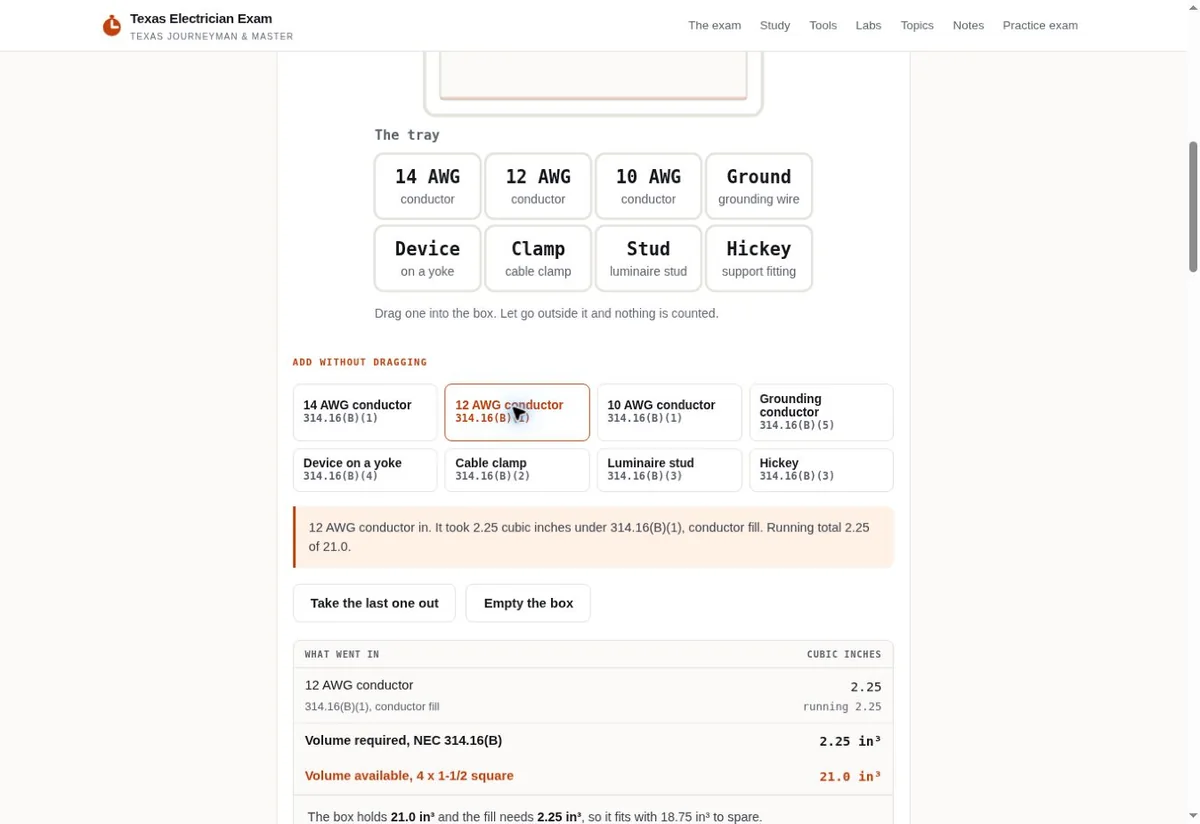
Texas Electrician Exam box fill calculator controls
Custom-work material answer boundaries: Exam controls and displayed output. View the project
Should every material be an option in the form?
Offer only choices the business can describe accurately at this stage. We can distinguish a request to discuss an option from a selection the system is authorized to accept. A long catalog of material names can imply a wider service than the studio approves. The public labels need to follow the current offer. A useful text route may handle an unlisted question without making it look like a ready-made product.
How should the receipt describe a material request?
Use the known sending result and preserve the proposed material's state. We can ask the maker what information it expects in the receiving view. The message should not announce that the material is sourced or that its use is approved. Those decisions belong to the studio's factual approval. A clear receipt can help the customer recognize the request and the question that remains for the next reply.

The Texas Electrician Exam interface shown here displays named controls and an output area. That existing education screen gives us visible input/output context for discussing a clear material question. It supplies no judgment about a maker's materials. We should not infer a commission price or suitability from its calculator format. The proposed studio interface needs the questions its own reviewer approves.

Keep the requested material name near any uncertainty about it. We can provide a plain-text place for the customer's description when the studio supports that route. A required dropdown may make a person choose a term that is only approximately right. The receiving message should preserve what they meant. The maker's later answer determines the actual option it can offer for the piece.

  • Check whether a label names a material or describes only a look. We can ask the maker which meaning it uses in this offer.
  • Keep the customer's proposed use visible beside the requested material. A separate field should not lose that context when the message reaches staff.
  • Read the action as a person with an unknown material. Our review should show whether they can ask a useful question without choosing an unsupported answer.
  • Ask the maker how a changed material choice is approved. The page can explain that process without inventing equivalence between two options.

Inspect the answer your maker approves before claiming search selection

A useful scope names the material question and the controlled explanation to improve. We can write and check that answer while keeping future AI-feature inclusion separate from the page's factual approval.

What helps on the first strategy call?
Bring a real material question, with customer details removed, and the relevant custom-work page. Identify who can approve the studio's material boundary. We can discuss any observed search answer if you have one. The first call is free. A concrete unresolved choice gives us something to assess before a broader collection of comparison content is proposed.
What should be included in the writing quote?
Ask which opening answers, captions and inquiry labels the agreed work covers. We can identify the facts the maker must supply and the copies that depend on them. The quote should explain how it handles an open source question. It also needs a plan for unresolved suitability. A writer should not be expected to settle that technical or commercial decision to finish the page. A bounded explanation may be the appropriate first deliverable.
How should a later AI answer be judged?
Keep the displayed wording with the actual question and time it was observed. We can compare its material claim with the maker-approved page and any cited source. One response does not show what every customer sees. It also does not establish that the page caused a commission. The review should preserve the specific boundary the business is able to approve, even when a search system chooses another source.

Read the answer with the maker and ask what a customer could reasonably infer from it. We can revise the opening if it promises an available material where the offer still requires discussion. Check the picture caption and action too. Their combined meaning should match the actual review state. The finished page should help the buyer ask a useful question about the piece they want.

Start with a material choice the studio actually handles. Our content work can preserve its relevant condition and connect it with the custom-work inquiry. The maker retains responsibility for what it offers and approves. That gives the page an honest practical role for a Mass Ave buyer. The material assessment still needs to happen before the maker promises a finished piece. We can include the unresolved material choice in the quote. It should identify who will supply the next answer and which wording depends on that person's approval.

Sources

From the businesses we've worked with

“I appreciate the attention to detail and the effort put into the work. Everything deserves credit when it's done properly.”

Marketing help for Indianapolis businesses

Based in Indianapolis, we serve central Indiana and clients across the United States.

Request a free strategy call

Indianapolis, Indiana

Service area map

Explore Indianapolis on OpenStreetMapArea reference; this is not an office pin. Map © OpenStreetMap contributors.