

Yahweh House of Prayer
A website for an Indianapolis church that brings worship information, ministry introductions, faith articles and contact options into one place.
SEO Agency · Indianapolis, Indiana
You’ve paid for SEO in Indianapolis, the report shows new blog posts each month, and the phone isn’t ringing any more often. Often Google can’t crawl key pages, your Google Business Profile describes the business differently from your site, or service pages are too thin. Trojan Digital Marketing, founded by Jeff Clerisier and based in Indianapolis, works on all three in one plan for Marion County businesses. We check crawl and index problems first, since new pages can’t help if Google never reaches them. SEO is priced after the free strategy call.
“…drove a noticeable uptick in leads within just a few weeks…”
“I had a great experience working with Jeff…”
Jeff Clerisier founded Trojan Digital Marketing in March 2018.
We have more than 1,400 live websites.
We’re based in Indianapolis, where the city and Marion County share one government, Unigov.
We also work with clients across the United States.
The landscape
Since Unigov took effect in 1970, Indianapolis and Marion County have shared one consolidated government, and the city grew to 402 square miles. Beech Grove, Lawrence, Southport and Speedway sit inside the county but still govern themselves, so a customer there may search by that town’s own name. Someone near Mass Ave and someone on the far east side can see different map results for the same search. Suburbs like Fishers, Greenwood and Avon each have their own map pack and competitors. Local franchises and national chains often chase the same terms.
So before writing anything, we decide which page should rank for which area. Rankings wobble when any one piece is weak: crawl access, page match, profile details or recent reviews. That’s why we work on all of them in one plan.
What is actually included
Crawl efficiency, index control, canonical hygiene, internal link pathways, page speed bottlenecks, rendering issues, and structured data reliability all live here. This is the layer that keeps strong pages from being buried by technical friction. We keep checking it after the first fixes, because a theme update or new plugin can quietly undo one.
Every priority page needs a clear purpose, relevant search intent, and readable structure. We map clusters, review overlap, and connect related pages around what Indianapolis customers need to understand before making an inquiry.
Local visibility depends on category choices, profile completeness, consistency across citations, review response behavior, and geographic page architecture. We align those pieces so your local presence is coherent for both search engines and potential customers comparing options across nearby suburbs.
Thin pages stall growth even when technical SEO is clean. We build service, location, and question driven content that addresses buying friction directly and supports both ranking and conversion. We plan content around the questions your current pages leave open, and we skip blog posts written only to hit a monthly count.
Authority signals still matter, but source quality and topical relevance matter more than raw volume. We look for links and mentions from Indianapolis groups tied to your work, such as the Mass Ave Merchants Association if your shop is a member. We skip bulk link packages, since Google's spam policies count bought links against a site.
You should see what changed, why, and what we'd do next. We read results from your own Search Console, analytics and call records, so you can check every number yourself. If progress slows, we tell you and change the order of the work.
Indianapolis local pack
Local pack results are shaped by three core signals: proximity, prominence, and relevance. Proximity is partly fixed, but relevance and prominence are controllable through profile quality, review behavior, citation consistency, and page architecture. Service area businesses and storefront businesses face different constraints, so category setup and location language have to match the real operating model of the business.
For multi suburb coverage, one page trying to rank everywhere usually fails because it does not satisfy local intent depth. We build service and location relationships deliberately: which page owns which intent, how internal links reinforce those pathways, and how profile signals support that map. For broader local coverage, we organize useful service and location pages on your main website, connect them through relevant internal links, and keep the content specific to the customers your business serves.
AI overlap
Classic SEO and answer engine visibility reinforce each other when the foundations are right. Crawlability, schema integrity, and clean hierarchy improve ranking eligibility while also making content easier for AI systems to parse and cite. Entity consistency across your site, local profiles, and recurring language increases confidence in citation contexts.
We cover the full methodology in our SEO, AEO, GEO, and AIO service overview and the market specific framing in our Indianapolis SEO and AEO page. This page stays focused on operational SEO depth and accountability.
First 90 days
| Phase | Timeframe | Work | What you see |
|---|---|---|---|
| Audit and baseline | Phase 1 | Technical crawl audit, local profile review, page intent map, conversion path review, and baseline visibility snapshot. | Review the priority list, the evidence behind each issue, and the work needed to address it. |
| Technical remediation | Phase 2 | Resolve indexing conflicts, canonical issues, duplicate pathways, speed bottlenecks, and structural errors that block crawl and confidence. | Site health stabilizes and priority pages become easier for search systems to process and trust. |
| Local and entity buildout | Phase 3 | Google Business Profile refinement, category and service alignment, citation consistency checks, review response process, and suburb coverage architecture. | Local signals become more coherent, and your business profile starts matching your website narrative across platforms. |
| Content architecture and production | Phase 4 | Define content clusters, improve priority service pages, launch question led support content, and tighten internal linking. | You begin to see clearer intent matching on core pages and stronger coverage across suburb and service combinations. |
| Authority acquisition | Ongoing | Targeted outreach and acquisition of relevant mentions and links that support category authority and local trust. | Your authority layer strengthens gradually with cleaner context and better topical reinforcement. |
| Review and iteration | Ongoing | Review outcomes, validate assumptions, reprioritize tasks, and adjust execution based on what is moving and what is stuck. | You keep an evidence based roadmap instead of repeating the same actions without learning. |
Buyer guidance
Ask any Indianapolis SEO company these questions, us included. An agency with a clear process can answer each one plainly on the first call.
Good answer: A good answer includes shared access plus explanation, not screenshots without context.
Good answer: A good answer names roles clearly and does not hide execution behind vague account management language.
Good answer: A good answer ties content to your services, buyer questions, and local intent instead of generic templates.
Good answer: A good answer prioritizes relevance and quality, and avoids guaranteed volume promises.
Good answer: A good answer explains scope and cadence clearly without locking you into ambiguous deliverables.
Good answer: A good answer lists concrete outputs and timelines, not only outcomes that cannot be controlled directly.
Good answer: A good answer includes diagnosis, re prioritization, and transparent communication rather than excuses or silence.
Comparison
| Typical SEO retainer | Trojan Digital Marketing | |
|---|---|---|
| Scope | Broad promises with limited operational detail | Defined technical, local, content, and authority scope tied to your actual priorities |
| Technical work | Light audits with minimal follow through | Continuous remediation and structural maintenance |
| Local signals | Profile setup and occasional updates | Ongoing category, citation, review, and suburb coverage management |
| Content | Generic volume publishing | Intent led service and location content with architecture support |
| Links | Quantity first sourcing | Relevance first acquisition with risk awareness |
| AI search readiness | Often treated as separate or ignored | Integrated with crawlability, schema, and entity consistency strategy |
| Reporting | Surface level metrics | Plain updates on what changed and why, tied to decisions and next steps |
| Contract | Fixed packages with broad terms | Scoped engagement after audit and strategy review |
| Who you talk to | Sales contact plus rotating support | Direct strategic contact with execution accountability |
Industries we work in
Category competition is intense and local pack visibility shifts by suburb. Winning requires strong service page architecture and consistent local signals, not one generic city page.
Search pressure centers on procedure specificity, trust signals, and location relevance. We go deeper on this category in our Indianapolis dental marketing page. Read the category page.
Medical SEO requires careful language discipline, clear service boundaries, and high trust presentation. Our Indianapolis medical marketing page outlines category specific considerations. Read the category page.
Discovery windows are shorter and intent can be highly local. Consistent profile activity, menu/service clarity, and review response behavior matter as much as classic page optimization.
Authority and credibility language drive conversion. The challenge is turning expertise into pages that match buyer questions without flattening nuance.
Scaling suburb coverage without duplicate content drag requires deliberate architecture, role clarity between location pages, and disciplined internal linking.
For broader channel planning beyond SEO, review our Indianapolis marketing agency overview and our Indianapolis business marketing guide. When SEO should be paired with site redesign or paid media, we coordinate through website design services and paid ad campaign services.
Proof
"I started my business with no clue how to scale it, but I met Jeff. He walked me through my current problems and gave me a step by step guide on each problem and what to prioritize in order. It’s been 2 years; I couldn’t imagine going anywhere else."Vanessa Williams, Bujeesummer
"Trojan Digital Marketing gave our website a complete make over. The board members and I are absolutely thrilled!"C. Teague McClendon, American Veteran Service Corp
If you want deeper context before a call, review our case studies and run a free SEO audit. For self guided learning, our free marketing course is also available.
A website for an Indianapolis church that brings worship information, ministry introductions, faith articles and contact options into one place.

More than 30 bilingual signs for the grocery section of Georgetown Natural Foods Market in Indianapolis, in the store’s signature brand colors.
FAQ
Pricing is scoped per engagement after an audit and strategy call. Scope changes based on technical debt, local pack complexity, content needs, and authority work required. We do not use a one size package because different categories and site conditions require different effort.
No. Lawrence kept its own city government when Unigov began in 1970, so a Lawrence business lists Lawrence as its city.
SEO is staged work, not a single switch. Early changes often appear in technical health and page clarity before major ranking movement on competitive terms. The right timeline depends on your starting condition and how competitive your category is across Indianapolis and surrounding suburbs.
No, and guarantees are a red flag. No agency controls search engines, competitors, or algorithm changes. A competent SEO partner can focus on process discipline, transparent reporting, and continuous adaptation, but not fixed ranking outcomes.
In practice, the terms are usually interchangeable. What matters is whether the team can execute technical, local, and content work together with accountability. Ask for the operating sequence and deliverable detail rather than focusing on label differences.
No. We run full SEO engagements that include technical and on page foundations, content architecture, authority work, and local signals where relevant. Local SEO is one critical layer, especially in Indianapolis, but it is not the only layer.
We map service demand and intent by suburb and build architecture accordingly. That usually means clear location and service relationships rather than forcing every term into one page. For aggressive multi market coverage, some businesses also evaluate our local service page strategy.
Technical SEO includes crawl/index diagnostics, canonical and duplication control, internal link optimization, page speed bottlenecks, structured data integrity, and remediation planning. We prioritize fixes by impact and dependency, then track completion openly each month.
We use tools where appropriate for workflow efficiency, but we do not publish unreviewed generic output as strategy. Content is planned around your services, local intent, and conversion context, then edited to meet quality and clarity standards. The objective is useful, specific pages that can rank and convert.
We focus on relevant, credible opportunities that fit your category and market positioning. We avoid bulk link schemes and low trust placements that can create long term risk. Authority work is paced and contextual, not mass produced.
Yes, when there is clear fit on goals and execution expectations. Small businesses often need tighter prioritization because resources are finite. The engagement is still scoped to real work rather than stripped to cosmetic tasks.
Whenever you ask, we'll summarize completed work, observed movement and next priorities. We also support direct visibility into source data where feasible so decisions are grounded in evidence. You shouldn't have to guess what happened between invoices.
We treat stalls as a diagnostic event, not a narrative problem. We review assumptions, inspect technical and content blockers, reassess competition, and re sequence priorities. Then we document what changes in the plan so execution stays accountable.
We need practical access to implement meaningful SEO work. A full rebuild is not always required; many sites can improve significantly through targeted remediation and architecture updates. If a rebuild is the best path, we scope it clearly instead of forcing it by default.
Start with a strategy call and a baseline audit. We review your current site, local visibility, and business priorities, then provide a scoped engagement plan. If you want to prepare before the call, use our free audit and free marketing course resources.
Yes, if you take work there. Both govern themselves inside Marion County, and people there may search by the town's own name, so we add them to your Google Business Profile service area. If you trade under a name that isn't your legal one as a sole proprietor or partnership, file it with the Marion County recorder. LLCs and corporations file assumed names through INBiz. Then the name on your profile matches a public record.
Start the conversation
Pricing is scoped after an audit and strategy call, with no one size package and no forced rebuild by default. We review your current state, set the order of work that pays off first and give you a practical engagement plan. If you prefer to start with direct outreach, you can also use our contact page.
“Trojan Digital Marketing gave our website a complete make over. The board members and I are absolutely thrilled!”
Based in Indianapolis, we serve businesses across central Indiana, including Carmel, Fishers, Zionsville, Westfield, Noblesville, Greenwood, Avon and Plainfield, and clients across the United States.
Request a free strategy callService area map
For contractor growth beyond Indiana, we can scope an exclusive Garrison network alongside your existing search work.
Roofing and water restoration offers serve eligible markets outside Indiana. We confirm territory and routing before you commit.
Explore branded exclusive roofing leads or branded exclusive water restoration leads for your service area.
Ask about window replacement lead options when that’s the trade your team serves.
When an offer changes, assign each existing page one truthful job. We start with the service staff can explain and the request they can accept.
An Indianapolis business may keep the same service names while changing what customers receive. That leaves older pages with promises staff would now qualify. We would begin with the current offer and compare each page's wording against it. This is a content question that can be settled before proposing a new URL. A familiar address may still serve a clear purpose once its explanation is corrected.
Write down the buyer's first question for each page. One page might explain the full service. Another might help someone prepare for an assessment. We can compare those jobs with the revised offer and mark passages that make both pages sound like the same purchase. The business then decides which explanation belongs where. Page titles alone won't settle that choice.
A wording conflict needs the two actual passages and the business fact that resolves them. We would preserve the addresses while that question is answered.

The Texas Journeyman Prep homepage has a Get my exam date choice. Check my application appears as another route. Each label names a different visitor question. We can use that distinction to plan two Indianapolis service pages with overlapping wording. Ask the business which question each page should answer and where its action should lead. Our proposed page titles would express those approved roles, helping a reader choose a service without decoding the firm's internal names.
An exclusion belongs in service copy when the business can explain its real boundary. We would ask what staff decline before treating a keyword as unsuitable.
A buyer who reads a local service page wants to know whether the business handles the requested work. We can improve that answer without assuming every unfamiliar inquiry is poor fit. The service owner supplies the boundary; search observations may reveal where the explanation is unclear. Those inputs do different jobs. Our draft should retain the approved business meaning even when an alternative phrase attracts attention.
A service correction may affect summaries on other pages. We would trace the exact changed claim through links and shared answers before marking the content settled.
A hypothetical buyer question can expose a weak distinction. We would use it to compare the two page roles without claiming that a real inquiry has been tested.
Before
After
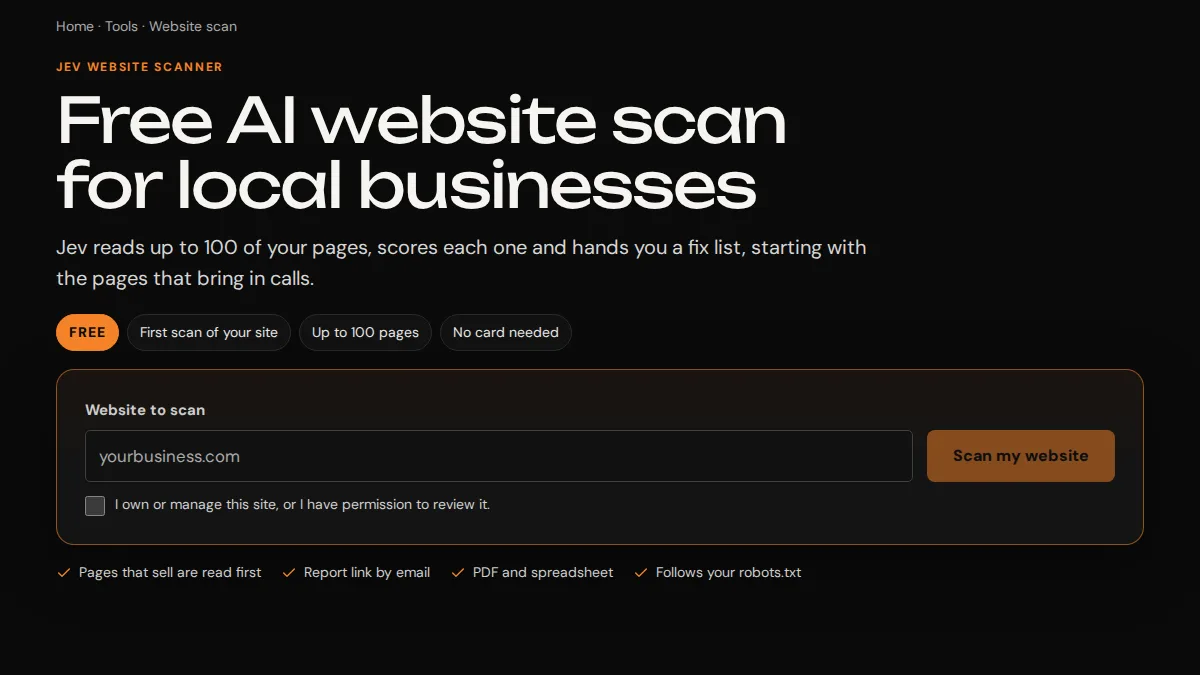
The Jev scanner screen asks for a website beside a Scan my website button. Its input and action name the same subject. We would read the revised service pages for a similar connection between requested detail and offered next step. If a page invites a repair discussion, its question should help staff discuss that repair. Our sample buyer question would compare the two invitations and expose any remaining overlap in their stated purpose.
Content acceptance asks whether the revised pages explain the approved offer. We would finish that check separately from any claim about search visibility or inquiry outcomes.
| Page responsibility | Offer fact required | Meaning each page must keep |
|---|---|---|
| Offer assignment | The current service description and the buyer question assigned to each URL. | Each page has a purpose the business can explain and approve. |
| Conflicting condition | The two published passages with the exact service condition that changed. | The corrected statements express the same approved fact where it applies. |
| Dependent answer | A related summary or FAQ that inherits the revised promise. | Its wording and onward link still fit the destination offer. |
| Acceptance question | A hypothetical request and the intended page used to answer it. | A reader can identify the right action without an extra internal explanation. |
Google's SEO Starter Guide discusses organizing a site so readers can navigate its information. In this narrow project, we would use that guidance to examine the relationship between the existing explanations. The approved content distinction is useful on its own. We would avoid treating its completion as a fixed forecast of rankings, since search systems and customer behavior need their own measured observations.
Sources