Need help?Jamie

Landscaping Marketing Agency

Landscaping Marketing Agency for Booked Design Build Jobs

Your estimator spends spring evenings at free consults for patios the homeowner can't afford yet, while the install calendar has gaps. Trojan Digital Marketing, founded by Jeff Clerisier and based in Indianapolis, does SEO, Google Ads and websites for landscaping companies. We give design build, hardscape and maintenance their own pages, and we add budget range and timing questions to the patio form before a site visit is booked. Work is priced after the free strategy call. During business hours, we aim to reply within five minutes.

We run more than 1,400 live websites. On a landscaping site we start with the quote form, since it decides who gets a site visit.

Design build and maintenance demand segmented by intent
Hardscape versus softscape ticket dynamics built into strategy
Portfolio led conversion systems with budget qualification
No inflated outcome claims or ranking guarantees
Primary frictionUnqualified consultation requests consume estimator time and suppress close rates.
Seasonal realityInstall windows and weather constraints should govern spend pace and lead intake goals.
Trust assetVisual proof and scope clarity usually outperform generic promotional language.
Control metricBooked qualified site visits by service lane and project class.

The first strategy call is free, and during business hours we aim to reply within five minutes.

“…drove a noticeable uptick in leads within just a few weeks…”
Mike BamosiGoogle review
“I had a great experience working with Jeff…”
Heather DoanGoogle review

Jeff Clerisier founded Trojan Digital Marketing in March 2018.

Based in Indianapolis, we serve businesses across central Indiana, including Carmel, Fishers, Zionsville, Westfield, Noblesville, Greenwood, Avon and Plainfield.

We also work with clients across the United States.

Read our Google reviews

What is different about landscaping marketing compared with other home service trades?

A landscaping sale often needs a design visit, work done in phases and photos the buyer trusts. We keep big design build jobs apart from weekly maintenance and ask about budget, timing and the yard before anyone drives out.

  • Use dedicated service lanes for project classes
  • Qualify intent before scheduling consultations
  • Tie channel performance to sold project quality

Why do many landscaping campaigns generate meetings but weak close rates?

Usually nobody asked about budget or timing before the visit was booked. So the estimator drives out to price a retaining wall for someone who pictured a weekend of fresh mulch.

  • Add pre qualification steps in forms and calls
  • Differentiate hardscape and softscape pathways
  • Prioritize high fit lead flow over raw volume

How important is visual portfolio structure to conversion?

Very. Before trusting an estimate, buyers want to see jobs like theirs. We sort photos by service, so the patio page shows patios, each with a line on size and materials.

  • Map portfolio examples to service pages
  • Show scope context, not only beauty shots
  • Support decisions with practical process copy

Can content reduce friction around permits and HOA approvals?

Yes, especially for patios, retaining walls, drainage, and larger outdoor living work. Practical expectation setting helps prospects self qualify and improves confidence in your planning process.

  • Publish scope aware planning explainers
  • Clarify permit and HOA variance by location
  • Set realistic timeline expectations early

Quick answer

What does a landscaping marketing agency improve first?

Most owners ask after consultations increase but sold project quality stays flat.

How can specialized landscaping marketing improve close quality?

We start with last season's inquiries and check which ones became sold jobs. Then we split design build, upgrades and maintenance into separate pages and ad groups, with budget and timing questions on each form. The aim is fewer consults with people who were only browsing.

Demand classes
Design build, enhancements, maintenance
Key conversion step
Budget and scope qualification
Major trust factor
Service specific visual proof
Scheduling risk
Overbooking during install windows
Primary KPI
Qualified consult to sale rate

Executive points

Key takeaways for landscaping operators

Here's what we'd check first on a landscaping account.

  1. Design build campaigns should filter for budget readiness before consultations are booked.
  2. Hardscape and softscape services need separate messaging because ticket size and decision friction differ.
  3. Sorting photos by project type helps buyers decide, so treat the gallery as part of the sale.
  4. Seasonal install capacity should control ad pacing more than arbitrary monthly budgets.
  5. Permit and HOA clarity reduces avoidable estimate fallout in higher complexity projects.
  6. Source reporting should prioritize sold project value over top of funnel activity.

Demand split

Design build demand and recurring landscape care need different funnels

Combining these lanes usually lowers close efficiency and confuses staffing priorities.

Design build and hardscape

  • Consultation first flow with budget range qualification
  • Portfolio proof mapped to project type and scale
  • Permit and HOA expectation framing where relevant
  • Longer follow up rhythm for multi stakeholder decisions

Maintenance and seasonal services

  • Faster quote pathways with route and scope checks
  • Service frequency clarity to reduce early churn
  • Upsell pathways into enhancements and upgrades
  • Capacity pacing tied to route density and labor availability

Service mechanics

Landscaping service lines and their conversion mechanics

Each lane below requires different qualification depth and sales support.

Design Build

Outdoor living spaces and full property redesigns

Design build buyers evaluate aesthetics, budget confidence, timeline realism, and contractor reliability before committing. Marketing should provide scoped examples, phased process expectations, and consultation qualifiers. Without this structure, teams often fill calendars with exploratory calls that do not match project economics or install season priorities.

Hardscape

Patios, retaining walls, and structural outdoor features

Hardscape projects involve drainage, substrate preparation, material tradeoffs, and sometimes permitting or HOA review. Acquisition content should explain those variables in plain language so prospects understand complexity before requesting quotes. This improves estimator efficiency and reduces price shock drop off after initial conversations.

Softscape

Planting, beds, grading, and aesthetic refreshes

Softscape demand can be highly visual and emotionally driven, but close quality improves when messaging includes maintenance implications and seasonal viability. Campaigns that frame only immediate appearance often attract low commitment inquiries, while process aware content attracts buyers prepared for scope and follow through.

Irrigation and Drainage

Water management and property performance projects

Drainage and irrigation leads frequently arise from functional pain points rather than aesthetic goals, so they need practical diagnostic messaging. Service pages should address symptom patterns, site constraints, and expected process. Better expectation setting reduces misaligned quote requests and increases productive consultations.

Enhancements

Lighting, edging, seasonal upgrades, and add ons

Enhancement services can materially increase customer value when sold through structured upsell ladders from maintenance or core projects. Marketing should show before and after outcomes with clear scope tiers. Generic one size copy usually misses buyers who are ready to expand project value once trust is established.

Commercial and HOA

Property management and community landscape contracts

Commercial and HOA buyers care most about reliability, regular updates and how the contract gets carried out, more than how the photos look. Their procurement path is slower and more process heavy. Dedicated messaging and qualification flow are essential to avoid funneling these leads through a residential conversion path that under serves both parties.

Planning priorities

Landscaping marketing priorities

Use this checklist to review your own business and its customer journey.

Method · Review your own inquiry records, staff input, and completed work. These are planning questions, not measured client benchmarks.

Budget

Discuss project expectations before a consultation.

Ask which work the customer is considering and what constraints matter. Use the answer to decide what information or assessment comes next.

Scope

Distinguish hardscape and planting services.

Organize the offer around the work your crews perform and review inquiries that do not fit that scope.

Proposal

Record the decision after a design meeting.

Summarize the discussed scope, identify outstanding questions, and agree on a useful next contact with the prospect.

Intake

Check how new requests reach the office.

Test contact delivery and assign responsibility for reviewing the property, requested work, and scheduling needs.

Capacity

Connect marketing plans with installation capacity.

Review the work already booked, seasonal operating constraints, and whether new inquiries can receive an appropriate assessment.

Shared language

Landscaping terms owners should align on

Clear definitions improve sales consistency and monthly channel decisions.

Design Build
A project model where planning, design, and installation are coordinated through one contractor process rather than separate disconnected bids.
Consult to Close Rate
Percentage of scheduled consultations that convert into signed project work, a critical KPI for landscaping economics.
Hardscape
Built landscape elements such as patios, walls, and walkways that carry structural scope and often higher ticket values.
Softscape
Living landscape elements including plantings, beds, and turf oriented aesthetic work.
Scope Fit
Whether requested work aligns with service offering, margin targets, and crew capability before scheduling field resources.
HOA Constraint
Approval or design limitations imposed by homeowner associations that can affect project timeline and scope decisions.
Install Window
Seasonal period where climate and crew availability allow efficient project execution and reliable scheduling.

Strategy options

Landscaping growth model comparison

The recommended model balances qualified demand with operational capacity and project economics.

Lead marketplacesDIY in houseOwned demand system
Consultation quality control
Low
Variable
High
Design build positioning
Limited
Partial
Structured
Seasonal pacing precision
Weak
Moderate
Strong
Data visibility
Platform limited
Tool dependent
Source to sale
Brand trust development
Shared
Inconsistent
Owned
Multi market scalability
Cost volatility
Resource heavy
Governed

Budget planning

How landscaping marketing is priced

Each tier is priced after the free strategy call, since service mix and market complexity shape what a landscaping program needs.

Foundation

Priced after the free strategy call

BEST FOR · Single market operators improving qualification and local demand capture

  • Local SEO and profile operations
  • Core service line campaign split
  • Call/form tracking setup
  • Landing and consult flow improvements

Growth

Priced after the free strategy call

BEST FOR · Design build teams scaling project volume with stronger close discipline

  • Advanced paid segmentation
  • Portfolio led content system
  • Consult quality and follow up optimization
  • Source to sale reporting
  • Seasonal pacing controls

Multi Market

Priced after the free strategy call

BEST FOR · Brands managing multiple territories or service divisions

  • Location architecture governance
  • Territory KPI operations
  • Cross market budget orchestration
  • Expanded content and CRO work
  • Leadership reporting cadence
Service mix complexity
More design build and hardscape depth increases strategy and content scope.
Territory count
Additional markets require localization and tighter governance.
Seasonality pressure
Narrow install windows demand active pacing and capacity alignment.
Portfolio depth
Visual assets and service mapping impact production workload.
CRM readiness
Weak consult and close stage tracking adds implementation effort.
Competitive density
Crowded metros require faster iteration and stronger conversion systems.

There's no published monthly number for landscaping work. Scope and price depend on your services, geography and execution readiness, and we set both after the free strategy call.

Execution plan

Six step landscaping growth sequence

This sequence improves lead quality before budget expansion.

STEP 01

Segment service lanes by economics

Separate design build, hardscape, softscape, and maintenance pathways to align campaigns with real delivery models.

STEP 02

Install budget and scope qualification

Add practical pre qualification prompts to reduce low fit consultations and improve estimator utilization.

STEP 03

Rebuild campaign and landing architecture

Map search intent to dedicated service pages with distinct conversion pathways and clear buyer expectations.

STEP 04

Publish project specific proof content

Organize portfolio and process assets by service type so buyers can evaluate fit before requesting meetings.

STEP 05

Connect source to sale reporting

Track channel performance through consultation, proposal, and sold project stages for cleaner budget decisions.

STEP 06 · Ongoing

Run seasonal pacing governance

Adjust spend to install capacity, backlog health, and project margin priorities across market windows.

Rollout phases

Typical landscaping rollout timeline

Timing is directional and varies by current systems and team bandwidth.

Phase 1

Diagnostic and qualification baseline

Audit service mix, consultation quality, and conversion leakage points.

Phase 2

Campaign and page restructure

Launch segmented demand lanes with improved form and call qualification.

Phase 3

Portfolio and process content deployment

Publish scoped project assets and expectation setting resources for core services.

Phase 4

Optimization and channel governance

Refine spend by sold project quality and seasonal capacity conditions.

Ongoing

Controlled scale

Expand market coverage only where close quality and operations support profitable growth.

Mid page Q&A

Questions landscaping owners ask before scaling

These concerns usually appear when consultation volume rises faster than close quality.

Should hardscape and maintenance share one campaign structure?

Usually no. Ticket size, buyer intent, and follow up cadence differ too much for one blended lane.

How do we reduce low budget consultation requests?

Introduce budget range and scope signals early in forms, pages, and call scripts.

Is visual content really that important?

Yes. In landscaping, project proof often drives trust before prospects discuss pricing.

How should HOA and permit friction be handled?

Set expectations early and frame approvals as part of planning, not last minute surprises.

What metric matters most for project teams?

Qualified consult to close rate by service lane tied to sold project value.

How often should we rebalance channels?

At least monthly, with faster adjustments during peak install windows and staffing shifts.

Coverage model for landscaping operators

Demand for landscaping work moves differently by metro size, weather cycles, permit friction, and competition density. We plan territory coverage around where calls convert profitably, not just where search volume looks big on paper.

Great Lakes

Chicago, IL, Detroit, MI, Cleveland, OH, Columbus, OH, Milwaukee, WI, Grand Rapids, MI, Cincinnati, OH, Pittsburgh, PA

Southeast

Atlanta, GA, Nashville, TN, Charlotte, NC, Raleigh, NC, Tampa, FL, Orlando, FL, Jacksonville, FL, Birmingham, AL, Louisville, KY

Texas & Gulf

Houston, TX, Dallas, Fort Worth, TX, Austin, TX, San Antonio, TX, New Orleans, LA, Baton Rouge, LA, Oklahoma City, OK, Tulsa, OK

Mountain West

Denver, CO, Colorado Springs, CO, Salt Lake City, UT, Boise, ID, Albuquerque, NM, Phoenix, AZ, Tucson, AZ, Las Vegas, NV

Pacific

Los Angeles, CA, San Diego, CA, San Francisco Bay Area, CA, Sacramento, CA, Portland, OR, Seattle, WA, Spokane, WA, Fresno, CA

Northeast & Mid Atlantic

New York City, NY, Philadelphia, PA, Boston, MA, Washington, DC, Baltimore, MD, Northern New Jersey, NJ, Providence, RI, Buffalo, NY, Richmond, VA

Indianapolis Metro

Indianapolis

Northwest Indy

Zionsville

Wabash Valley

Lafayette

Coverage plans are reviewed against travel time, crew capacity, and lead handling speed so growth does not outrun operations.

Location strategy pages

If you run landscaping routes across multiple territories, market pages should mirror route logic, not county lines. These references show how we localize intent and page structure by market maturity.

Indiana markets

National footprint planning

  • U.S. multi market rollout · Framework for sequencing expansion markets before paid spend scales.

Why microsite networks work for multi market service operators

For landscaping companies entering several metros, one giant page usually blurs intent. Microsites let each market carry its own proof, offers, and conversion flow while keeping operations centralized.

Market Architecture

Separate demand capture by service line and metro maturity

A mature market with referral depth needs different landing depth than a new market buying early awareness clicks. A microsite network allows each territory to run the right page depth, call routing, and conversion goal without forcing one compromise structure across every city.

Operational Fit

Align pages with dispatch reality, not a generic sitemap

When page clusters follow how crews are actually scheduled, close rates improve because expectations are clearer at intake. Copy can set travel windows, appointment patterns, and scope boundaries that match your office process instead of creating calls your team can’t serve profitably.

Measurement

Read channel performance by territory with less noise

Blended reporting hides what is truly working. Breaking properties by market makes it easier to compare cost per qualified lead, booked job rate, and average ticket by location. That gives owners a cleaner basis for deciding whether to push SEO, LSA, paid search, or retention in each region.

Brand Control

Keep standards consistent while localizing proof

You can preserve the same core voice, trust framing, and compliance language while swapping in location specific reviews, project photos, and service priorities. That balance protects brand credibility and still gives local buyers the confidence that you understand their neighborhood conditions.

Next step

Audit your landscaping funnel before peak season

We review qualification, channel structure, and project economics before suggesting scale.

Get a practical landscaping growth plan

Bring your service mix, close rate reality, and seasonal capacity targets. We’ll map the fixes that pay off first.

Owner audit

Landscaping marketing readiness checklist

If these controls are weak, scaling spend often creates expensive consultation noise.

Service lanes are segmented

Design build, hardscape, and maintenance campaigns run with distinct goals and conversion paths.

Budget qualification is active

Prospects provide practical scope and budget signals before estimator time is committed.

Portfolio is mapped to intent

Project proof assets are organized by service type and buyer decision stage.

Seasonal pacing is controlled

Spend and lead targets align with install windows and labor capacity.

Permit and HOA expectations are clear

Higher friction projects include realistic planning guidance in sales materials.

Source to sale tracking is live

Channel decisions rely on sold project outcomes, not top funnel vanity metrics.

Method stance

How we approach landscaping growth

Landscaping marketing should protect estimator time, improve project fit, and scale only when operations can deliver with quality.
Trojan Digital Marketing

Related strategy pages

Keep channel decisions connected. Don’t optimize in silos.

FAQ

Questions we hear before kickoff. Direct answers, no guarantees.

Do you guarantee landscaping rankings?

No. We do not guarantee rankings or lead volume. We focus on disciplined execution and transparent reporting.

Can you support design build and maintenance at the same time?

Yes, but usually in separate lanes so conversion and budgeting stay aligned with each service model.

How do we reduce consultation no shows?

Qualification, expectation setting, and faster follow up all help improve consultation quality and attendance.

Should we advertise every landscaping service equally?

Not usually. Prioritize services with strong margin fit and operational readiness, then expand intentionally.

Can portfolio content be measured for performance?

Yes. We map portfolio sections to service pages and monitor engagement, inquiries, and consult quality by lane.

How do HOA constraints affect marketing?

They influence timeline and scope expectations, so campaigns should set realistic planning context early.

Is local SEO enough for landscaping growth?

Often no. Most teams need coordinated SEO, paid demand capture, and conversion process discipline.

Do you handle multi location landscaping brands?

Yes. We support market architecture and cross territory reporting with governance controls.

What should we track beyond lead volume?

Track qualified consults, close rate, sold project value, and source level profitability by service line.

What do you need for an initial audit?

Current channel data, sales process details, service priorities, and capacity constraints are enough to begin.

What happens on the free strategy call?

We look at where last season's leads came from, which ones became sold jobs and how many installs your crews can take this year. Then we tell you what we'd fix first. SEO, ads or a new website are priced after that call, once the scope is clear.

What does landscaping marketing cost?

Ongoing SEO and Google Ads for a landscaping company are priced after the free strategy call, once we know your install radius and the projects you want. A newer company can start with the Marketing Startup Kit: $7,997, or three monthly payments of $2,799. It covers a custom 15 page website, your Google Business Profile, twenty blog posts and three months of strategy calls.

Planning call

Talk through your landscaping growth plan

Bring your current lead mix, close rate reality, and capacity goals. We’ll map what to fix first and what can wait.

  • A practical read on where your current leads break between click, call, and booked work.
  • Channel priorities tied to margin and crew capacity, not vanity traffic targets.
  • Clear next actions your internal team can execute even if you move in stages.
  • No ranking guarantees, no pressure close, and no requirement to switch vendors immediately.

The first strategy call is free, and during business hours we aim to reply within five minutes.

Explore landscaping campaign plans by market

Local demand shapes the plan. Review the area resources below, then we'll discuss the services and customers your business wants to reach.

From the businesses we've worked with

“It’s been 2 years; I couldn’t imagine going anywhere else.”
Vanessa WilliamsBujeesummer

Based in Indianapolis, we serve businesses across central Indiana, including Carmel, Fishers, Zionsville, Westfield, Noblesville, Greenwood, Avon and Plainfield, and clients across the United States.

Request a free strategy call

The first strategy call is free, and during business hours we aim to reply within five minutes.

Explore practical toolsRead related insights

Ask what the customer wants reconsidered in a planting project

A plant-replacement question begins with the part of the earlier project the customer wants discussed. We can write that contact route while the provider assesses the plant and project context.

  1. Name the earlier planting question Ask the customer which part of the project they want to revisit. We can give them room to describe it without choosing a replacement plant or naming a technical cause.
  2. Preserve their description Keep the customer's words beside the question. Our page can let staff see whether they are asking about a named plant, a group of plants, or an unclear part of the project.
  3. Choose the provider's next contact Your team needs to decide who answers planting questions about earlier work. We can write the contact explanation around that role once it is approved.
  4. Leave the outcome open The business must assess what is being requested. We can keep the public acknowledgement accurate while plant identity, conditions and any replacement arrangement are still unanswered.

Landscaping marketing can include the questions that arise after a customer has discussed or received a planting project. The page doesn't have to offer another full redesign to receive that question. We can define a small addition around what the customer wants reconsidered. Your provider remains responsible for any finding about the plant or the next work. That gives the writing a practical purpose without promising a plant's performance.

What should the page call this request?
Use the name your landscaping office accepts, such as a question about an earlier planting project. We can choose the wording with staff. If replacement is only being requested, the title should leave room for the provider to answer before work is agreed.
Should the form ask why the plant needs replacement?
It can ask the customer to describe their concern if the provider wants that context. We can leave the cause open. The first message shouldn't require a person to diagnose plant health or choose the appropriate treatment.

Keep an uncertain plant name uncertain

A customer may describe a plant without knowing its name. We can preserve that description and let the landscaping team decide what information it needs to identify the project detail.

Georgetown Market bilingual functional beverages department sign
Beverage-category names sharing one bilingual sign. View the project

The paired department names on the Indianapolis sign give readers a stated subject in two languages. We can use that clear naming to discuss how a planting form describes its subject. A customer may know a plant by its common name, appearance or position on a plan. Our proposed fields can preserve the description they actually have while the landscaping team identifies the project detail.

  • Give the visitor a place to describe the plant they mean. We can explain that an uncertain name is welcome as a starting point for staff.
  • Ask whether the provider's own project description has a reference the customer recognizes. Our instructions can use that approved reference instead of inventing a plant identifier.
  • Keep a location description in the customer's words when the office wants it. We can avoid turning a phrase such as near the entry into a confirmed plan location.
  • Let the provider choose any later image or document request. We can explain its approved exchange method without suggesting that a marketing form determines plant identity.
Can we show a sample plant name in the form?
Use a fictional example approved by the provider if it helps explain the field. We can make clear that a customer may describe an unknown plant. The example shouldn't appear to recommend that plant for the customer's property.
What if the customer names several plants?
Our draft can keep those descriptions distinct within the question. Staff can then ask which plant or group the customer wants to discuss first. The page shouldn't treat each uncertain name as an accepted replacement order.

Connect the question to the provider-approved project reference

A planting question needs the earlier project context the office can recognize. We can label that reference clearly while the provider checks which record relates to the customer request.

Landscape replacement question context
Planting questionProject contextProvider answer
Earlier plantingUse the job or plan reference the provider accepts. We can describe where the customer may find it if the business supplies that instruction.The office can begin locating the earlier conversation. The correct project still needs confirmation.
Plant descriptionThe customer gives the name or description they know. We can retain any uncertainty in the message.A supplied name helps staff investigate. It doesn't establish the plant's actual identity.
Replacement requestAsk what the person wants the provider to reconsider. Our wording can preserve that question alongside the project reference.The customer has requested a discussion. A replacement offer hasn't been accepted.
Provider replyThe landscaping team supplies its answer after considering the project context. We can explain the contact route it approves.Any plant advice or proposed work must come from the responsible provider.

An old plan may help the office understand the request, but its title alone doesn't establish current site conditions. We can write a contact explanation that keeps the earlier project and the present question together. Staff can decide what additional detail they need. The public page should leave that assessment open. It can still make the requested conversation clear to someone who has misplaced the project reference.

Describe a replacement request before work is accepted

Asking about replacement opens a provider conversation. We can keep the request distinguishable from any later offer, accepted work or finding about what will grow in the customer's site.

Hypothetical example An unnamed landscaping customer asks about replacing a plant whose identity and site conditions remain unknown.

Before

  • The fictional customer describes a plant from an earlier project and asks whether it can be replaced. The provider hasn't checked the plant or project.
  • The proposed receipt selects a new plant and says it will succeed at the property, although no assessment or work agreement exists.

After

  • We can retain the uncertain plant description and the customer's question under the earlier project reference. Staff can establish the relevant context.
  • The acknowledgement can explain the provider's approved next contact. Any plant choice, replacement offer and outcome remain unanswered until the responsible team responds.
What if the customer expects replacement to be included?
We can let them ask that question in their own words. The provider must explain any terms that apply to its actual work. Our public copy shouldn't infer an included replacement from a general project description or a prior conversation.
Can the provider offer a new planting estimate?
That is a possible later answer if the business chooses it. We can keep the initial route focused on the existing question. The page shouldn't present a new estimate as accepted work merely because a customer asked about replacement.

Read the proposed message from both sides of the conversation. A customer needs to know how to ask about the planting concern. The landscaping team needs to see what is still unknown. We can keep that gap clear in the writing. If the business later approves a specific replacement offer, its own explanation can state the agreed work and any limits that actually apply.

Give each piece of planting context its own field label

The project reference and the plant description serve different purposes. We can name those fields separately so the customer can describe the question without having to supply a technical finding.

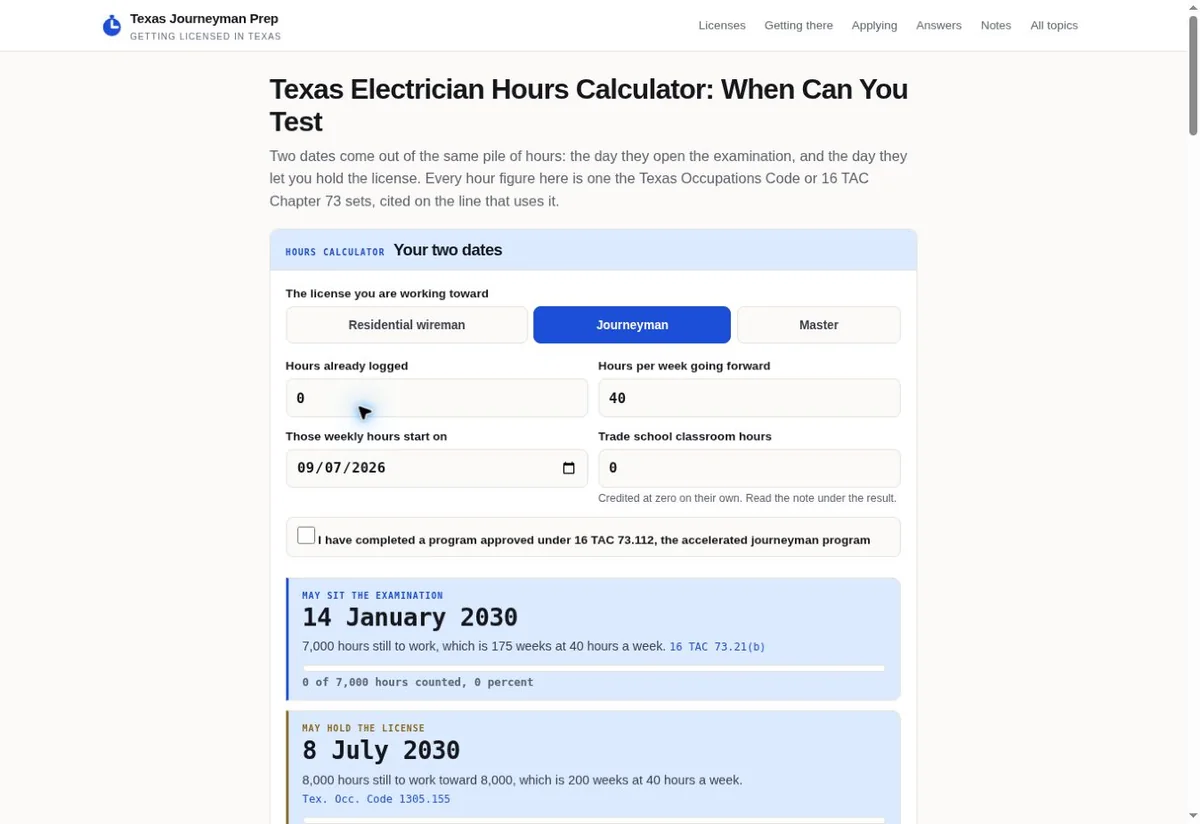
Texas Journeyman Prep calculator with labeled fields
Existing and proposed hours in labeled fields. View the project
  • Use the accepted project reference as one field when your office needs it. We can explain an alternative when the visitor cannot find that reference.
  • Name the plant description field around what the customer knows. Our wording can let them describe a place in the plan or a plant with an uncertain name.
  • Give the replacement question room of its own. We can ask what the visitor wants to discuss rather than preselecting an outcome for the provider.
  • Check the field help with the staff member who receives planting questions. We can revise any line that asks a customer to make a technical assessment.

The calculator gives its existing-hours field and its forward-looking hours field separate labels. We can discuss that separation when naming a past planting reference and the customer's present question. Each field should tell the person which piece of context belongs there. Your landscaping team supplies the wording it uses for earlier projects and the contact route it wants customers to follow.

Approve the contact wording without adding plant-care advice

The landscaping provider should approve the planting question route and its reply process. We can prepare that wording while keeping care advice and suitability findings with the responsible team.

What should the owner approve in the final copy?
Check the accepted project reference, the way an unknown plant can be described, and the person who answers the request. We can prepare those items together. Any statement about included replacement work or planting advice needs the provider's own approval and support.
What can the receipt accurately confirm?
It can describe receipt of the message after delivery has been checked. We can state that the customer asked about an earlier planting project. The receipt should leave plant identity, replacement terms and any next work open until the provider gives its answer.
How should this route be kept current?
Tell us when the project-reference method or planting-question contact changes. We can adjust the explanation and field help within agreed website maintenance. The provider should also identify any old instruction that no longer fits its own handling process.
  1. Try an unknown plant description We can read a fictional message that names no plant. Ask staff whether the instructions let them begin the conversation without a guessed identity.
  2. Try an old project reference Ask the office what it needs if the customer only remembers the earlier discussion. Our field help can reflect that approved search process.
  3. Try an unanswered replacement question Read the receipt while the requested work remains unaccepted. We can remove any wording that suggests a plant choice or performance outcome has already been agreed.

Sources

Read more on this

Explore related industries