Questions, answered.
Local context
- The 2014 Census Texas place file records Plano as 4858016, separately from Dallas 4819000. It supports the named-place distinction only. Census Bureau citysdk Texas places, 2014
Are the roofing and water restoration membership prices valid for windows?
No. Their published fees and lead terms apply to their respective trades. We quote the window replacement membership separately. That includes any chargeable inquiry definition, renewal conditions and treatment of disputed contacts. Don't carry over another trade's call-duration test or credit formula. We can discuss how you prefer to buy the channel, but the written window proposal must say what is available. Our generic owned tiers do have published prices and can provide a separate, concrete alternative.
What would a Plano window replacement membership actually buy?
It would buy access to a quoted Trojan-operated window network using your company's brand in the agreed market. We would route its inquiries to you as the assigned contractor. Trojan retains the domains. Your business handles the prospect and the installation discussion. Jeff needs to confirm the accepted work, territory and window terms before you commit. We haven't published a window fee or inquiry allowance. The first call can also compare an owned network if domain control is part of your buying goal.
Does an exclusive window territory mean every prospect is ready to hire?
No. Exclusivity concerns allocation: one assigned contractor receives the inquiries from the agreed membership market. A visitor can still be comparing products or describing work you don't accept. We help make the public invitation clearer, and your staff checks fit. Any billable qualification rule must be established in the window agreement. We won't call a contact a booked installation because it arrived through your branded page. Your company decides which requests progress into a consultation or quote.
Can we include storm damage or a broken window in the offer?
Yes, if your company actually accepts that work and Jeff includes it in the proposed channel. We would state the service you provide, which may differ from glass repair or temporary protection. Your office confirms whether it can respond and what assessment comes next. A page inviting a damage inquiry doesn't reserve a crew or promise emergency dispatch. Planned replacement can have its own route, so a homeowner choosing future installation isn't pushed into an urgent-work message.
What does the five-inquiry window observation tell a new buyer?
After five weeks online, 100 sites in our window network had received five inquiries. That record doesn't identify a calendar period or local market. We don't have a qualified-lead count or completed-job count from it. It is an early operating observation you can ask Jeff about. It can't establish a Plano forecast, a yearly average or a minimum delivery term. We would assess your accepted work and actual channel activity separately.
How do the owned-network charges compare with a quoted membership?
The membership needs its own window quote. Ownership has four published tiers and a minimum of 100 sites. For that minimum, Tier 1 starts with 3,900 dollars of setup plus 8,000 dollars for its first service year. Its later annual managed charge totals 6,500 dollars. Higher content tiers have different charges and article quantities. We include every inquiry from the owned network without per-lead billing. Domain ownership and the continuing service work should both be considered when you compare purchases.
What happens to an owned window network after managed renewal ends?
Your company keeps its registered domains, and the sites remain live. We stop the managed article work and routine price or FAQ upkeep, and your business takes over registrar renewal payments. Confirm hosting and technical responsibilities in the agreement before buying. A registrar transfer is separate from the optional 8,000-dollar full platform migration with a software license. We can discuss that choice with your appointed technical person. Keeping domain registration doesn't automatically give your company the entire software system.
Will the pages put our company into Google AI answers?
We can't promise that placement. Google says the established SEO approach still applies to its AI search features. We can publish clear, supported service answers and keep them accessible to search. Useful replacement information gives a visitor more reason to understand your offer, regardless of how they arrive. AI engines decide what they show. We track available observations without calling an occasional appearance a permanent position or a guaranteed source of installation inquiries.
Can we use our existing website rather than buy a network?
Yes. We can quote work on the replacement pages and inquiry route you already have. That may fit when the main issue is an unclear installation offer or poor project information. Our window and door marketing service covers that broader discussion. A network is a separate channel purchase with its own ownership and operating choices. We can compare the work honestly on the free call. You don't have to select a site count before explaining the problem.
What should I send Jeff to get a window proposal?
Send the towns you serve, your accepted window jobs and the contact destination your office checks. Include your website and say whether you prefer a membership or want to own the domains. We can discuss both if you're unsure. The contact form requires email, with a phone field for a callback. Share public business facts first and leave private customer files out. The initial call is free. Jeff confirms the brief before preparing a quote, so you know which window terms still need agreement.
Buy a window inquiry channel with the terms spelled out
Open this walkthroughClose this walkthrough
You install replacement windows. We build the organic search channel that helps people find your business and ask about that work. For Plano, a window membership would put your company on a Trojan-operated network and send its inquiries directly to you. We first quote the territory and the work you'll accept. A window membership price hasn't been published.
Prefer to own the domains? Our owned network is a separate purchase, starting with 100 websites. At that size, Tier 1 costs 11,900 dollars initially, covering setup and the first service year. Its following yearly charge is 6,500 dollars. All inquiries from your owned network are included. Neither option comes with a promised inquiry count or an installation sale.
| Purchase route | What we would provide | What you need before agreeing |
|---|---|---|
| Quoted window membership | Trojan runs the sites under your brand. The agreed market has one assigned contractor receiving those inquiries. | Jeff confirms availability, accepted jobs and the window-specific payment and renewal terms. |
| Owned Garrison network | Your business registers the domains. We build and manage the agreed search resources; every inquiry is yours. | Choose 100 to 1,000 sites, a content tier and real coverage. The four published tiers appear below. |
| Improve the website you have | We can work on replacement service pages and the route into your office. | A separate marketing quote fits owners who need a clearer offer before considering a network. |
The first conversation with Jeff is free. Tell us where your crews work, which replacement projects fit and who answers new inquiries. We'll talk through membership availability alongside ownership. You can ask for a written proposal without pretending that you already know how many websites you need.
We care about the request your estimator actually receives. A homeowner planning several replacements is different from someone buying a loose pane or asking about curtains. Our pages should explain your accepted work early. Your office still decides which conversations become measurements, proposals or booked installations.
Our own window network has an early record to discuss
Open this walkthroughClose this walkthrough
We have a small, concrete window observation: the first 100 websites received five inquiries during their first five weeks online. This is our early window record. It doesn't supply calendar dates for that five-week stretch or identify a market. We won't assign those contacts to Plano.
The record also doesn't tell us how many were qualified, quoted or won. We keep that distinction because an installer needs to budget against the work it can accept. Five inquiries are something to examine. They aren't five sales, and they don't establish a yearly rate for your company.
We've learned to pay attention to the individual towns behind a network. We look at their search activity and change or rebuild pages in places that remain quiet. More domains alone won't settle a poor service match. Our aim is to give the right buyer a clear reason to contact the named contractor.
Ask Jeff about that early window activity on the first call. Then bring your own recent requests, with customer details removed. We can compare the kind of question people asked with the jobs you want. Our window replacement lead service explains the wider channel. The separate roofing and restoration records stay with their own trades and reporting periods.
Tell us which window jobs deserve your next callback
Open this walkthroughClose this walkthrough
Start with the work you sell today. Do you supply and install replacement windows, install customer-supplied products, or take a narrower kind of project? We need that answer before naming pages or choosing a territory. If the advertised offer leaves it open, your staff will spend the first call correcting it.
We'd separate planned replacement from damage-related requests. Planned work might involve one room, several openings or a whole-home project. A damaged pane may call for a service you don't provide. Your membership brief can include storm or broken-glass questions only when your business accepts the corresponding work.
| Prospect's starting need | What you tell Trojan | How we frame the inquiry |
|---|---|---|
| Several aging windows | Accepted property types, project size and your supply-and-install role. | A replacement discussion that leaves measurements and product selection for your staff. |
| One failed or damaged window | Whether small replacement, glass repair or temporary work is accepted. | The specific service you provide, with a clear boundary around work you decline. |
| A staged home improvement | Whether you take phased projects and how the owner can discuss later rooms. | A planning request with the present phase identified. |
| Product without installation | Whether you sell supply-only orders or require installation as part of the purchase. | A direct explanation before the visitor asks for pricing. |
| Shades, blinds or curtains | Whether you have a separate covering service. | A different service route. Window replacement membership doesn't mean window treatments. |
You can leave technical choices undecided. The initial message needs a location and a broad job description, rather than a final opening measurement. We wouldn't ask a homeowner to select a frame system just to start a conversation. Your installer makes the technical assessment.
Set a minimum job size if your operation needs one. We can explain it in normal buyer language, with your approval. It should describe what you accept instead of shaming a person with a smaller request. A polite, accurate boundary saves both parties from arranging an unsuitable visit.
We also ask who can authorize the proposed work. The visitor might be an owner, a property manager or someone gathering options for another person. You decide what permission is needed before an appointment. We can gather the contact's role without making every inquiry claim ownership it can't establish.
Price the towns your installation team can actually cover
Open this walkthroughClose this walkthrough
Plano belongs in the proposal because you want to accept work there. It shouldn't become a default promise that every nearby address is covered. Give us your present town list and any boundaries that affect an estimator's visit. We'll use the list you approve when discussing the network.
In the Census Bureau's 2014 Texas place dataset, Plano has identifier 4858016; Dallas appears separately as 4819000. That supports keeping the two names distinct in our geographic brief. The older file doesn't tell us today's window demand, your driving time or which authority handles a particular property.
A company might take planned installation work across several towns while limiting small damage jobs to a shorter trip. We can write those as separate coverage rules if they reflect your operation. A single broad claim would conceal the difference and invite calls your office has to turn away.
Tell us about any property types you exclude, and explain changes that would make a town temporarily unavailable. We don't need a private crew schedule. We need an accurate public invitation. Your proposed pages can say that staff confirm coverage from the submitted location before arranging the next step.
Our Dallas window resource discusses the neighboring market separately. If you want both areas, Jeff can talk through a combined footprint and its ownership or allocation terms. Don't infer that asking about Plano reserves Dallas too. We confirm the actual territory in the written offer.
Plano is outside Indiana, where Trojan is based. We work with businesses nationally. The current rules for a window-treatment membership don't define a window-replacement contract. We will quote this replacement offer on its own terms and confirm eligibility rather than importing another trade's geographic restrictions.
Get the window membership terms before setting a budget
Open this walkthroughClose this walkthrough
A membership keeps domain ownership with Trojan. We operate the agreed network under your company's identity, with one contractor assigned to the market. Its inquiries go straight to that contractor. You are buying an operating channel, so you need to understand both the payment arrangement and what happens when it ends.
Window membership is a quoted offer. We haven't published a window subscription amount, included inquiry allowance or additional qualified-lead price. Roofing and water restoration have their own published plans. Those numbers aren't window prices. Jeff must confirm the arrangement you can actually buy for your accepted work.
Our quote should say how billing works and what counts toward any charge. If it uses an inquiry definition, that definition belongs in the agreement. Ask how incorrect numbers, duplicate contacts or a request outside the territory are handled. A window proposal needs its own answers before you compare it with a purchased-lead supplier.
Questions to settle about window billing and renewal
Ask for the initial term, renewal date and cancellation notice in writing. Confirm whether charges depend on contact volume or an ongoing service fee. If an allowance or credit is proposed, check its exact calculation and conditions. No window allowance or shortfall-credit formula is established on this page.
We'd also identify what can change at renewal and how you will hear about it. Your office should know which records support a disputed charge and when to raise the question. The agreement should name the receiving business and payment terms without relying on another trade's price table.
The direct route is central to the offer. Your brand should be apparent when a visitor reads the site and asks for contact. Exclusivity means a single assigned contractor for the agreed market receives that network's inquiries. It doesn't mean every search belongs to you or that no other business advertises in Plano.
We need your company's approved identity, contact destination and a person who can approve updates. A new phone number or change in accepted work can affect the whole invitation. Give us that change before your office starts receiving unsuitable requests. The receiving process deserves the same attention as the published page.
You can read our broader membership explanation and the membership and ownership comparison. Use those to prepare questions about control and costs. We still need a window-specific proposal before you accept a payment term or assume a refund right.
Build organic coverage around real replacement questions
Open this walkthroughClose this walkthrough
The offer starts with organic search. We create and maintain service information aimed at people considering the work you accept. SEO deals with ordinary search discovery. GEO and AEO help us think about clear answers that search and AI experiences can understand. None of those labels buys a ranking.
For your window network, we would begin with the accepted installation offer and its supporting questions. What does a consultation cover? Can a customer replace only selected rooms? Do you supply the windows? The page answers come from your company. We shouldn't make up a supplier range or a warranty to fill a gap.
We connect those explanations so a visitor can move from a question into an appropriate inquiry. A broad replacement page could link to an approved discussion of phased work. A damage page would exist only for work you handle. Each resource should have a reason to stand on its own.
Google's guidance for AI features says established SEO practices still apply. Its search documentation doesn't require a special AI text file or separate schema to qualify for those features. We focus on accessible text and pages that can be found and indexed. Eligibility never promises that an answer engine will cite your business.
We also keep the service facts consistent across the destinations you control. Your name, accepted area and contact details should describe the same business. A genuine Google Business Profile can support that picture when your company is eligible. We won't fabricate a showroom address or pretend a website gives you a local office.
What a large window network needs beyond domain names
We need distinct, maintained resources that serve actual visitors. Google identifies scaled content made chiefly to manipulate ranking as spam. Owning many domains doesn't exempt a project from that rule. We assess the reader's question and the information available before assigning another page.
Our writing can include approved project explanations and practical preparation answers. Your installer supplies the facts behind technical claims. Repeated location labels attached to unchanged paragraphs won't give a homeowner a stronger reason to call. We want the network to develop around real service information.
Impressions and clicks can show whether people are finding a resource over time. Inquiries show a different part of the channel. We look at both without turning one into proof of the other. The goal is a growing, credible route into your business, with changes informed by actual activity.
Make the handoff useful to the person answering
Open this walkthroughClose this walkthrough
The receiving destination is agreed with you before launch. We need the number or inbox your business wants prospects to use, and the staff member responsible for checking it. The membership routes inquiries to your company. It doesn't answer as your dispatcher or commit your estimator to an appointment.
We'd test the proposed route using an agreed sample message that contains no real customer record. Your staff can inspect what arrived and whether its job context is readable. A successful test confirms that handoff at the time of testing. Routine changes still need someone to keep the destination current.
- Identify the request. The visitor states the property location and the broad window work they want to discuss.
- Deliver it to your chosen office. The agreed destination receives the message without a second contractor being assigned the same network market.
- Confirm service fit. Your team checks coverage and the job category before offering a visit.
- Explain the next contact. Staff arrange a callback or discuss an assessment under your own process.
- Keep the outcome. Your business records whether the contact reached a proposal or accepted installation.
For a caller reporting damaged glass, the page can invite an urgent conversation if that's work you take. Your office confirms response availability. We can't promise that a crew is waiting or that a marketing inquiry receives emergency service. A request should reach the correct person without claiming a completed booking.
For a planned replacement, the office may need to ask about the number of openings or the desired phase. We can carry those broad details into the inquiry where appropriate. Leave room for the visitor who doesn't know. An approximate answer can help the conversation without becoming a technical specification.
We separate incoming contacts from the qualification rules in your eventual agreement. A routed inquiry can still be unsuitable for a visit. Your staff's acceptance and any billable definition must be clear enough to compare consistently. We won't borrow the roofing plan's call-duration rule for windows.
Two real Trojan screens show how we make choices clear
Open this walkthroughClose this walkthrough
We've built interfaces that give people a clear choice before asking them to continue. The Texas Journeyman Prep homepage is one example from our own work. Its visible buttons separate “Check my application” from another task, “Get my exam date.” Each path tells the user what they are about to do.

The relevant lesson is to name a buyer's next task. We could label a replacement route around discussing a project and a separate accepted-damage route around describing the problem. Your staff would approve those paths. This image shows our interface work, with the original exam service identity visible.
The project's calculator also separates a known total from an entered future pace. One field, “Hours already logged”, records a past total. The second, “Hours per week going forward”, asks about future weeks. In an installer's budget, we keep received contacts separate from the assumptions about later activity.
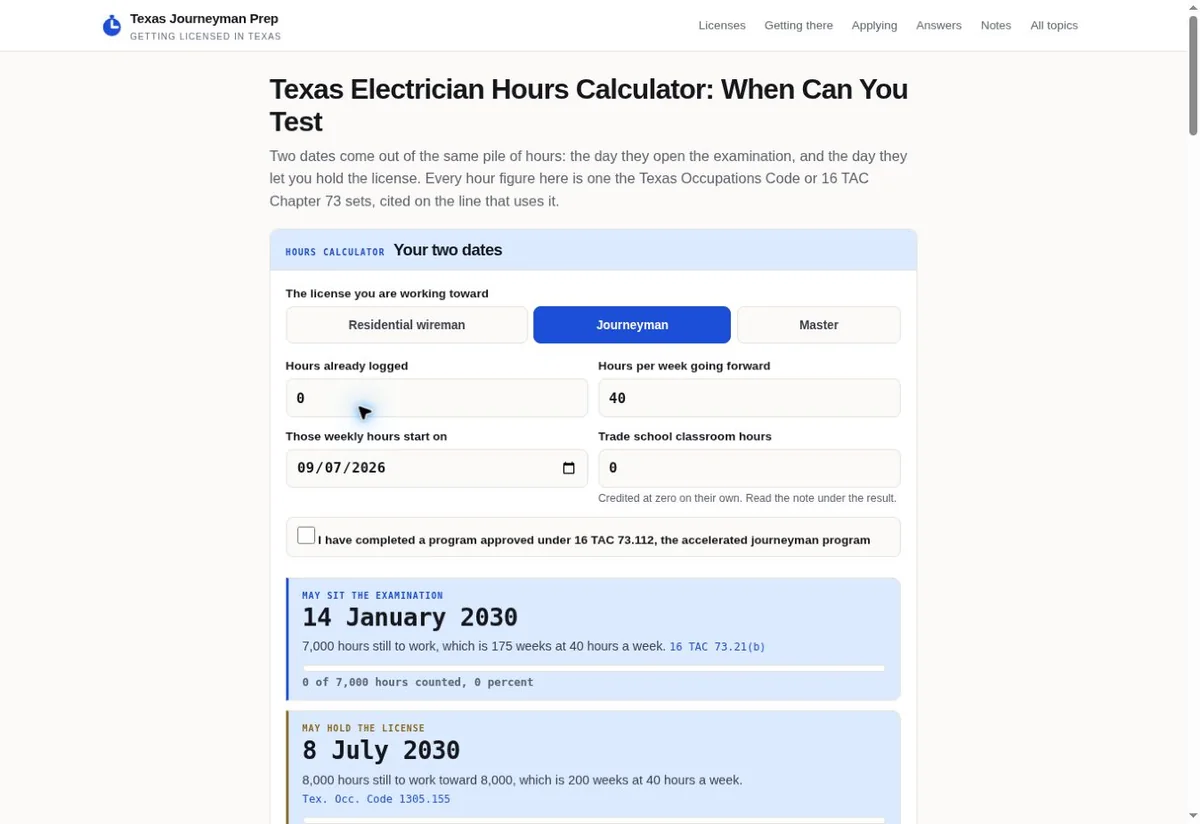
Neither picture forecasts your window activity. The connection is the way we present tasks and inputs. You can inspect the actual Texas Journeyman Prep project, then ask Jeff how that approach would fit your public replacement offer. On a replacement page, we'd make the accepted job path clear before the visitor prepares a message.
Put the owned-network alternative on the same buying sheet
Open this walkthroughClose this walkthrough
If you want the domains registered to your company, consider ownership alongside the quoted membership. Our published owned plans cover networks from 100 through 1,000 sites. The September 2026 prices below are in US dollars. Each combines a one-time setup amount with a per-site first-year service charge.
| Owned content tier | Setup charge | First service year per site | Later yearly service per site | New articles per site each year |
|---|---|---|---|---|
| Tier 1 · maintain core pages | 3,900 dollars at setup | 80 dollars for each site | 65 dollars at each annual renewal | Zero recurring blog articles |
| Tier 2 · annual article addition | 5,000 dollars at setup | 100 dollars for each site | 75 dollars at each annual renewal | 12 articles |
| Tier 3 · expanded article allowance | 5,000 dollars at setup | 110 dollars for each site | 85 dollars at each annual renewal | 24 articles |
| Tier 4 · largest article allowance | 6,000 dollars at setup | 120 dollars for each site | 95 dollars at each annual renewal | 48 articles |
At 100 sites, the initial Tier 2 total is 15,000 dollars, with a following annual charge of 7,500 dollars. Tier 3 begins at 16,000 dollars and later renews for 8,500 dollars. Tier 4 begins at 18,000 dollars; its later yearly service costs 9,500 dollars. Those examples use the minimum published network size.
For another site count, multiply that count by the chosen tier's first-year amount, then add its setup charge. Later annual service uses the same count times the renewal amount. For example, a 150-site Tier 1 purchase totals 15,900 dollars initially. Its later annual service would cost 9,750 dollars at these rates.
All of your owned network's inquiries are included. There isn't a per-lead surcharge or an annual inquiry allowance on these owned tiers. The recurring article quantities describe content work; they aren't inquiry targets. Tier 1 has no recurring blog allowance, while its managed service still includes core page upkeep.
Jeff can compare the content workload with the window questions your business can support. We wouldn't select a higher tier merely to publish more of the same text. Product changes and approved project material can give additional articles a purpose. Read the current owned-network offer before choosing the plan.
Know what you keep when managed service stops
Open this walkthroughClose this walkthrough
Under the owned option, your business is the domain registrant. Ending managed renewal doesn't make those domains Trojan's property. The sites remain live, but the ongoing work changes. We stop fresh articles and routine pricing or FAQ updates, and we stop covering registrar renewal charges.
Your company takes responsibility for paying the registrar after that change. Ask how the live hosting arrangement and technical responsibilities will be documented. We should settle the ongoing dependencies before you buy. Domain control doesn't automatically hand over the entire software platform.
Domain transfer and full platform migration are different purchases
Moving a domain between registrars is separate from moving the whole site platform. A registrar you move to can have its own fees for the transfer and renewal. Our optional full platform migration with a software license costs 8,000 dollars. That additional purchase is distinct from registering your domains in your company's name.
Ask Jeff what would be delivered in a licensed migration and who would maintain it afterward. We can discuss the technical handoff with the person your business appoints. Your agreement should make access and responsibility clear before anyone relies on a particular hosting arrangement.
A membership works differently because Trojan owns its domains. You shouldn't expect that cancelling membership transfers them to you. Ask about your company's supplied material and the agreed contact arrangements when that relationship ends. The quoted window terms must establish the answer for your purchase.
If ownership matters most, say that at the beginning. We can price the owned network directly and avoid treating it as a future membership upgrade. Your choice should reflect the asset you want and the work needed to run it. A lower opening payment and a retained domain asset are different buying considerations.
Use your own installation economics to judge the commitment
Open this walkthroughClose this walkthrough
We don't know what a suitable window project contributes to your business. Your labor, products and estimator time all affect the amount you can spend acquiring it. You can bring an approximate contribution figure to the call. We don't need customer names or confidential invoices to discuss a marketing budget.
Start with the installation category you'd like to expand. Then consider how many requests your office can assess. A large installation may justify a different acquisition allowance from a one-window request. We can discuss separate categories without assigning a fictional close rate. Your own past proposals provide a firmer starting point.
Count the work after the inquiry too. Someone must respond, check fit and arrange the next contact. Your estimator might travel before preparing a quote. Those are business costs alongside the channel fee. A comparison that omits them can make a stream of unsuitable requests look cheaper than it is.
If you are already buying leads or running ads, keep those records separate. You may want organic resources as an additional route while the existing channel continues. We can examine whether a request is exclusive and how the prospect found your name. Your current supplier's actual terms matter more than a general label.
Our window and door marketing service can also address your main website or paid landing pages. Those projects have their own quotes. A membership proposal shouldn't silently include advertising spend, product photography or another service you never requested.
Plan for a slower period as well as an active one. Some pages may produce no contacts. The five-week window record cannot supply a monthly minimum for your budget. We would rather agree on an amount you can sustain while evaluating real activity than make a sale using an invented installation forecast.
Give us facts we can safely put in front of homeowners
Open this walkthroughClose this walkthrough
Your team approves the installation facts. Send us the product lines you actually offer and the work your staff can explain. We can write clear pages from those details. We shouldn't turn a manufacturer's broad product statement into a promise that every replacement project will deliver the same result.
Warranty and financing language need the same care. If you want either on the page, provide the current approved terms and their source. We won't invent a monthly payment, utility saving or rebate to make a page more persuasive. The first inquiry should rest on the offer you can honor.
Original project photographs can support a replacement story when you have permission to use them. Tell us what your company supplied or installed and which facts can be published. A finished house may involve work by several businesses. The caption should identify your contribution clearly.
You can approve public facts without sending private customer files. For example, a permitted photo and a short description of the installed work can be enough. We can ask about a claim that needs clarification. Your designated approver decides whether the business is ready to publish it.
A change in your accepted products should trigger a content update. So should a different consultation process or a territory change. We can connect those changes to the pages affected. Changing a date alone won't repair an outdated invitation. We want the resource to stay accurate when a prospect returns.
This approach also keeps window coverings separate. Shades and blinds may appear in the same homeowner's plans, but they're a different purchase from replacement windows. We would link to a covering service only if your business genuinely offers it. The membership you ask us to quote here concerns the replacement channel.
Compare activity with the promise you actually bought
Open this walkthroughClose this walkthrough
We need a fair period and a consistent way to label the contacts. A new resource may be launched after the rest of a network. Mixing different start dates can hide that difference. Keep the observation period attached to the site group you're assessing.
| Record to keep | Question it helps answer | What it doesn't establish alone |
|---|---|---|
| Published site group and launch date | Which resources were available during the period? | A larger listed total doesn't mean every page was live for equal time. |
| Search impressions and page visits | Are people discovering the accepted replacement information? | Visibility doesn't prove that an installation was sold. |
| Incoming contact and requested job | What reached your office, and did it concern accepted work? | A message alone doesn't establish the agreement's qualification standard. |
| Consultation and proposal outcome | What did your staff choose to assess or quote? | A pending quote isn't completed revenue. |
| Renewal obligations in the proposal | What service and payment are being renewed? | The roof or restoration contract doesn't supply window terms. |
We can look for a recurring mismatch before recommending expansion. Perhaps people ask for glass repair you don't take, or a town sends requests outside your visit area. That gives us a specific page or coverage issue to address. Additional sites wouldn't answer the mismatch by themselves.
Keep organic activity separate from paid campaign activity where the records allow it. A prospect may have seen your name in more than one place. We don't assign a particular search phrase to a sale just because both appear during the same month. Document what you actually know.
The window agreement should state the renewal notice and billing dates. Your business can then arrange its own checkpoint before that deadline. We haven't established a window cancellation period here. Ask Jeff to put it in the quote so your budget calendar follows the actual term.
Bring a short installer brief to the free call with Jeff
Open this walkthroughClose this walkthrough
You don't need a polished marketing plan. Give us your business name, the towns you accept and the replacement jobs you want. Add the approved contact destination and the person who approves public facts. Jeff can use that brief to discuss a window membership and an owned alternative.
Tell us if the main concern is unsuitable small jobs, a weak consultation page or a need for another source of inquiries. Those point to different work. We can start with the channel question without claiming a network solves every part of your sales process.
What we would confirm before you sign
We would confirm proposed territory and accepted job categories, then identify who owns the domains and where inquiries go. The membership route needs a window price and its own terms. The owned route needs a site count, content tier and documented service responsibilities.
Your written proposal should explain what is included and what requires a separate purchase. We can discuss launch work and a practical approval sequence once your business facts are ready. No launch date, appointment slot or inquiry total is confirmed by reading this page.
Our other trade channels may help you compare the structure. Roofing lead options and water restoration memberships have separate trade terms. They can remain your main growth channels if that's your business. Window replacement can be considered alongside them without merging their records or prices.
Use the contact form to send the brief when you're ready. It asks for an email; add your phone number if you'd like Jeff to call. You choose when to send the inquiry. We'll discuss the work with you before preparing a quote, and your team confirms any later installation appointment.
Sources & further reading
YOUR NEXT MOVE