Specialty retail earns attention through the details of its selection and service. A shopper choosing a gift, comparing a piece of equipment, or planning a room may need more than a product photograph and a price. They want to know whether the item fits their purpose and what your store can help them resolve.
We start from your staff's answers. Jeff asks which questions they answer most across the counter, and each one becomes a guide page written from the answer they actually give. Beside every guide goes one button, to book time or reserve the item, so acting on the advice takes one tap.
It works best for a boutique, hobby shop or home goods store whose staff know things a marketplace listing doesn't. A store that mostly sells the same boxed items as the big chains has less advice to publish, and we'd say so on the first call. Explore buying intent, an illustrative 90 day plan, and project questions.
Specialty retail marketing questions
How much does specialty retail marketing cost?
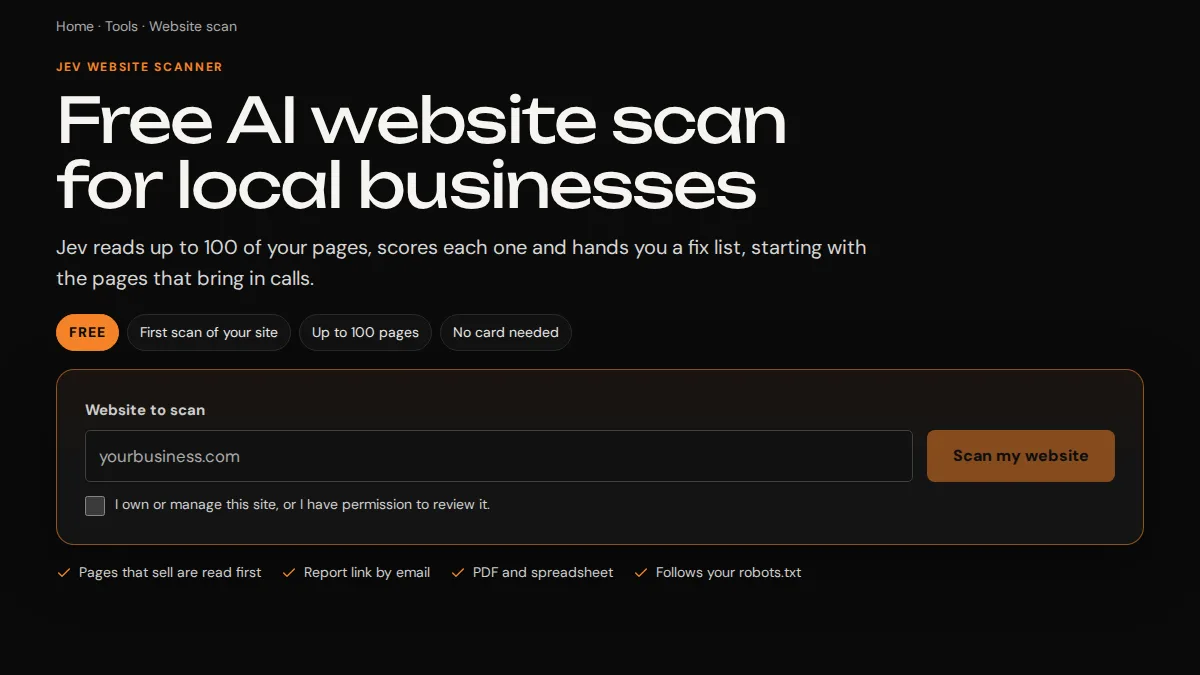
Specialty retail work is priced after the free strategy call, because a shop with one showroom and a shop shipping across the country need different builds. To see where your site stands before that, the free Jev scan reads up to 100 pages and emails you the report. The $99 full audit goes further and scores as many as three competitors you choose.
Can this work for a store that primarily sells in person?
Yes, and many in-person shops should skip checkout at first. Give each guide a button to ask about an item, reserve it or book a fitting, and say who answers and when. The shopper then walks in expecting the person they messaged.
Should we publish every product before starting?
Not necessarily. A focused category with accurate products and a clear buying route can be a sensible first scope. A complete catalog is useful only when the store can maintain its data and the additional pages help customers make decisions.
Can you create product comparisons?
Yes, using current specifications and meaningful criteria. We identify the source of factual attributes and distinguish them from the store's advice. A comparison should help shoppers assess fit rather than claim one item is best for everyone.
Do you guarantee local rankings or AI recommendations?
No. We can improve the information, technical presentation, and measurement within the agreed scope. Search engines and AI systems control their results. We report observed activity and supported outcomes, with the limits of the available data.
What should a retailer bring to the first conversation?
Bring the website, a few important categories, common customer questions, and the systems used for inventory and sales. Examples of current promotions and store photography are useful. We can then identify the smallest complete journey worth improving.
How can a specialty shop compete with online marketplaces?
Publish the advice your staff already give at the counter, like which running shoe suits a flat foot, because a marketplace listing can't answer that. Put a way to act right beside the advice, such as booking time with the person who wrote it. A shopper who learned something useful on your page has a real reason to buy from you.
Should we sell online or focus on store visits?
Start with whatever your stock data can support. If your register system can't show live inventory, a reserve for pickup button is more honest than a cart that oversells. Once counts stay accurate for a few months, online checkout for repeat items is a small step, and products that need a fitting can stay booking only.
What goes into a buying guide page?
A good buying guide opens with who it's for, then compares the few options your staff actually steer people between, with prices and the reason each one fits a certain shopper. It carries the name of the staff member whose advice it holds and ends with a button to book time. We interview that person and write it up in their voice.
How long before we see more shoppers?
There's no honest fixed timeline, because search results also depend on things like your reviews and links from other sites. Watch the profile's website clicks and direction requests month by month against the same month last year. Give a buying guide at least a full season before you judge it, since people research some purchases months ahead.
Do we need to be on Mass Ave or in Indianapolis to work with Trojan Digital Marketing?
No. We're based in Indianapolis, our Indiana service area reaches Westfield, Noblesville, Avon and Plainfield, and shops in other states work with us remotely. The Mass Ave details on this page are public facts from our own research, dated so they can be rechecked, and they aren't client work. A shop elsewhere brings its own district's details, and those get checked the same way.
Can we see what Trojan Digital Marketing's clients say?
Yes, our Google reviews are public, and Heather Doan's opens with “I had a great experience working with Jeff.” That review isn't presented here as specialty retail work, and this page names no retail clients. What you can check for yourself is our founding in March 2018 and Jeff's web and brand work going back to 2016.
“…drove a noticeable uptick in leads within just a few weeks…”
“I had a great experience working with Jeff…”
Jeff Clerisier founded Trojan Digital Marketing in March 2018.
Based in Indianapolis, we serve businesses across central Indiana, including Carmel, Fishers, Zionsville, Westfield, Noblesville, Greenwood, Avon and Plainfield.
We also work with clients across the United States.
A PRACTICAL MARKETING WORKSHOPTurn product browsing into a reason to choose your store
Open this walkthroughClose this walkthrough
Specialty retailers need to explain what their selection and service add to the purchase. A visitor may be comparing products, seeking knowledgeable help, checking a particular item, or planning a visit. We would organize the website around those tasks and the store’s actual offer. Product collections should do more than repeat manufacturer descriptions; they can show how the store curates a category and what customers should bring to a useful conversation.
Worked example · hypothetical planning scenario
Imagine a hypothetical specialty retailer known for helping customers choose among several product lines. Its website is a manufacturer logo wall with no explanation of the store’s role. We would build a comparison guide around approved distinctions, representative products, and the questions staff ask before recommending options. A “Prepare for your visit” feature could let a shopper save the categories or questions they want to discuss. Exact item availability would be confirmed through the actual inventory or staff process. A separate service page would explain demonstrations, appointments, customization, or other offerings only where they exist. The business can record product questions, appointment requests, store direction actions, and verified purchases as different observations rather than claim every guide view generated a sale.
| Shopper stage | Store specific material | Useful next action |
|---|---|---|
| Comparing a category | Approved selection guide and staff perspective | Explore the differences that matter to the purchase |
| Looking for an exact item | Verified product reference and availability route | Check current availability |
| Seeking in person help | Actual service and visit information | Prepare questions or request an offered appointment |
Collect the knowledge already on the sales floor
- Ask staff which product distinctions change a customer’s decision and which common questions can be answered accurately in a public guide.
- Use actual store and selection photographs, with current availability separated from representative imagery.
- Document services the store provides beyond the product itself and explain the real process for using them.
- Identify which content is supplied by a manufacturer and which reflects the store’s own verified experience or assortment decisions.
Build one guide your staff would use
Bring a product category with recurring customer questions and explain your store’s approach to helping people choose. Trojan Digital Marketing can turn that expertise into a useful comparison page and a clearer path to the next shopping conversation.
What should a Mass Ave shop's website say about the district?
A specialty shop on Mass Ave in Indianapolis can hand shoppers details they're able to check, from the district's history to how street parking works.
Mass Ave, Indianapolis, Indiana
Mass Ave's arts district runs 0.86 miles, from New York and Delaware streets up to Bellefontaine Street. The avenue is one of four diagonals in Alexander Ralston's 1821 city plan.
A strip under a mile long suits directions by cross street, so a shop page can name the nearest one.
Wikipedia, Mass Ave Cultural Arts DistrictChecked September 25, 2026The National Register of Historic Places listed Mass Ave's 300 through 900 blocks in December 1982. A 2006 preservation plan covers both Chatham-Arch and Mass Ave, since the 600 and 700 blocks fall in each.
A shop planning new exterior signs can read the preservation plan before a campaign depends on them.
Historic Indianapolis, Indianapolis Collected: Bringing the masses to Mass AveChecked September 25, 2026Eleven merchants banded together in 1909 to lobby for street lights, the start of the Mass Ave Merchants Association. It's now a 501(c)(6) nonprofit working for its members' business interests in the district.
A member shop can link its association listing from its About page, which gives shoppers a local tie they can check.
Downtown Indy, Mass Ave Merchants Association (MAMA)Checked September 25, 2026The Mass Ave Cultural Arts District, a 501(c)(3) nonprofit that markets the avenue as '45 Degrees from Ordinary', offers business memberships to merchants, arts groups, property managers and other businesses in the district.
A member's hours and address in the district listing should match its own website and Google Business Profile.
Mass Ave Cultural Arts District, Join and SupportChecked September 25, 2026ParkIndy raised on-street meters in the downtown core, along Massachusetts Avenue and in Broad Ripple to 2 dollars an hour on February 1, 2025. At that change, meters ran Monday through Saturday, 7 am to 11 pm, and were free on Sundays and select holidays.
A visit page can mention metered street parking and the Sunday exception, with a date so staff know when to recheck it.
Indianapolis Business Journal, ParkIndy to increase hourly rates at meters downtown, in Broad RippleChecked September 25, 2026
Public district facts from our research, checked September 25, 2026. Meter rates change, so recheck before publishing. No Mass Ave clients are named or implied.
Which purchase route fits each kind of product?
Each kind of product an Indianapolis specialty store sells needs its own route to purchase, and for some items a booked fitting works better than a cart.
| Product type | First route to offer | What the page shows |
|---|---|---|
| Needs fitting or sizing | Book time with a staff member | How long a fitting takes and what to bring |
| Shoppers compare a few close models | A buying guide with staff picks | Who each model suits and what it costs |
| Repeat purchase of a known item | Reserve for pickup, or buy online once stock data is reliable | Size, a stock note and pickup hours |
| Special order or hard to find | An ask about this item form | Your usual order wait and how you'll reply |
How does a staff conversation become a buying guide?
We turn one recorded conversation with your staff into a buying guide for your Indianapolis specialty shop, and the person whose advice it holds reviews it first.
- Pick a question shoppers ask weeklyChoose one your staff answer at least once a week, like which of two popular models suits a beginner.
- Record the answer as staff give itA short call or voice memo captures the reasons and the exceptions in the words staff use with shoppers.
- Write the guide in that voiceWe draft the page with the staff member's name on it, their picks, current prices and a booking button.
- Staff check every claimThe person quoted reads the draft and fixes anything they wouldn't say across the counter.
- Link it from the product pagesWe link each product the guide mentions back to it, so a shopper browsing one model finds the comparison.
Start with the decision your shopper is making
A gift buyer may be choosing by occasion, recipient, and budget. An experienced hobbyist may care about compatibility, dimensions, or replacement parts. A home goods shopper may want to compare materials in person. These visitors can arrive at the same store while needing very different information.
We review sales floor questions, existing site search terms, product inquiries, and the store's most important categories. The objective is to identify the decisions that your team regularly helps customers make. Those decisions can guide navigation, category pages, comparison content, and calls to action.
For a hypothetical gift retailer, an occasion guide might help a visitor narrow the selection and then show current options. For a specialty equipment shop, a compatibility explanation may be more valuable. Neither example implies that we have performed that specific client work; each illustrates how the service scope changes with the buying task.
| Buying task | Useful page content | Appropriate next step |
|---|---|---|
| Choose by occasion | Relevant options, practical differences, and current terms | Browse a focused collection |
| Check product fit | Verified specifications and compatibility information | Confirm an exact item or ask a product question |
| Evaluate in person | Store location, display availability, and appointment process if offered | Plan a visit or request an appointment |
| Buy a known item | Exact product, price, availability, and fulfillment details | Purchase or confirm the store's ordering route |
Explain why this selection belongs in your store
A specialty retailer can add useful context that a manufacturer description does not provide. Why does the store carry this category? What differences do staff explain most often? Which accessories or services genuinely belong with the purchase? A thoughtful page can answer those questions without making exaggerated claims about the product.
Read more
We can interview staff and turn their approved knowledge into category introductions, buying guides, comparison tables, and concise product notes. Facts such as size, material, model compatibility, warranty terms, or care instructions need a current source. Opinions should be identifiable as the store's perspective and explained through concrete criteria.
A comparison should help the customer see tradeoffs. For example, two products may differ in dimensions, finish, included accessories, or intended use. A useful table lists the same attributes for each and leaves unknown information clearly unresolved. It should not declare a universal winner when suitability depends on the buyer's circumstances.
We also avoid creating a long collection page for an assortment the store does not maintain. A small, accurate guide can be more useful than a broad catalog built around popular terms that lead to unavailable products.
Make product data support the promise
Product name, variant, size, price, availability, and fulfillment information should refer to the same item. A photo of one version paired with the description of another creates avoidable confusion. We review the source of these fields before recommending a catalog expansion or advertising feed.
Read more
If the store sells online, we can assess the route from category to product to checkout, including pickup or shipping information where offered. If the store sells primarily in person, the site can help shoppers identify an item and contact the team. The button should describe that actual action rather than imply an online purchase or reservation that the store cannot fulfill.
Google's local product listings guidance describes options for eligible retailers to show in store product information. A feed is worth considering when the store has suitable data and a workable maintenance process. It is not a substitute for accurate inventory or a promise that every product will appear in search.
For a manually maintained site, we can state that a category reflects the usual selection and provide an exact item inquiry. For connected inventory, we define which system is authoritative and how errors are corrected. The customer facing language should match the freshness of the underlying information.
Connect local discovery with a worthwhile visit
- Business
- Start from the real business.
- Coverage
- Identify the places it actually serves.
- Office
- Do not turn a service area into an invented office.
A specialty store page should give the visitor enough practical detail to decide whether a trip makes sense. Include the verified store location, hours, entrance or parking information where useful, and which services operate at that location. If a consultation requires an appointment, explain how to request one and what the visitor should bring.
Read more
Google identifies accurate business information as part of local discovery. We can review the details your team controls and establish a process for operating changes. We do not create fictional branches or imply a local office where the business does not have one.
Store photographs can show the entrance, relevant displays, and the scale of products people may want to see. A clear directions link should work immediately; an interactive map can load on request. This keeps a useful visit aid from becoming a heavy obstacle on a mobile page.
Local content should have a real connection to the store. A page about a genuine event, service, or location is useful. A set of nearly identical town pages with no distinct offering gives shoppers little help in choosing a visit.
Use SEO, AEO, and GEO to answer buying questions
Search engine optimization supports discoverable category and product pages. Answer engine optimization helps the store respond clearly to practical buying questions. Generative engine optimization adds attention to consistent identity and evidence that an AI system can interpret. These approaches should improve the information a shopper receives, not add a layer of artificial language to every paragraph.
Read more
We connect a focused buying guide to the relevant collection, the collection to specific products, and those products to the available purchase or inquiry route. Staff explanations can add original value when they are accurate and useful. Source backed specifications should remain distinguishable from editorial advice.
Our search service can support that structure. The AI search evidence guide explains how to distinguish discoverability work from claims about actual AI exposure. We do not promise placement in an answer, a particular ranking, or sales that have not been measured.
Carry a recognizable store identity across touchpoints
The website, store signs, event materials, and campaign creative should feel connected while serving their own purposes. A window display needs a clear message from a distance. A product page needs detail. A social post may introduce a collection and direct interested shoppers to the maintained page with current terms.
Read more
We can plan original photography around the actual store, products, displays, and services. Supplier assets can be included when the merchant has the appropriate usage rights and the images match current products. A campaign should not suggest a collection is exclusive, locally made, or handmade unless the store can support that description.
The Georgetown Market project is a documented example of in store signs Jeff designed as the store's marketing director. It shows a relevant design capability, while remaining a grocery signage case with no published sales or search growth evidence. Any specialty retail proposal should be assessed against its own deliverables and evidence.
Scope the work around the store's buying cycle
A retailer with quick repeat purchases needs a different publishing rhythm from one whose customers spend weeks considering a purchase. We start with the buying decision, the available product information, and the staff capacity to respond. The proposal can then combine the services that support that particular route.
- A shopper question map identifying the most useful category, product, and visit pages.
- A product data review that records authoritative fields and recurring inconsistencies.
- Category pages or buying guides built around concrete selection criteria.
- A mobile purchase, appointment, or product inquiry journey matched to store operations.
- A local information review and a process for keeping hours and services accurate.
- A photography and creative plan for the agreed digital and in store materials.
- Measurement definitions that separate interest, assisted sales, and completed purchases.
Website implementation can be scoped through our website design service. Ongoing content distribution can be discussed through social media management. We specify which tasks are included and which facts remain with the retailer.
An illustrative first 90 days for one important category
This sequence is a planning example. It does not promise completion dates or commercial results. A project involving a large product feed, checkout migration, or several locations may require a different schedule.
Days 1 to 30: understand the decision and the data
Select a category where the store has a real strength and customers need help deciding. Interview the people who answer product questions. Review the available specifications, imagery, inventory source, and current page journey. Agree on the primary next action and record the baseline data available without inventing missing attribution.
Days 31 to 60: build a useful category experience
Prepare the category page and one supporting comparison or buying guide. Resolve the important product data differences and confirm the store's service and fulfillment language. Test the journey on a phone, including inquiry routing or checkout. Coordinate any campaign or in store material around the same approved facts.
Days 61 to 90: review what shoppers still need
Study the product questions, category engagement, and completed actions actually recorded. Ask staff which explanations have become easier and which misunderstandings remain. Review whether the page attracts the intended customer need. Improve one decision point, then determine whether the approach should extend to another category or a different stage of the buying cycle.
Keep assisted buying visible in the reporting
Some retail purchases happen online; others follow a phone call, a store visit, or several conversations. We define website purchases, product inquiries, appointment requests, directions actions, and campaign redemptions separately. A contact action should not be labeled as revenue simply because it preceded a possible sale.
Read more
When the store can supply reliable aggregate transaction records, we can review them alongside digital activity. Any comparison needs context: assortment changes, promotions, stockouts, seasonal demand, and service capacity can influence results. A before and after movement alone does not establish that one website change caused it.
Useful operational measures include fewer incompatible item inquiries, clearer appointment requests, complete product fields, and quicker corrections to stale offers. These measures help the store improve the customer experience while a longer buying cycle develops.
Help shoppers understand the value of your selection
Contact Trojan Digital Marketing to discuss your store's buying journey, or request a free website audit. We will connect the proposed content, design, and measurement to a real customer decision and a service your team can deliver.
Related projects


Sources & further reading
Talk with Trojan Digital Marketing
Based in Indianapolis, we serve central Indiana and clients across the United States.