Questions, answered.
What is the smallest owned roofing purchase?
The published range begins at 100 websites. Using Tier 1, that selection totals 11,900 dollars for year one and 6,500 dollars for each later annual renewal. Jeff reviews whether the requested roofing allocation and content support that purchase before you agree to it.
Does exclusive mean the customer can't call another roofer?
Garrison's commitment concerns the assigned roofing market and where its inquiries are sent. We don't resell that allocated contact to competing contractors. A customer remains free to approach another company themselves. Confirm the named market and receiving business in your agreement so the commitment is clear.
Is a qualified roofing contact the same as a sold job?
A membership qualification requires an eligible homeowner or property-owner request within your area for an accepted service. Calls must exceed 60 seconds; eligible submitted forms also count. That definition doesn't establish a sale. The owned purchase includes generated inquiries without charging another fee when a contact qualifies.
Who handles calls our staff can't answer?
Your business needs an approved receiving route and a person responsible for missed contacts. An owned website purchase doesn't automatically provide an answering service. We discuss routing, but your staff's callback policy and availability need their own approval. Public wording should match what your roofing team can actually do.
What survives if we stop the annual managed plan?
The domains remain your company's property, and the published terms keep the websites live there. Managed updates stop, and paying the registrar becomes your responsibility. Hosting and access arrangements are documented before signing. Examine those details while choosing the offer, including who will receive future renewal messages.
When does the 8,000 dollar transfer option apply?
That optional package covers moving the live network and licensing the software that creates and updates it. It has a separate documented migration scope. Transferring domain registrations to a new registrar doesn't require buying the package. Any charges from the receiving registrar are separate from that platform option.
Could a roofing membership be a better starting purchase?
It can be if you prefer paying for an allocated Trojan-owned network. The 50-site monthly plan is 399 dollars with all qualified leads included. Its annual alternative starts at 800 dollars, includes five qualified leads and charges 125 dollars for additional qualified roofing contacts. Ownership uses a different price model.
Is an annual membership shortfall paid back in cash?
The current annual offer applies a credit to the next renewal. Each missing included lead uses your locked additional-lead rate, and the total credit can't exceed the renewal charge. It carries no cash value. Monthly membership has no included-lead allowance to exhaust, so this credit rule belongs to the annual option.
Does the Tampa page confirm my territory is available?
We still need to check the requested allocation and the places your roofing company serves. Give Jeff the actual list, including any requested Brandon coverage. A sample city label doesn't reserve it. Roofing networks are offered in eligible areas outside Indiana, with the final trade and market recorded in your agreement.
Is Trojan a Tampa roofing company?
Trojan provides the marketing websites and related planning described here. The contractor whose brand receives the inquiries supplies the roofing services. We're based in Indianapolis and aren't claiming a Tampa office, Tampa roofing crew or local project history through this page.
Will we get a guaranteed ranking or launch date?
The offer doesn't promise a search position or booked roofing volume. Launch timing depends on the work and approvals agreed for your purchase. Discuss that schedule with Jeff before committing. We haven't published a standard Tampa launch deadline or a date when the network will recover its cost.
What should we check on a network site before launch?
Read the receiving company's name beside its contact choices, then test whether the phone and form routes reach the approved destination. Examine the site on a phone. We also need your approval of service claims and photo permissions, with an agreed process for later corrections.
Buy a roofing lead asset with the ownership terms in view.
Open this walkthroughClose this walkthrough
You can purchase a Garrison roofing website network for Tampa, Florida, with domains registered to your company and inquiries delivered to your staff. Our owned plans cover 100 to 1,000 sites, with every generated inquiry included.
| Choice | Sites and payment | Rights and inquiries |
|---|---|---|
| Owned Tier 1 | 100 sites: initial total 11,900 dollars. Yearly renewal: 6,500 dollars. | Your business holds the domains. All generated inquiries included. |
| Monthly membership | 50 sites: 399 dollars each month. | Trojan-held network; every qualified roofing lead included. |
| Annual membership | 50 sites: 800 dollars initially; 600 dollars per yearly renewal. | Trojan-held network; five included qualified leads. Extra qualified roofing contacts cost 125 dollars each. |
We first check your roofing offer, the places you can serve and whether the requested market is available. Roofing networks are offered in eligible markets outside Indiana. Naming Tampa on this page doesn't reserve a territory or promise a quantity of work. Your agreement needs the actual allocation before you pay.
Discuss my Tampa roofing territory
The opening strategy conversation is free. During our business hours, we aim to answer your request within five minutes. Bring your working service area and ask Jeff which ownership terms fit it. Across our company, we have over fourteen hundred websites live. That experience isn't a count of Tampa roofing customers.
What our early roofing record taught us to watch.
Open this walkthroughClose this walkthrough
Our Indiana residential roofing record attributes 11 inquiries to the original 200 websites. The count excludes 88 later additions to the network. The reporting window begins June 29, 2026 and ends August 31, 2026. It counts calls and submitted forms, leaving missed calls out. Qualification, booked work and revenue aren't established by those figures.
That experience is why we inspect search activity town by town. When a town remains quiet, our operating approach is to rebuild or replace it. We don't apply the Indiana inquiry count to Tampa. Ask Jeff how the agreed locations will be evaluated. Inspect the dated Garrison ownership proof and roofing network overview before choosing an assumption for your own purchase.
What are you buying when you choose ownership?
Open this walkthroughClose this walkthrough
A named business behind the sites
The network introduces your roofing company. People need to know whose services they're reading about and who will receive their details. We don't propose websites that pose as unrelated local roofers. Your approved business identity should appear in the relevant contact information, service descriptions and disclosures. That identity stays important even when a site answers a very narrow customer question.
Domain registration you can retain
In the owned model, the business holding the domain registration is yours. Before signing, ask how you'll check that registration and who can make registrar changes. Our published terms distinguish keeping those domains from buying the software that generates the whole network. A domain transfer and a platform migration have different work behind them, so the agreement should price them separately.
Direct access to the incoming request
Your staff receive the network's calls and forms. We can organize the marketing destination around your actual service choices, but your company still decides which jobs to quote. A request may need clarification, and a customer may choose somebody else. Buying the asset includes its inquiries; it doesn't turn a visitor into a signed roofing contract.
An operating cost after the build
Owned sites still need domain renewal and maintenance. The annual plan pays for that managed work and the agreed content updates. We want you to examine those costs alongside your main company website and existing lead sources. Choose ownership when its control and ongoing responsibilities fit your business, rather than treating a site count as a sales forecast.
If you're comparing a single Tampa microsite with a larger purchase, our existing Tampa roofing microsite page explains the focused-site approach. This page deals with buying and retaining the network. We can discuss whether improving your established website should come first.
Choose the roofing work your team actually wants to quote.
Open this walkthroughClose this walkthrough
A Tampa, Florida buying discussion should start with your crews and accepted jobs. We wouldn't assign the same intake questions to a homeowner's replacement request and a commercial budget review. Tell us which services are active, who approves each service description and which requests you routinely decline. The network can then make those boundaries easy for a customer to understand.
Homeowner replacement discussions
A homeowner might want an assessment before deciding whether replacement is appropriate. We would ask your company how it handles that first conversation and what the customer should have ready. Copy should describe the inspection or estimate you genuinely provide. Avoid having the form decide the roof's condition or telling the visitor that every concern requires a replacement.
Repair requests
If repairs are part of your current offer, give them a clear route. A caller should be able to say what they've noticed without selecting a diagnosis. Our page questions can help distinguish a request for a repair discussion from a request for replacement pricing. Your qualified roofing staff make the technical judgment and explain what happens after contact.
Commercial planning inquiries
For a commercial service you accept, we would separate the building contact, the proposed work and any access arrangements your team needs. A facilities manager's planning question can require a different follow up from a homeowner's first estimate. Keep technical claims tied to your approved offer. We're selling marketing websites, and your roofing company remains responsible for its trade work.
Requests after reported weather damage
If somebody mentions a weather event, retain the customer's description and let your team assess the request. We won't label damage, coverage or an insurance outcome from a marketing form. Your published response hours must match your operation. An after-hours contact option shouldn't imply a staffed emergency service unless you have approved and can deliver that service.
Keep an inquiry, a qualified lead and a booked job separate.
Open this walkthroughClose this walkthrough
An owned network includes the inquiries it produces. There's no additional lead invoice to trigger when a call passes a threshold. You should still classify those requests so you can judge the purchase. Our membership rules offer a specific comparison: the qualifying contact must concern a service you sell, come from a homeowner or property owner and fall inside your service area.
| Record | What it tells you | What to confirm next |
|---|---|---|
| Incoming call or form | A person contacted the business through the network. | Can your staff identify the requested work and reach the person? |
| Qualified membership lead | An eligible call lasts longer than 60 seconds, or an eligible homeowner or property-owner form asks about your service. | Check area and service fit against the actual membership agreement. |
| Estimate discussion | Your team has agreed on a possible next roofing step. | Record who will follow up and whether an appointment is confirmed. |
| Won roofing job | Your own sales record confirms accepted work. | Connect it to the original inquiry without assuming every call became revenue. |
Our additional membership lead charges follow manual checks against that definition. A vendor's pitch or somebody looking for employment doesn't satisfy it. For owned sites, even an unsuitable inquiry remains something your staff can inspect. We would track unsuitable contacts as a quality issue rather than describe them as sales.
Agree how to handle repeat contacts and unclear records before comparing suppliers. The network price doesn't supply a definition of a profitable job. That judgment comes from your costs and the work your company completed.
See the full owned-network price before selecting a tier.
Open this walkthroughClose this walkthrough
These are our published September 2026 owned terms, checked against the current price model on October 1, 2026. Amounts are in US dollars. Each tier uses a separate setup amount, first-year site charge and annual renewal charge. We would confirm the selected tier, final site count and payment schedule with you before an agreement becomes a purchase.
| Plan | Setup, once | Year one, each site | Year two onward, each site yearly | New blogs per site yearly |
|---|---|---|---|---|
| Tier 1 | 3,900 dollars | 80 dollars | 65 dollars | No recurring blog allowance |
| Tier 2 | 5,000 dollars | 100 dollars | 75 dollars | 12 |
| Tier 3 | 5,000 dollars | 110 dollars | 85 dollars | 24 |
| Tier 4 | 6,000 dollars | 120 dollars | 95 dollars | 48 |
The minimum Tier 1 example
At 100 sites, multiply 80 dollars by 100 and add the 3,900 dollar setup. The first-year amount is 11,900 dollars. Renewal for that same 100-site Tier 1 selection is 6,500 dollars yearly. This is a calculation of the published network price. It doesn't represent a Tampa lead estimate or a promise that the minimum size suits your territory.
A larger Tier 1 example
At 200 sites, the first-year total is 19,900 dollars: 16,000 dollars for the sites plus setup of 3,900 dollars. The subsequent annual amount is 13,000 dollars. We include every inquiry from that owned network. Your company's sales costs and any advertising spend still need their own place in the budget.
All four tiers fund domain renewal, ongoing maintenance and updates to core pages. The blog column describes the recurring article allowance for each site. Our central owned-network price page lets you inspect the broader offer. If another document shows different prices, ask us to resolve the difference against your selected agreement before paying.
Buy the article allowance your business can support.
Open this walkthroughClose this walkthrough
Tier 1 can suit a company that wants its existing service information kept current without a recurring blog allowance. Higher tiers fund new articles. More publishing carries a responsibility: somebody needs to approve roofing facts and correct a changed offer. We should discuss your source material and approval capacity before recommending an article quantity.
What would a residential article need from our company?
We would ask which customer question the article should answer and what your team can accurately say about it. Your accepted materials, estimate approach or approved project photos may supply the substance. A marketing writer shouldn't invent how your crews work. Once you approve a service fact, identify who will tell us when it changes.
How would commercial topics stay relevant?
Start with a question your commercial customers actually bring to you. Perhaps they need to know what information supports an initial planning conversation. We would describe your accepted process without inventing building-specific requirements. Avoid turning a general article into a diagnosis or implying that a pictured building belongs to one of your Tampa clients.
A topic can become inaccurate even when its wording still sounds polished. We would want corrections to pricing, product availability or contact details to reach the affected pages. Your staff should know how to flag a correction and who approves the replacement. Publishing a larger allowance doesn't remove that obligation.
Agree on access while everybody is still at the table.
Open this walkthroughClose this walkthrough
Domain ownership is easiest to understand when you can name the business on the registration and the people allowed to manage it. Before purchase, we would walk through that access with your designated contact. Ask how a lost login or departing staff member is handled. An owner should be able to retrieve the account without relying on somebody's personal inbox forever.
- Name the registrant. Confirm the company whose registration holds each domain. Keep that distinct from the agency contact helping manage the account.
- Identify the account contact. Decide which company-controlled email receives renewal and access messages. Your internal security process should govern who can change it.
- Separate content permissions. Record the rights attached to approved text and supplied photographs. Ask how you'll obtain the agreed content if management changes.
- Locate the inquiry destinations. Check the inboxes and phone routes that actually receive contacts. A website login isn't the same as access to the inquiry history.
- Resolve the hosting arrangement. Discuss where the live sites remain and what must happen if you choose another provider. Our contract should identify that handoff before you need it.
Keep passwords and customer details out of this purchase conversation. We don't need a confidential account password inside a first inquiry. Give Jeff the business contact who can discuss access, then use an agreed secure process for any later account work.
Our software has separate licensing terms from the domain registrations. The optional full platform move costs 8,000 dollars and covers migration of the live network with its generating and updating software. Your agreement documents the platform, license and migration work. Moving a domain to a different registrar doesn't require buying that whole package, although the registrar may have its own fees.
Know what continues when managed renewal ends.
Open this walkthroughClose this walkthrough
Under our published owned terms, your company keeps its domains when it stops renewing the managed service. The sites remain live on those domains. What stops is Trojan's managed work, including fresh articles, pricing and FAQ updates, and paying for your domain renewals. You then handle registrar renewal yourself. We document the hosting and handoff arrangements before signing.
That's a reason to plan the transition while your contact records are organized. Ask who receives the domain expiry messages and which company account pays the next registrar bill. A domain can be yours while an unattended renewal still creates an operational problem. Your own company needs somebody responsible for that future expense.
Does stopping management include the generator software?
The standard owned arrangement and the optional full platform migration have separate terms. Keeping your domain registration doesn't automatically transfer the generation software. If moving that system is important, discuss its 8,000 dollar transfer and licensing option up front. We should resolve what you'll receive and where it will run before you choose that option.
Can we change registrars without migrating the whole system?
Our published offer allows you to move your domains separately from the full platform package. The receiving registrar can charge transfer or renewal fees. Work through the affected domains, contacts and hosting dependencies with us before making changes. Confirm the arrangements that keep the agreed sites reachable during that handoff.
If your company's main reason to buy is independence, take time with these distinctions. We'd rather discuss an exit scenario during the purchase conversation than leave you to infer it from an ownership headline. Renewal, hosting and software rights should all have an understandable answer in the final agreement.
A membership is a separate way to buy direct roofing inquiries.
Open this walkthroughClose this walkthrough
You may want to try the network service without buying the domains. Our Garrison memberships use a Trojan-owned network allocated to your company for the agreed trade and market. They offer monthly or annual pay-per-lead pricing. The customer's inquiry still goes to your staff. Domain ownership is the material difference when you compare that arrangement with this page's owned purchase.
| Option | Fixed price | Lead treatment | Continuation |
|---|---|---|---|
| Monthly membership | 399 dollars each month | All qualified leads are included; no extra per-lead bill. | The initial 90-day proving period is billed monthly. Afterward, you continue monthly and can stop by giving 30 days notice. |
| Annual pay-per-lead membership | 800 dollars for year one; 600 dollars at yearly renewal. | Five qualified leads are included in each membership year. Each additional qualified roofing lead is 125 dollars. | Additional leads are checked and invoiced monthly in arrears. The allowance starts again with the next annual renewal. The plan runs a year at a time. Follow your agreement's notice terms if you choose not to renew. |
The annual option keeps your additional lead rate fixed while renewals continue without a gap. If an included lead is missing at year end, its value becomes a credit against the following renewal. The credit uses your locked lead rate, can't exceed the renewal price and has no cash value. For that entry roofing plan, one missing included lead produces a 125 dollar renewal credit.
Our monthly option doesn't need a lead allowance or shortfall credit because it includes the qualified leads the network generates. Both membership choices still require territory review and an actual agreement. Neither offers a guaranteed roofing job count. Look at the roofing membership offer and complete membership prices if lower initial spending matters more to you than owning the domains. Our provider comparison explains the different published fee models.
Exclusivity needs a named trade and a named market.
Open this walkthroughClose this walkthrough
Within our network, one contractor receives the agreed trade-and-market allocation. Those inquiries are routed to that contractor rather than resold by Garrison to competitors. A homeowner can still independently call another roofer. We want the agreement to make that distinction clear so you can evaluate the actual commitment without expecting control over somebody else's shopping choices.
The useful territory question is whether the allocation matches where you can send crews and perform the work. Saying that you serve Tampa may be enough for an opening conversation. It isn't enough for a final market list. We'd discuss your actual coverage and record the accepted locations in the agreement.
Ask about the requested market
Tell us which roofing service the allocation covers. Ask whether that market is currently available and how adjacent allocations are defined. We won't treat a page visit or an inquiry as a reservation. Get the agreed answer before choosing the network size.
Check the receiving company
Make sure the branded sites and receiving phone or inbox identify the business doing the work. If you have separate brands, clarify which one holds the allocation. Our routing should follow the approved arrangement instead of changing identity at the point of contact.
Discuss later changes
A new service area or a changed roofing offer can affect the allocation. Ask what approval is needed to update it and how your public pages will be corrected. Expanding a domain list doesn't itself extend an exclusive territory.
We offer roofing networks outside Indiana in eligible agreed markets. Tampa, Florida is the subject of this purchase page, but we still need to check your requested allocation. Don't take a sample location or a diagram on another page as evidence that a market has been held for your company.
Decide who follows up when your roofer misses the call.
Open this walkthroughClose this walkthrough
A direct phone route is valuable only if somebody owns its follow up. Your crew might be on a roof when an inquiry arrives. We would ask which number should receive that call and what the customer hears if nobody answers. The answer belongs to your business process; a marketing page shouldn't invent a staffed desk or a round-the-clock promise.
- Select the real destination. Use the phone route your company can support. Verify it with the person responsible for taking roofing inquiries before it appears across the network.
- Choose a missed-call owner. A named staff role should inspect the call record and decide whether a return call is needed. Identify a substitute when that person is unavailable.
- Set honest public wording. State response expectations your company has approved. Trojan's five-minute business-hours reply aim covers our strategy inquiries. Your roofing office approves its own inspection response wording.
- Keep the outcome. Record an answered call, a callback attempt and a confirmed next step separately. That lets your company spot a routing fault without recording every contact as a sale.
We can discuss the marketing route and the handoff that your staff need. This network purchase doesn't automatically include a receptionist, an answering service or a new phone provider. If you want a different intake arrangement, agree its scope and costs separately. Don't buy a website tier on the assumption that somebody else will answer its calls.
For the membership comparison, call duration is part of the published qualification rule, alongside service and area fit. An unanswered ring isn't a completed roof job. For the owned plan, there is no extra lead fee for a contact that passes that test. Your company should still investigate missed opportunities when evaluating the network's practical value.
A roofing form should hand your staff enough to act.
Open this walkthroughClose this walkthrough
Start with the information your business uses to respond to a roofing request. We would discuss a reachable contact, project location and a plain description of the work. Don't ask a homeowner to diagnose the roof so they can submit the form. If your team needs further details, the first follow up can establish them.
| Customer input | Reason to ask | Limit to keep |
|---|---|---|
| Their contact details | Your staff need a workable route to respond. | Explain the purpose and avoid collecting unrelated private documents. |
| The project location | Check whether the request falls within the company's accepted area. | Don't display their address in public proof or sales examples. |
| Home or commercial request | Send the contact to a person who understands the offer. | Only show choices for services your company actually provides. |
| The customer's own description | Begin the conversation with what they noticed or want to plan. | Don't treat their words as a confirmed roofing assessment. |
Your receiving inbox needs an owner just as much as the phone route does. Decide who checks submissions and who can spot a delivery failure. We would test representative routes using approved test details, without generating a real roofing request. The confirmation should accurately say whether the submission was received.
Keep customer permissions and access rules explicit. Ownership of the website doesn't authorize every possible reuse of someone's contact information. Use your approved privacy process for storage and follow up. Our purchase conversation can identify the systems involved without putting customer records into a public marketing document.
Give local property questions to the people who can verify them.
Open this walkthroughClose this walkthrough
For a Tampa, Florida network, we would ask your team which property questions should appear before an estimate discussion. A service-area label can't approve a project. Your roofing staff need to confirm the location, accepted work and any requirements relevant to the actual request. We don't publish a permit shortcut or a technical answer that your business hasn't checked.
Questions your company should resolve
Who confirms the property's permit authority? What information does your estimator need? Does the company accept the requested type of work at that address? We would record the approved customer explanation rather than have a marketing writer answer those trade questions.
Questions the network can organize
Which service page should the customer read? Where should their contact be routed? How can they request a conversation without guessing at a roof material or permit status? Our job is to present your answers and make the contact route understandable.
The Census Bureau's 2014 Florida place file lists Tampa and Brandon as separate named places. We checked that archived dataset on October 1, 2026. If your proposed coverage includes Brandon, name it in the purchase conversation instead of assuming a Tampa allocation includes it. This historical record doesn't establish current permit jurisdiction or a roofing-demand forecast.
Inspect the kind of interface work behind our offer.
Open this walkthroughClose this walkthrough

Notice the named Westfield Roofing brand and the contact choices in its opening screen. In your Tampa purchase, we'd ask which business name customers should see before they call. The receiving company and its actual roofing offer need to agree. Your supplied photos should describe your own work, with the permissions needed to show it.
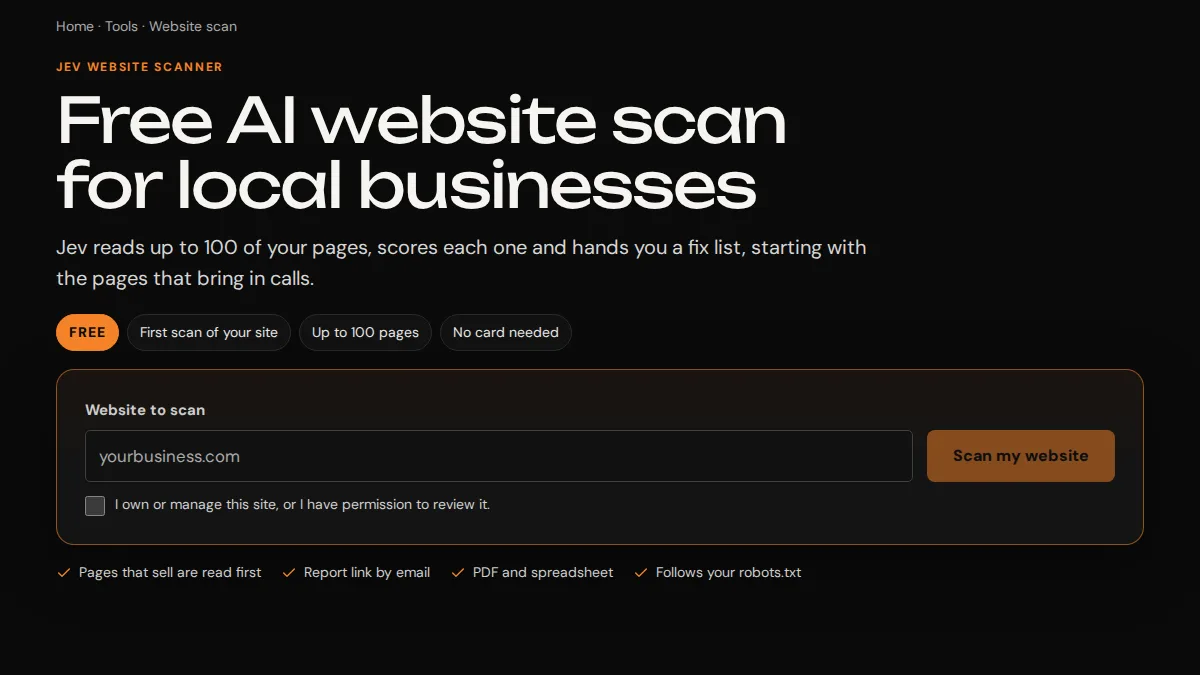
We built Jev to inspect website pages. Its starting form shows exactly which input begins the check. For a maintained roofing network, we want to examine the changed page and its contact action after an update. The annual agreement defines that upkeep. Showing our scanner here doesn't add a scanner subscription or establish Tampa inquiry results.
Buy useful websites without a promised search position.
Open this walkthroughClose this walkthrough
Search visibility can change, and a site isn't owed a ranking because you purchased it. We would discuss the customer purpose of the pages and how your company will measure their use. Ownership lets you retain a defined asset. It doesn't guarantee that Google will index every page or send enough suitable roofing inquiries to fill your schedule.
A local page needs material that belongs to your offer. We can help organize your actual service choices and approved customer answers. Simply repeating the same offer under different place names can leave readers with very little to choose between. We should establish why each destination is worth maintaining before adding it to the network.
Can the owned sites support paid traffic?
We can discuss an advertising use when the landing page and roofing offer fit the campaign. Advertising spend is separate from the published owned-network price. Agree which business controls the ad account and which campaign work is included before buying it. Paid visits and organic discovery should have distinct records so the same outcome isn't credited twice.
Will extra pages guarantee AI-search mentions?
No fixed site count establishes that outcome. Your approved business information can help a visitor understand the company, but search and answer systems decide what to show. We wouldn't promise that purchasing an article allowance secures a citation. Judge improvements using the observations you can actually collect.
We also avoid promising a date when the network will start paying for itself. You can discuss launch work and dependencies with Jeff, then put the agreed schedule in the purchase terms. Search discovery and roofing sales have their own uncertainty after launch. A good marketing plan needs room to respond to actual data.
Compare the cost with your completed work, using your own records.
Open this walkthroughClose this walkthrough
The annual price is known once you've agreed the tier and site count. The cost per suitable inquiry becomes knowable only after the network produces contacts you can classify. We would start by separating spending on the owned network from any ad budget and your internal sales costs. That keeps your evaluation tied to the actual purchase.
- Record the period you're examining. Put the network price and any separate marketing costs beside the dates they cover. Avoid comparing a whole-year fee with somebody else's single-month result.
- Count contact records consistently. Use the same treatment of repeat callers, unsuitable areas and vendor messages each time. Explain any rule change so later comparisons remain understandable.
- Connect estimates to the inquiry. Your sales records should distinguish an estimate request from an appointment that happened. A click on the contact button doesn't settle either outcome.
- Connect completed jobs to costs. Use the revenue and job costs your company can verify. Gross sales alone don't show how much contribution remains after performing the roofing work.
If you want to explore assumptions before buying, our lead cost calculator can help you examine your own figures. Its inputs are scenarios. We won't present a percentage you enter as measured Tampa performance. Bring real records when you want to assess an existing source of leads.
We haven't supplied a Tampa lead-volume history on this page. The project references demonstrate existing interface work, and the price examples calculate the published offer. Neither establishes the future value of your proposed allocation. Keeping that distinction visible makes it easier to decide what you're willing to invest and what you need to observe.
Work through the purchase in an order your company can approve.
Open this walkthroughClose this walkthrough
- Explain the real roofing offer. Tell Jeff whether you want homeowner replacement inquiries, approved repair work, commercial planning or another service you currently accept. Describe who takes the first contact.
- Check the requested allocation. Bring the actual locations you can serve. We review trade-and-market availability before a payment or site count is treated as an agreed territory.
- Select the owned tier. Examine the setup, first-year and renewal amounts together. Decide whether the recurring article allowance has enough approved subject matter behind it.
- Resolve access and handoff. Confirm domain registration, account contacts, content permissions and inquiry destinations. Review what stays live and who handles registrar renewal if management stops.
- Approve the public information. Your company supplies or approves its service claims and relevant photos. We shouldn't launch unconfirmed credentials, hours or project stories simply to fill a page.
- Agree the launch checks. Test the contact routes and examine the experience on a phone. Put the launch schedule and outstanding dependencies into the agreement instead of assuming an automatic date.
Our first conversation can identify whether this model deserves a closer look. It isn't a binding territory allocation or a promise of a finished report. You may decide that membership is the more comfortable starting point, or that your main website needs attention first. We can discuss those choices before you commit to an owned network.
Discuss my Tampa roofing territory
Bring your company website and service-area list. The strategy call is free, and our business-hours reply aim is five minutes.
Sources & further reading
YOUR NEXT MOVE