Need help?Jamie

Market service plans

Brownsburg SEO Strategy for Retail and Service Demand

Your website still describes the business you had years ago, and customers keep asking staff about services and special orders the site never mentions.

Trojan Digital Marketing plans SEO strategy for retail and service businesses in Brownsburg, Indiana, deciding which pages your offers need and which searches each one should answer. Maybe half of what you sell still isn't on the website. Brownsburg's new downtown sits about a quarter mile north of Town Hall, so a page saying only 'downtown' can mislead shoppers.

List the products or services customers ask your staff about that the site never mentions, and bring Search Console access if you have it. The first strategy call is free, and during business hours we aim to reply within five minutes.

  • A page for each offer customers ask staff about
  • Street and landmark named, since downtown moved
  • Search Console queries read against last year

Trojan is owner-run: Jeff Clerisier started it in March 2018. From July 2023 to July 2025 he also ran marketing at Georgetown Market in Indianapolis and worked there as assistant store manager, so a Brownsburg retailer's plan comes from someone who has worked a store floor as well as its website.

Illustrative creative production workspace.
IllustrationSearch snippet preview for “seo brownsburg”A preview built from this page’s title tag and meta description for that search. It isn’t a live search result and shows no ranking.SNIPPET PREVIEWseo brownsburg|Trojan Digital Marketingtrojandigitalmarketing.com › brownsburg-seo…Brownsburg SEO Strategy for Retailand Service DemandSEO strategy for Brownsburg, Indiana shops andservice firms, from Green Street storefrontsto trades: a page for every offer. Book a…

YOUR WORKING BRIEF

Choose where to start

Select the parts you want to discuss. Your choices carry into the inquiry form.

Discuss this service0 priorities selected

SEE HOW THE PIECES CONNECT

Explore the decisions
behind the plan.

THE TROJAN SYSTEMSEARCH
From a useful page to a relevant searchUseful websiteRelevant discoveryCRAWL · UNDERSTAND · CONNECT
  1. Useful website
  2. Crawl and understand the page
  3. Connect it to a relevant search
From a useful page to a relevant search

Trojan Digital Marketing offers Brownsburg SEO strategy for businesses whose website needs to explain more of what they actually provide. A supermarket may offer special orders and prepared food as well as ordinary shopping. A service company may need to distinguish several kinds of project. We review those offers, the customer decisions behind them and the pages already published. The plan then identifies useful content and implementation priorities, without assuming that a larger number of pages is automatically a better website.

Questions about local SEO in Brownsburg, Indiana

How much does an SEO strategy cost for a Brownsburg business?

It's priced after the free strategy call, because a shop with four offers and a trade with a dozen service lines need very different amounts of planning. When the site needs rebuilding too, the $7,997 Marketing Startup Kit includes keyword and content strategy plus twenty SEO blog posts. For a paid look first, the $99 Jev audit scores up to 3,000 pages and up to three competitors you name.

Should a Brownsburg shop's page call its location downtown?

Only with a street and a landmark beside the word. Brownsburg's historic center was at Main and Green streets, while the new downtown went up about a quarter mile north of Town Hall, near North Green Street, where The Arbuckle and Brownsburg Town Center have ground-floor shops. A shopper told 'downtown' could picture either spot, so your page names the block.

We're a contractor. Should our Brownsburg page explain permits?

Yes, if you pull permits for your customers. Brownsburg's Development Services department says the process and forms depend on the job, from a new sign in an existing space to a ground-up build, and applicants register on its online portal. A page saying who applies and what the homeowner handles answers a question buyers have before they call, and we confirm each detail with the town first.

What happens on the free strategy call?

You tell us which offers pay best and which ones customers keep asking staff about, and we open your current pages together. Search Console access helps, since it shows the searches already reaching you. If your business would gain more from fixing its Google profile or its contact form first, you'll hear that on the call, before any SEO work is scoped.

How will we know whether the SEO plan is working?

Each month's Search Console clicks get compared with the same month a year earlier, alongside the calls and forms you actually received. That matters in a town growing as fast as Brownsburg, where the town counts 11,791 households and describes a 27% growth rate, because more residents alone can lift traffic. A page drawing the wrong inquiries gets rewritten first.

Have you done SEO for Brownsburg businesses before?

Not yet. Jeff Clerisier, Trojan's founder, was Georgetown Market's marketing director in Indianapolis from 2023 to 2025, and we designed more than 30 bilingual grocery signs for the store, like SOUPS above SOPAS, in its three brand colors so shoppers find a section at a glance. A retail plan here does that online, giving each offer one clear page. Andrew Montieth of Georgetown Market wrote, 'Sales have been better the last few months thanks to some additional marketing efforts.'

How long before an SEO plan shows up in search?

There's no promised date, because Google decides when rankings move. What's fixed is the order. In the Marketing Startup Kit, keyword and content strategy is locked in week one, before any design, and the twenty blog posts are published in weeks five to eight. From then on, each month's Search Console clicks get read against the same month a year earlier.

Which Brownsburg facts shape an SEO plan for shops and services?

An SEO strategy in Brownsburg, Indiana has to account for a downtown that moved north and a household count that keeps climbing, since both change what buyers type.

We last read these sources on September 25, 2026, and counts like households get updated, so check the town's page before quoting one. Nothing here describes past Trojan work in town.

Which Brownsburg offers deserve a page of their own?

For a Brownsburg, Indiana shop or service company, SEO strategy starts by sorting each offer into its own page or a section of another.

The offerOwn page?What that page has to cover
Special orders a store takes on request
Yes, when customers ask about them often
How to ask and how long confirming usually takes
A service with a Brownsburg permit step
Yes, if you apply on the customer's behalf
Who applies through Development Services and what the customer handles
Store hours and directions
No, they belong on one visit page
The street plus a landmark people already know
A seasonal product or service
Only if it comes back every year
When it runs and how to check it's available

Begin with the offers that deserve attention

We ask the business which services or product categories it wants customers to understand and which it can currently support. Customer questions, staff notes and available search data help define those priorities. Each page receives an audience, purpose and next action. A special order request needs different preparation from a general visit. The content should reflect that distinction so customers can recognize the offer and staff receive a more useful starting point for the conversation.

Use Brownsburg commercial context carefully

Make account access explicitYourbusinessDomainWebsiteAnalyticsRecords
Domain and website
Document ownership and access.
Analytics and records
Define access and the handover.
Make account access explicitDomain, website, analytics and customer records need clear ownership and a workable handover.

The town describes downtown retail and dining around community destinations, including Town Hall Green and Arbuckle Acres Park. Its capital project resources also identify Green Street and the Ronald Reagan corridor. We use these as planning context, not proof of search demand or current access conditions. Your actual location and customer coverage determine where local references belong. A nearby event does not establish an order, partnership or customer relationship for your business.

A proposed supermarket service architecture

Imagine an independent Brownsburg supermarket that offers grocery shopping, prepared food orders and bulk product requests. A proposed SEO structure would explain each actual offer separately. The prepared food page could describe the request process and the information staff needs. The bulk request page could explain how product identification, quantity and availability are reviewed. The store page would focus on verified visit information and departments rather than promising that every pictured item is available.

Read more

A supporting guide could help a customer prepare a group food inquiry, distinguishing an initial request from a confirmed order. Staff would approve statements about menu options, allergens, handling and delivery, and unsupported assurances would be excluded. Original photographs would represent the real store or be clearly described as illustrative. This is a proposed content plan, not a claim about a local supermarket or its sales results.

Review existing content for overlap and missing detail

We inventory the current URLs and available search history, then match each page with a business purpose. A useful page may need deeper explanation rather than replacement. We identify pages repeating the same introduction and questions that are only answered in a hard to find article. The Brownsburg market hub provides the broader service connection, while this strategy defines the underlying architecture. Existing customer facing URLs receive explicit treatment before a redesign or content expansion changes anything.

Build an ordered editorial and implementation brief

Map questions to the right pageQuestionFitProofNextService AService BService C
Service A
Planned coverage: fit and next step.
Service B
Planned coverage: proof and next step.
Service C
Planned coverage: fit and proof.
Map questions to the right pageAn editorial planning example pairs a service with a buyer need. Filled cells identify planned coverage, not performance.
  1. Confirm the priority offers and the operational details the business can publish.
  2. Map those offers to current pages and identify genuine customer questions left unanswered.
  3. Resolve broken journeys and access problems on important destinations.
  4. Draft substantial service pages with distinct purposes and reviewed examples.
  5. Add supporting guides only where they help a separate customer decision.

The deliverable names each page, the source material required, the reviewer and the intended action. Google's SEO Starter Guide supports an understandable site structure. Our plan also gives staff a practical maintenance responsibility for information such as ordering arrangements that can change after publication.

Supply the operating details behind the page

For a food retailer, useful inputs include approved department descriptions, current order procedures, original photography and examples of questions staff answer repeatedly. Other businesses may supply project scopes or consultation notes. We ask which facts require specialist review and which are confidential. The writer should not invent product availability, service capacity, certifications or a promised turnaround to make the page look complete. Missing information becomes a question for the business or a boundary in the published explanation.

Assess whether inquiries match the intended offer

Available search data can show which query groups lead to which pages. Staff records can show whether requests concern the intended service and contain the information needed for review. A supermarket's bulk inquiry is a different signal from a shopper checking hours. We distinguish those actions and record website or offer changes that affect comparisons. Impressions alone do not establish useful demand, and an order cannot automatically be attributed to one page without supporting evidence.

Bring a neglected offer into the first scope

Send the website and a product or service customers struggle to find or understand. Trojan can scope the page inventory, search research and content work around that offer. Brownsburg website design covers the customer experience, while Brownsburg AI SEO, AEO and GEO covers business facts and evidence. Explore the Brownsburg market hub to compare the services. The first proposal should explain the next useful pages and the material required to make them specific.

Sources & further reading

YOUR NEXT MOVE

Make the next step count.

Add a branded lead source to your search plan.

For contractor growth beyond Indiana, we can scope an exclusive Garrison network alongside your existing search work.

Roofing and water restoration offers serve eligible markets outside Indiana. We confirm territory and routing before you commit.

Explore branded exclusive roofing leads or branded exclusive water restoration leads for your service area.

Ask about window replacement lead options when that’s the trade your team serves.

Discuss your trade and service area.

Answer the delivery question before describing a wider area

A delivery answer should explain the task the business is prepared to discuss. We start with the customer's question and ask staff which details must be known before they can accept it.

Which delivery question belongs in the opening?
Ask the receiving team what customers need to know before sending a request. They may ask whether an item can be delivered to a named place or what information helps staff assess that location. We can write the heading around that specific question. A broad statement about coverage leaves the customer unsure whether their particular task has been considered.
What do we need from the business first?
Bring the public service description and the person who can approve its delivery terms. Tell us which part of the current answer staff repeatedly have to qualify. We can compare that wording with the actual offer. The business supplies the conditions it supports, so our draft should leave any missing operating fact as a question for that person.
Should the answer include the whole service area?
Use the area information that helps the delivery question being asked. The page may need a short coverage statement and a route to the fuller service details. We would ask staff how they assess a place outside that description. A list of towns gives little information about the requested item or what its receiving location needs.

For a Brownsburg, Indiana business, a delivery-content discussion can begin with one public answer that staff find too broad. We ask what a person might assume from it and which fact the team needs to check before proceeding. That gives the writing a specific customer task. We can assess it using a fictional location question without collecting a real order or inventing a delivery history.

State what a served place means in the offer

A coverage statement describes where the business considers a service request. We keep that meaning clear so a customer can also find the owner's actual collection and contact arrangements.

Texas Journeyman Prep homepage with two choices
Separate homepage choices help frame delivery and collection as different customer tasks. View the project
Delivery condition publication checks
Delivery conditionDelivery-team informationCustomer choice to explain
Place namedThe owner states what naming Brownsburg means for the delivery offer. We need the approved scope and any location detail required for staff assessment.Read the area statement alone. A customer should understand which service question it supports without inferring a place where they can collect an item.
Collection questionStaff supply their genuine collection arrangement when one exists and decide which visit details can appear publicly.The collection answer refers to the actual business destination. We check that a served town has not been described as an additional shop.
Delivery conditionThe responsible team explains the missing fact that can change its answer for a particular place or item.The condition remains attached to the public answer. A person with a different request can find the approved next question.
Open requestThe receiver defines what the first message starts and which later step confirms whether the delivery can proceed.Our sample receipt describes that reached stage accurately. Submission should leave the staff-dependent answer visibly pending.

The Texas Journeyman Prep homepage presents two separate visitor choices in this reference. Their visible separation gives us a way to discuss a delivery question beside a collection question. We can ask which choice a reader would use for the stated task and whether its label explains the difference. Your delivery team supplies the conditions that each answer needs before we propose the page wording.

Keep any public visit instruction tied to the place staff have confirmed customers may attend. We can ask the business to show where that instruction currently lives and which task it handles. A coverage page can link there when relevant. Giving a town its own service answer should not make a reader believe the business receives visitors at an address it has never supplied.

Ask the receiver which details make a delivery question assessable

The first enquiry should carry the context staff need to start checking the request. We turn those approved details into readable questions while keeping later acceptance with the business.

  1. Name the item context Ask staff what broad description helps them recognize the requested delivery. We should know whether a product name or an existing order reference is enough to begin. The page can explain how to supply it without demanding a full private order record at the starting point.
  2. Clarify the place being discussed The receiver decides which location detail is needed for its first check. We can explain that requirement beside the question. A town name may name the area while leaving the particular receiving point unresolved. The business should approve what it needs before we choose a required field.
  3. Explain the condition in customer words A term used by the delivery team may need a plain answer. We can ask how staff would describe it to someone arranging the first request. The answer should tell the reader why that detail matters without turning the customer into the person deciding whether the service can be performed.
  4. Preserve the pending answer Ask the receiver what remains unsettled once the initial details arrive. We should describe that stage in the visible receipt and any public next-step answer. The team supplies the later confirmation process. A form action alone cannot decide the particular delivery arrangement.

Keep the initial question suited to what staff can use. An unnecessary required detail can block someone who has enough context to begin a conversation. We can test the proposed fields with a marked fictional request and ask the receiver what they would do next. The result may reveal a missing answer or a detail that belongs in the later staff discussion.

Ask who handles a delivery question when the usual receiver is unavailable. Our page labels should still name a maintained task. The business can approve an internal substitute arrangement without publishing a person's private account. We should inspect the route it chooses before the public answer invites customers to rely on it.

Keep the request open when the receiving place has not been assessed

An initial delivery question can supply useful context while leaving acceptance undecided. We make that pending meaning clear in the public answer and the route that carries the question.

Hypothetical example A hypothetical Brownsburg business receives a delivery request for a place staff have yet to assess

Before

  • In this invented situation, the business publishes a general coverage answer. A customer names a receiving place and asks for delivery of an item. Staff still need a location detail before they can say whether the proposed arrangement fits the offer. A generic page message presents the request as ready for scheduling. No real customer, site condition or delivered order is represented here.

After

  • The proposed answer describes what the first enquiry starts. It asks for the location detail the business has approved and states that staff still assess the arrangement. We would submit a safe test with that detail left open, then inspect the correction or staff-question route. The receipt should preserve the pending delivery question. The exercise supplies no acceptance, route plan or measured change in orders.
How should we phrase an unanswered location question?
State which fact staff need and where the customer can supply it. We can use the team's approved words to explain the next action. The answer should leave room for a person who does not know that fact yet. The receiver decides whether another question can resolve it or whether the request must remain open.
Can a coverage map settle this question?
It can illustrate places using the business's approved information. It cannot supply a missing condition at the particular receiving point. We should keep the public answer grounded in the staff assessment the business actually performs. A person still needs an understandable route to ask about the request when the broad area description leaves it unresolved.

An accurate pending status can be useful before any order is agreed. Ask a staff member to read the sample request and describe what they know. We can compare that account with the message the customer sees. The website should preserve the same uncertainty, including the detail that staff still need to check through their normal process.

Give each planning input a meaning the staff route can retain

A planning screen can help us discuss the information a question needs. We use its visible fields as a format reference and choose your delivery labels from the receiving team's actual requirements.

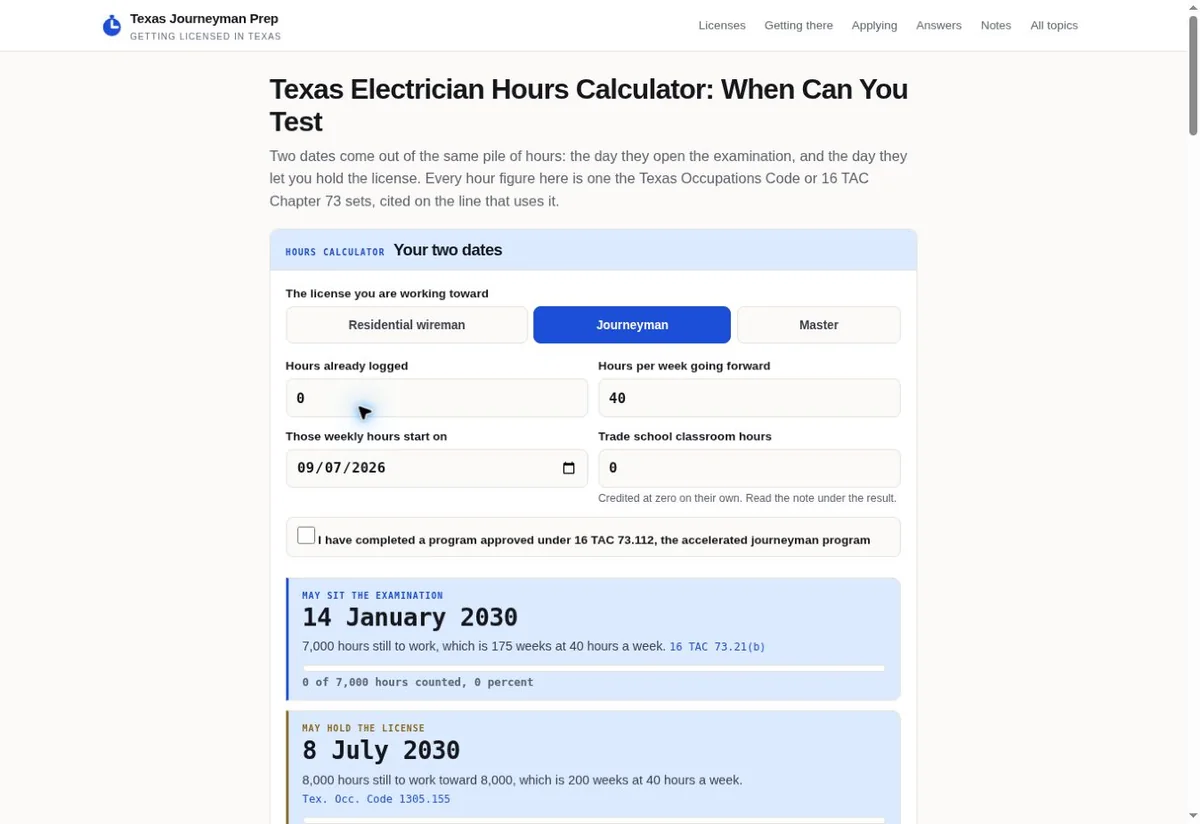
Texas Journeyman Prep calculator with labeled fields
Planning input labels provide a reference for explaining distinct delivery details. View the project

The pictured Texas Journeyman Prep calculator uses visible labels for separate planning inputs. We can discuss that label placement when a delivery enquiry asks for facts with different meanings. A destination and a receiving condition should each have wording the customer can interpret. Your team decides which detail belongs in the question. We can then arrange those approved requests so the visitor sees what staff needs.

A delivery field should state what the customer is being asked to describe. A broad address label may need context if staff are discussing a receiving place distinct from the customer's usual contact location. We can sketch the approved distinction using safe fictional wording. Then ask the receiver which value they expect to see in the enquiry record.

  • Check the label beside the input after a sample has been typed. We want the person to retain the question's meaning while editing it. The business should approve any hint that explains which receiving detail belongs there.
  • Ask what happens when someone leaves a location detail unresolved. Our proposed route can explain the next staff question when the business supports that path. A visitor should not invent a value merely to satisfy a required field.
  • Follow the selected task into the staff view. We can inspect whether the supplied location description remains attached to the delivery question. A field value without its purpose can force staff to reconstruct what the customer meant.
  • Read the completion message with the owner's acceptance process in mind. We should describe the action reached by the sample. If staff still need to assess the receiving arrangement, the receipt must leave that step pending.

Check the area answer against what the business has approved

The delivery answer should stand on current business information before search observations are assessed. We ask the owner to approve its conditions and the meaning of any place named in it.

Which local fact can be used without assuming delivery demand?
The Indiana place CSV has a Brownsburg town row associated with Hendricks County. We can use that identity to clarify which community the answer names. It tells us nothing about your delivery offer or customer requests. The owner should approve the area description and the conditions that govern a question from that place.
When does an area page need more than a town name?
It needs information that helps a distinct customer question and that the business can maintain. We can inspect whether the delivery answer changes in a meaningful way for the area. If the answer already lives accurately on the service page, a clear link may serve the task. Publishing another version adds another place where a condition can become outdated.
Can search wording broaden the delivery offer?
The offer remains what the business approves. We can consider language a customer uses while preserving its actual meaning. A broad query may require an explanation of the narrower service. Staff should check that a heading read alone does not promise an arrangement they cannot support.
What does Google's helpful-content guidance add?
It asks whether the content gives readers useful information for their purpose. We can apply that question to a person seeking an individual delivery answer. The page should help them understand the missing condition and ask staff about it. That content check supplies no guarantee of discovery or later orders.

Carry a changed delivery condition into the short answers that use it

An updated service condition may leave old wording in a preparation page. We trace the business-owned answers named in the work so their delivery meaning stays connected to the approved offer.

  1. Identify the changed condition Have the owner explain which part of the public answer has changed. We need the replacement wording and the question it affects. A general refresh request can otherwise cause the editor to add a new date while leaving the outdated delivery expectation intact.
  2. Read the linked preparation answer Open the material the delivery page sends a customer to next. We can compare its location questions with the new condition. A preparation note should request the context staff now need and retain the right pending meaning for a submitted question.
  3. Inspect the receipt wording Use a permitted marked enquiry if the route is included in the job. We should find the current task label and see what the receiver gets. A form's receipt can still repeat an old acceptance expectation after the main page has been corrected.
  4. Name the person approving later changes The business chooses who can authorize a revised delivery statement. We can discuss how that person supplies the agreed words to the editor. The responsibility should cover the specific linked answers checked in the work, so the next update has a known starting point.

Website changes cannot recall copies already sent to other people. The business may know about an older document or saved instruction that customers still use. We can inspect its known public destination and explain the current question route there when authorized. Staff decide how to handle a request that quotes the former terms and whether direct communication is appropriate.

A customer may ask whether the described delivery includes taking the item beyond its first receiving point. We need the business to say what its public answer can cover. Staff may have to learn more about the place before discussing that request. Our page can name the question in plain words and show where to ask it. Keep any approved limit beside the part of the offer it affects. A broad coverage line should not leave the reader to infer a handling task the team has yet to discuss.

Ask staff how a customer should add a new place detail after sending the first question. We can explain the route the business approves for that update. The receiver should recognize which earlier enquiry it concerns and what the added detail changes. Use a safe sample to check that connection when the route belongs in the job. The public wording should describe an update for staff attention. It should leave the delivery answer open while the business decides whether the revised request fits its offer.

Start the SEO discussion with the condition customers keep missing

Bring one public delivery statement and the qualification your staff add during a call. We can discuss the content needed to connect those two parts of the same customer question.

What should we bring without sharing orders?
Bring the public delivery page and an anonymized version of the recurring question. Explain which person can approve the response. We can use a fictional receiving place to assess the wording together. A customer's order history is unnecessary for naming the public condition that needs a clearer answer.
What determines the amount of writing work?
We need to see where the delivery claim appears and which supporting answers use it. One corrected introduction differs from preparing a longer conditional guide and a connected enquiry task. Our first discussion can name those requirements. Pricing and project timing follow the agreed content and implementation involved.
How can the business judge the first content change?
Have the receiver read a marked exception and use the public page to find the next question. We can ask them to explain which detail remains unresolved. That is a direct check of the answer's meaning. Search activity and delivered orders need later business records before any outcome can be described.

The initial call is free, and we can begin with the delivery condition your team already knows it needs to explain. Tell us which page makes that condition hard to find. We can assess the approved wording and the route available for a customer whose location needs another question. That gives the Brownsburg SEO scope a concrete answer to improve.

Sources

From the businesses we've worked with

“Trojan Digital Marketing gave our website a complete make over. The board members and I are absolutely thrilled!”
C. Teague McClendonAmerican Veteran Service Corp

KNOW YOUR NEXT STEP

Let’s talk about
Brownsburg.

Based in Indianapolis, we serve businesses across central Indiana, including Carmel, Fishers, Zionsville, Westfield, Noblesville, Greenwood, Avon and Plainfield, and clients across the United States.

Talk with Trojan

Brownsburg, Indiana

Service area map

Explore Brownsburg on OpenStreetMapArea reference; this is not an office pin. Map © OpenStreetMap contributors.