Questions, answered.
Can we buy fewer than 100 restoration websites?
Our published owned range begins at 100 websites and ends at 1,000. Membership starts at 50 sites, with Trojan retaining the domains. If your preferred count falls outside the published options, ask Jeff about the available scope before planning a purchase around it.
Does a Texas company qualify if it also serves Indiana?
We assess the places proposed for the network. Both restoration offers exclude Indiana markets. A Texas headquarters doesn't authorize an Indiana allocation. Name the Texas places you want covered and keep any excluded service markets separate when we discuss your proposed website list.
Will our Dallas sites repeat the early Indiana inquiry count?
We can't promise that. Our seventeen-inquiry record concerns 204 Indiana restoration sites during July and August 2026, ending August 31. It counts calls and forms, with missed calls excluded. The record doesn't establish Dallas results or how many requests became qualified leads or paid work.
What should our owner approve before domain registration?
Approve the business name used for registration and the domain inventory. We also need the accepted service markets and an authorized company contact. Ask how your account access and renewal notices will work. Those answers help your business maintain control when the person handling the project changes.
Does Tier 1 include monthly blog writing?
Tier 1 has no included annual blog articles. Its managed renewal includes the specified maintenance and core page refresh work. Our other tiers have different article allowances. We can explain the core tasks before you choose a tier, so an article count doesn't substitute for understanding the maintenance offer.
Are additional qualified inquiries billed on monthly membership?
The monthly plan includes all qualified leads in its monthly charge. We don't apply the annual plan's allowance or extra restoration rate to that choice. Its first commitment is 90 days, billed monthly. Afterward it continues monthly and requires 30 days' cancellation notice.
Can an annual shortfall credit be paid to our company?
The annual credit applies to your next renewal and has no cash value. We calculate it using missing included qualified leads and your locked extra lead rate. Its limit is the renewal charge. A credit doesn't show that a request became a completed restoration job.
Do we need the software package to move a domain?
A registrar move doesn't require the separate 8,000-dollar software migration and licence package. The receiving registrar may charge for its own transfer or renewal. We can identify which move you're considering and define the access needed before you authorize that work.
What happens after we request the free strategy call?
Your request starts a discussion with Trojan about the market list and the offer. It doesn't reserve a restoration appointment. The form requires an email address. If you'd like us to call, include a phone number too. We aim for a five-minute reply during business hours and agree any paid work separately.
Buy a Dallas water restoration inquiry network with a clear owner
- Relevant visit
- A person reaches the page.
- Inquiry
- The person contacts the business.
- Qualified lead
- The inquiry meets the agreed rules.
- Booked job
- The customer chooses to proceed.
Your restoration company can own the domains that bring people to its intake team. Our Garrison owned offer starts with 100 websites and registers their domains to your business. Calls and form requests go to your team. We charge the agreed build and annual site costs, with every generated inquiry included.
For Dallas, Texas, the first task is agreeing which services your company accepts and which places its staff can serve. We then review the proposed website list against that real coverage. Buying a network doesn't create a restoration crew or extend your dispatch hours. Your business keeps those operating decisions.
Tier 1 starts at 11,900 dollars for 100 sites in the first year. The published annual renewal for that size is 6,500 dollars. A monthly Garrison membership starts at 399 dollars for 50 sites if you'd rather use a smaller ongoing plan. Both restoration offers serve markets outside Indiana.
We can discuss either choice on a free first strategy call. Bring your company name and the Texas places you accept work in. Tell us whether keeping the domains matters most, or whether a membership fits your current budget. You can also ask Jeff to help compare the two.
Owned Garrison sites
Your business becomes the domain registrant. We agree the build tier and site count before quoting the network. Ongoing managed work has its own renewal cost. Keeping the domains and taking over the software are separate choices.
Garrison membership
Trojan owns the membership websites and their domains. Your allocated sites carry your company branding and send inquiries to your staff. Choose a monthly inclusive plan or an annual plan with a stated qualified lead allowance.
We build these websites to answer urgent local restoration searches with approved service detail. Our organic SEO and GEO work aims to make that information easy for people and search tools to read. Clear company identity and useful coverage pages support that goal. We track impressions and clicks as early signals, while inquiries stay a separate result. Search visibility and AI citations aren't promised.
What our early restoration inquiries taught us
We recorded 17 water restoration inquiries across 204 Indiana websites during July and August of 2026. The record closes on August 31. Eleven inquiries arrived during the August floods; the other six came outside that event period. That split matters when a contractor decides how to read an early total.
Read more
The requests included water in a church basement and a sprinkler line that had burst. Another described seven inches of basement water. Those details show the kinds of inquiries in our record. They don't establish the services a Dallas contractor offers, or the work that any receiving company completed.
Our count includes calls and submitted forms. Missed calls are left out. The published record doesn't prove how many inquiries met a billing definition, became jobs, or produced revenue. Its sites were in Indiana. We haven't turned that result into a promised Dallas rate or an annual lead estimate.
For your intake plan, the lesson is practical: a total can hide a concentrated event. We want the receiving business to know when a request arrived and who will act on it. Comparing an event week with routine weeks helps your staff spot a backlog before it becomes a forgotten inquiry.
We also check town search records as the network runs. When a town stays quiet, we rebuild or replace its pages. That operating work gives us something concrete to discuss at renewal. It doesn't turn a search impression into an inquiry. Your own call and form records remain the basis for assessing response.
You can read the broader restoration inquiry record and offer before choosing a planning assumption. We'll keep your proposed Texas purchase separate from that dated Indiana experience. Your city list and receiving staff still need their own review, even when the website count matches an existing network.
Agree the Dallas market before buying a site count
Dallas should appear by name in your proposed allocation. A broad phrase such as the Dallas area leaves room for different expectations. If you also accept work in Plano, name it separately and explain the service boundary. We need your accepted places before we can decide what the network should cover.
Read more
The Census Bureau's 2014 Texas place file contains separate entries for Dallas and Plano. We use that limited place distinction here to keep the proposed list clear. Your company supplies its present service boundaries. That older geography doesn't establish current demand or a rule about permits.
A site count also needs a content purpose. One hundred websites doesn't automatically mean one hundred towns. We work through the proposed domains and the reason each belongs in the build. A contractor shouldn't approve a town simply because it fills a spreadsheet row or makes the package look larger.
Tell us which restoration services your team actually sells in each accepted place. If the company handles a request type only through a separate agreement, flag that during planning. We can then keep the public wording tied to the services you approve. A website shouldn't recruit work your team has ruled out.
The Garrison allocation is for one contractor within the agreed trade and market. We don't sell that same allocation to another restoration company. A customer can still approach other contractors. We'll put the market definition in the agreement so your staff understands what the allocation covers.
Our Dallas microsite page gives another view of the local website offer. This purchase page concentrates on the assets your business would acquire and the work needed to receive inquiries. We can discuss both pages without asking you to choose a package from a headline alone.
See the domain schedule before you approve the build
- Domain and website
- Document ownership and access.
- Analytics and records
- Define access and the handover.
We start the owned purchase with a named business and a proposed asset list. The agreement should identify the domains you're paying to acquire. Your legal business name belongs in the registrant record. A recognizable brand on the homepage is helpful, but the registrar's ownership record answers a different question.
Read more
Ask who will handle registration and how you'll receive the agreed account access. A staff member should be able to locate the domain list without hunting through a former employee's inbox. We can discuss the account arrangement before registration starts, including who receives notices and who can approve a change.
Your domain inventory should identify the site attached to each name. It should also show the approved trade and market allocation. We use that list to check the order against the launch. An unexplained domain that never appears in the agreed list shouldn't become an assumed part of your purchase.
Record the renewal responsibility beside each domain. While our managed renewal is active, the plan covers the domain renewals described in the offer. If you end that work, your company takes over paying those registrations. We want that duty clear before a notice reaches an unattended email address.
Keep the company's recovery contact under company control. If you use a shared business mailbox, decide who watches it and how access changes when staff leave. We aren't prescribing a particular registrar feature. We're asking for an account plan your owner can maintain after the first build is complete.
Domain ownership also needs a boundary. The registrar record doesn't automatically grant every software licence or every platform permission. We set out hosting and handoff duties in the agreement. You can then assess what you own, what we maintain, and what a later technical move would require.
Price the owned build and its later renewal separately
These are our published September 2026 owned prices in US dollars. Each tier combines a one-time setup charge with a first-year amount for each website. The following year's per-site amount is a different figure. We calculate your quote from the approved count and tier, after reviewing the market list.
| Build tier | Setup and first-year site price | Later annual site renewal | Yearly blog allowance for each site |
|---|---|---|---|
| Tier 1 | 3,900 dollars plus 80 dollars per site | 65 dollars per site | Zero blog articles |
| Tier 2 | 5,000 dollars plus 100 dollars per site | 75 dollars per site | 12 blog articles |
| Tier 3 | 5,000 dollars plus 110 dollars per site | 85 dollars per site | 24 blog articles |
| Tier 4 | 6,000 dollars plus 120 dollars per site | 95 dollars per site | 48 blog articles |
We build owned packages from 100 to 1,000 websites. At the minimum Tier 1 size, the first-year calculation is 3,900 plus 100 times 80. That totals 11,900 dollars. The later annual calculation is 100 times 65, or 6,500 dollars. Those amounts describe the website purchase and managed renewal.
For a Tier 1 package of 200 sites, the same calculation gives 19,900 dollars in year one and 13,000 dollars for annual renewal. We use these examples to explain the bill. They don't supply an inquiry count, a cost per booked job, or a forecast for your Dallas business.
Every owned tier includes the specified domain renewals and maintenance, with core page refreshes. The blog allowance changes by tier. Tier 1 has no included blog articles. We can explain what the agreed core work covers so you don't buy an article allowance expecting a different service.
Your receiving team has costs outside the website price. Phones and staff time still belong in your own operating budget. If you propose a separate software connection, ask us to define its work and price before relying on it. Our published website fee shouldn't conceal an unapproved outside subscription.
The complete owned network offer is the place to compare all tiers. Bring the size you're considering to the first call. We can work through the numbers with you and identify which questions need a written answer before any build is authorized.
Put the receiving company's identity where visitors can find it
Your restoration branding should help a visitor understand who will receive the request. We need your approved business name and contact details before publishing them. If your trading name differs from the domain registrant, we'll identify that difference in the asset paperwork so the two records remain understandable.
The Yahweh House of Prayer project below gives a concrete interface reference. Its organization name and Contact choice share the header, with a welcome message below. A visitor can see the identity while locating the contact route. We can apply that clear placement to a contractor's approved business details.

We can use the project's visible name and contact route as a reference when you approve your own header. Ask whether staff can identify the receiving company from the same visitor view. Your restoration wording and customer promises still need to reflect the services your company authorizes.
Before launch, your owner should approve how the company is described. We won't borrow a licence or a trade certificate from another business. If you want a credential included, supply evidence that applies to your company and the stated service. A relevant-looking badge can still create a false claim.
Photo approval needs the same care. Give us images your business has permission to publish and explain what each shows. We can label a general project image accurately without presenting it as a Dallas job. A caption should help someone understand the subject and the reason it appears on the page.
Agree who controls the phone route and the form recipient
- 1. Name
- Move to the name field.
- 2. Email
- Keep keyboard focus visible.
- 3. Send inquiry
- Complete the action without a mouse.
Direct routing means inquiries are sent to your receiving team. It doesn't answer every account question by itself. We need to agree the destination number and the mailbox that receives forms. If your business has several staff groups, tell us which group is responsible for this network's requests.
Read more
Ask whether a proposed phone number already belongs to your company or would be provided through another service. The agreement should say who controls that number and what happens if managed work ends. We shouldn't let a phone arrangement become an unexpected dependency after you've bought the domains.
For form notifications, choose a destination that someone actually monitors. A manager's private email can become a weak point when that manager leaves. We can discuss a company-controlled destination and the people allowed to see the records. Your internal access rules should reflect the information customers will submit.
Your staff should know how to report a recipient change. We can define a request and approval process for that change in the scope. Until a change is tested, retain a record of the old destination. That makes it easier to understand where an inquiry went during a transition.
Keep the phone arrangement and the website ownership on separate lines in your asset schedule. A domain transfer doesn't by itself move a telephone account. We want your owner to understand both dependencies before signing. If a supplier has its own transfer terms, those terms need their own review.
We describe the wider service on our water restoration lead generation page. Your purchase discussion can be more specific: which company receives the request, which staff member owns the next action, and which approved account holds the route. Those answers make the network usable.
Define the inquiry records your business can retain
An owned domain is an asset; an inquiry is a customer record. We discuss the records your business needs alongside the website purchase. Ask what fields are retained and who can obtain them. The agreement should identify any export arrangement rather than leaving your staff to guess after launch.
Read more
A simple request record can include its received date and originating site. Your team can then record whether someone reached the customer. We can agree how that information is supplied without promising an unscoped CRM integration. The website project and a full sales system can have different owners and costs.
Use a defined status for each next action. A submitted form doesn't mean an estimate was accepted. Your staff might record that contact was attempted or that the requested service fell outside your offer. We want reporting to preserve those differences so a website total doesn't become a sales claim.
For the owned offer, all generated inquiries are included in the network price. We don't assess an additional fee for each one. You can still apply your own internal qualification labels. Those labels help manage your work; they don't change the published owned price into a membership billing rule.
Only ask customers for information your staff needs at that stage. Your company can decide what belongs in a later conversation instead of the initial form. We can shape the approved intake fields around that decision. Avoid making the website a place for unnecessary private documents.
Access and retention need a written answer when the relationship ends. Tell us who should receive the agreed records and in what form. Your business should understand any continuing service needed to keep a record system running. We will separate that question from keeping your registered domain names.
Compare a membership that sends requests to the same staff
Membership is a real alternative when buying at least 100 domains isn't the right commitment. We own the membership assets and maintain them under the chosen plan. Your allocated sites display your branding and send their calls and forms to your business. The published restoration sizes start at 50 sites.
Monthly membership includes every qualified lead for one monthly price. It has no annual allowance to exhaust and no additional qualified lead charge. The initial commitment lasts 90 days, paid monthly. After that, the arrangement runs month to month, with 30 days' notice to cancel.
The annual choice has a full first-year price and a separate renewal price. Its first year includes the build, domains, hosting and upkeep. An included qualified lead count applies each membership year. Additional qualified leads use the stated restoration rate after that allowance has been used.
Annual membership commits your company for one membership year. You can choose not to renew by giving the notice required in your agreement. We'll confirm that notice process before signup so your owner knows how to end the next renewal.
| Allocated websites | Monthly inclusive price | Annual year one / renewal | Annual included leads / extra lead rate |
|---|---|---|---|
| 50 | 399 dollars each month | 800 / 600 dollars | 5 included / 175 dollars |
| 100 | 699 dollars each month | 1,600 / 1,200 dollars | 10 included / 165 dollars |
| 150 | 949 dollars each month | 2,400 / 1,800 dollars | 15 included / 155 dollars |
| 200 | 1,199 dollars each month | 3,200 / 2,400 dollars | 20 included / 150 dollars |
| 300 | 1,699 dollars each month | 4,800 / 3,600 dollars | 30 included / 145 dollars |
The first annual amount already includes the initial build. Don't add that amount a second time as a setup charge. We can show the first-year bill and the later renewal on separate lines. The monthly column follows its own plan; it doesn't add an annual qualified lead allowance.
Annual renewal includes the specified ongoing domains and hosting, with upkeep and fresh local content. The included lead allowance starts again for the new membership year. We manually assess additional qualified requests and bill the accepted charges each month after they occur. Your staff can keep its own related request records.
The membership pricing section gives the broader choices. Our membership comparison can help you examine the commitment and billing rules. We'll discuss both paths before treating your preference as a request to begin paid work.
Understand an annual qualified lead charge before it appears
For an annual restoration membership, a qualifying call must last more than 60 seconds. The caller must be a homeowner or an owner of property within the agreed service territory. The requested work must match a service your company sells. A long vendor call fails that definition. Length alone doesn't decide whether a charge belongs on the bill.
Read more
A form can qualify when the submitting homeowner or property owner meets the same area and service conditions. Vendor messages and job applications are excluded. We can work through how the team identifies repeat requests for one project before signup. The agreement should explain how a billing question is raised.
The additional restoration rate is fixed at signup while the annual membership renews without interruption. We may publish different signup prices for future members. Your uninterrupted annual account keeps its agreed additional rate. Manual assessment also needs a clear route for explaining a disputed item.
At the membership year end, any missing included qualified leads become a credit against the next annual renewal. We calculate it from the missing count and your locked additional rate. The credit cannot exceed the renewal charge. It has no cash value and doesn't pay out as a refund.
For example, the 50-site annual restoration plan includes five qualified leads. If the assessed year ends with four, one is missing. At the published 175-dollar additional rate, that means a 175-dollar renewal credit. If all five are missing, the calculated 875 dollars is capped at the 600-dollar renewal.
That example explains the contract calculation. It doesn't promise five incoming requests or a particular month when they will arrive. We don't apply the annual credit rule to monthly membership or to an owned purchase. Each offer has its own bill and cancellation terms.
Make the website usable for the people who answer
Your restoration intake staff should be part of the purchase discussion before launch. They know which destinations work and which details help start a conversation. We can build around the services they can actually route. The page's public contact promise must fit the business process they will use.
Read more
Choose a manager who can approve the receiving details. That person should know how the owner wants inquiries assigned when staff change. We can document the approved route in the project handoff. A purchased network needs a clear contact inside your company after the launch emails have been archived.
A request may arrive while the team is already handling other work. Decide how the staff will recognize an unassigned message and pass it to the right person. We can discuss the site information that supports that process. Your company decides its response coverage and how it prioritizes accepted services.
Give the receiving team the proposed domain list. It helps them recognize an inquiry that came through a new site instead of assuming an unfamiliar brand name is spam. We can provide the agreed inventory as part of the build handoff. Your staff can then connect a request to the approved network.
When a visitor asks for a service you don't sell, staff should have a clear way to record that mismatch. Tell us if the published page encouraged it. We can examine the wording during the agreed maintenance work. The inquiry record helps identify a specific page issue without implying that every refusal is a website fault.
You retain responsibility for any restoration advice, appointment or work offered after contact. Our role is to build and maintain the agreed marketing network. We want the handoff to help your team respond under its own authority. A website purchase doesn't appoint Trojan to speak for your crews.
Make permission clear before a website change
A network with many domains needs a simple rule about who can approve work. We can identify your authorized contact in the scope and agree how changes are requested. The owner may delegate routine copy approval while keeping major account changes under separate control. That choice should be written down.
Our Jev Website Scanner start screen shows a website address field and a Scan my website button. A visible checkbox asks the person to confirm ownership, management or permission to review the site. It is a clear visual example of asking for authority before a requested action.
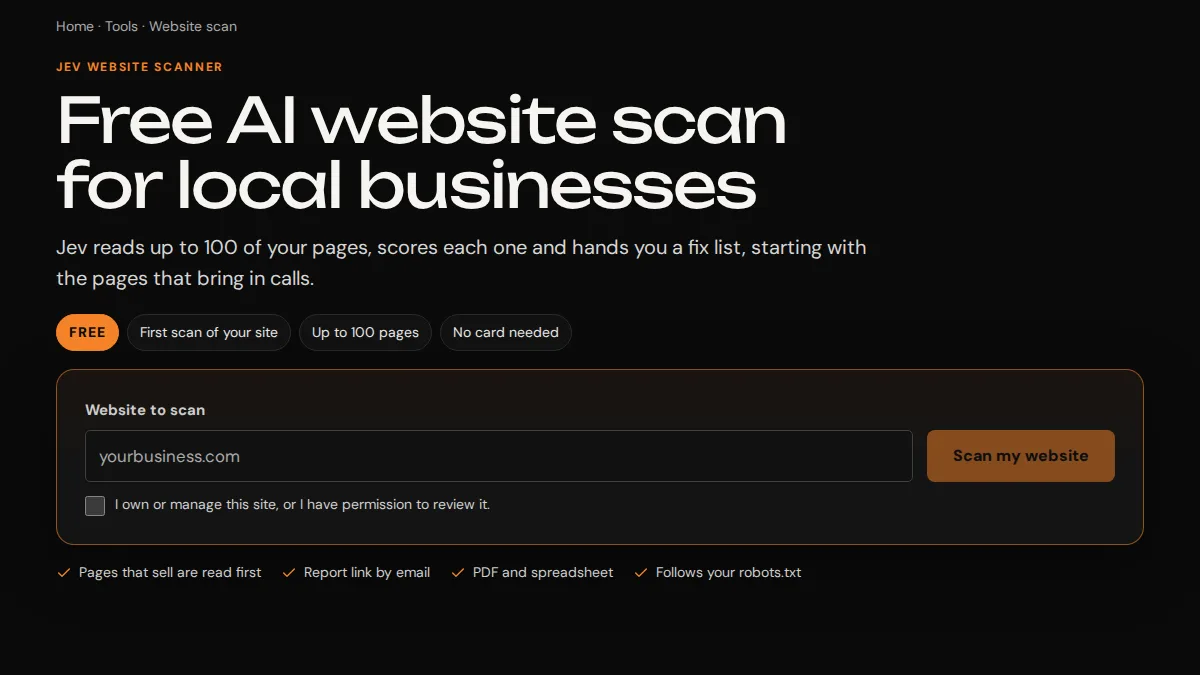
For your network, we can make a proposed change easy for the authorized contact to recognize. Name the affected domain and describe the action before asking for approval. A staff member should understand whether the request concerns page wording or permission to alter an account.
Keep credentials out of an ordinary copy request. We can agree a suitable access method when technical work needs one. Your company should know which access can be removed after the task ends. Routine article approval shouldn't require giving every reviewer the ability to change domain registration.
If you replace the authorized contact, tell us through the agreed process. We'll need an approved destination for further requests. Your business can retain its previous approvals as part of its own project records. That helps a new manager understand the wording and routing already in use.
Choose the content work your company can keep accurate
Your pages need an approval source for business facts. We ask your company to identify the services it accepts and the contact details it wants published. If a fact changes, the receiving team should know how to report it. An old service description can keep creating work your company has stopped accepting.
Read more
For owned plans, the core page refresh work is separate from the yearly blog allowance. We can explain those duties when you compare tiers. Buying 48 annual articles per site still leaves your business responsible for approving its own claims. The quantity doesn't authorize invented local projects or trade credentials.
Every proposed page needs a reason to serve a visitor. We can organize the network around distinct accepted services and the markets your company approves. Repeating one paragraph under a long list of town names doesn't answer the purchase question. The list should survive a check for real service fit.
Your company may have useful project images and customer-approved details. Tell us which may be used and how each should be described. We'll keep their actual context clear. A job in one place shouldn't become a supposed Dallas project simply because the network needs a local photograph.
Discuss who can approve a page correction during managed work. We need a reliable way to reach that person when wording affects the receiving team. A maintained network should reflect the approved service offer as it changes. It shouldn't continue recruiting requests based on a superseded price or contact route.
When we inspect town search activity, we can connect a quiet page with a defined content task. Your business can see which page was revised and why. A revised page still has to earn its next inquiry. We'll keep that distinction in reports instead of counting an edit as a new lead.
Agree the launch checks before the network is live
Launch acceptance should be part of the purchase scope. We can agree which domain and routing checks will be performed and who receives the result. Your staff needs to know how a test request will be labeled. A clearly identified test shouldn't enter the business's ordinary inquiry total.
Match the build to the approved inventory. We compare the launched domains with the agreed purchase list. Your company checks the names and market allocation before accepting the completed build. Any change to the inventory should be explained rather than hidden in a larger final count.
Confirm the company details on the pages. Your approved contact checks the name and service wording. We also check that the public receiving details match the route your team agreed. A corrected page should be examined in its actual visitor view before it is treated as finished.
Test the agreed inquiry destinations. We plan labeled checks with your receiving staff. They confirm that the test reached the intended destination and can be recognized as a test. Any live action used for acceptance must be authorized in the project scope.
Deliver the account and renewal schedule. We identify the agreed access and the party responsible for each continuing cost. Your owner can then confirm who will monitor notices. The site list and contact route should remain understandable to someone joining the business later.
The checks above describe proposed acceptance work. We haven't performed them for a Dallas buyer through this page. Ask us to put the actual process and deliverables in your quote. That lets you compare the purchase with a membership on the basis of what your team will receive.
A launch date needs its own agreement after the market list and approvals are settled. We won't promise a fixed delivery date from a website count alone. Your decision should include the time your company needs to provide accurate facts and approve the build.
Know what happens when managed work ends
The owned domains stay registered to your business if you cancel managed work. The published offer also states that the sites remain live on those domains. We discuss the hosting arrangement and handoff responsibilities before the agreement. Your owner should understand the continuing conditions rather than assuming every future cost disappears.
Read more
When managed work stops, Trojan stops paying the domain renewals described in that service. Your company becomes responsible for keeping the registrations current. The ongoing fresh content and FAQ work also stops. We can identify the first renewal dates you will need to handle as part of an agreed handoff.
A move to a different registrar is separate from moving the full software platform. Changing the registrar doesn't require buying the optional software migration package. Your receiving registrar may have its own transfer or renewal costs. Ask us which part of the proposed move you're authorizing.
The optional full migration and software licence package is 8,000 dollars. It includes the live sites and a licence for the software that generates their pages and manages updates. We define the platform and licence terms before that work. Domain ownership alone doesn't include that separate package.
Your staff should also review the inquiry route when ending a managed relationship. A website can remain reachable while a neglected mailbox creates a new problem. We want the receiving destinations and their account owners to be clear at handoff. That check concerns your business process as well as the website.
Membership has a different exit. Its domains remain Trojan's assets. Ending membership doesn't convert the allocated sites into an owned package. If you think you may want ownership later, ask Jeff to discuss the available purchase terms. We won't assume a conversion right that hasn't been agreed.
Bring your service map and purchase questions to Jeff
Start with the Texas markets your staff can accept today. Include Dallas and name any additional places separately. Tell us the restoration services you want the network to describe. We can then review whether the proposed allocation and website count fit the business you actually run.
Read more
If you prefer ownership, give us the legal business name that should hold the domains. Ask for the initial bill and annual renewal at your proposed count. We can discuss what the build tier includes and what remains a separate task. You don't need to choose a blog allowance before that discussion.
If membership seems more practical, tell us which commitment you're considering. We can compare the monthly inclusive charge with the annual allowance and extra restoration rate. You can ask about ownership later without pretending a membership already grants it. The first call is a place to clarify the choice.
Our contact form is a contractor prospect request. It doesn't send a restoration crew or confirm an appointment. During our business hours, a five-minute initial reply is the aim. Jeff can discuss the market and pricing questions with you before any paid work is approved.
Use the same free-call request whether you have a preferred plan or need help comparing them. Add the receiving team's practical concerns so we can address them in the scope. We want you to leave the discussion knowing what you're buying and which duties stay with your company.
Sources & further reading
- Garrison owned network scope and prices
- Garrison membership plans and price conditions
- Membership billing and commitment comparison
- Dated Indiana water restoration inquiry observations
- US Census Bureau citysdk: 2014 Texas place geography
- Yahweh House of Prayer website project
- Jev Website Scanner interface project
YOUR NEXT MOVE