Need help?Jamie

Market service plans

Castleton AI SEO When ChatGPT Gets Your Store Wrong

You asked ChatGPT about your store and it mixed you up with a brand you carry, or it said you install something you only sell.

Trojan Digital Marketing, a team based in Indianapolis, does AI SEO for Castleton stores and appointment businesses that ChatGPT or Perplexity keeps describing wrong. We check every public page about you against one set of facts, starting with your product pages and your Castleton Square listing on Simon's site. AI tools read both, and when the two disagree, the tool has to pick one.

Send the form with one question you asked ChatGPT about your store and a copy of its answer. The first strategy call is free, and during business hours we aim to reply within five minutes.

  • Your role kept separate from the brands you carry
  • Answers written from facts your staff approves
  • Center and maker pages checked against your own

Our website scan, powered by Jev, quotes the sentence behind each finding on your page, so you see what an AI reader sees. You choose which fixes come first, and the team behind more than 1,400 live websites makes them. Jeff Clerisier founded the company in March 2018.

Illustrative creative production workspace.
IllustrationFacts behind an answer about CastletonFacts and sources this page takes from public bodies and guidance, drawn as inputs to one answer. It isn’t AI output and cites no business.FACTS TO ANSWERGoogle Search Central: Optimizing for generative AI features · developers.google.comSOURCE · developers.google.c…Google Search Central:Optimizing for generative…ANSWER1 SOURCE

YOUR WORKING BRIEF

Choose where to start

Select the parts you want to discuss. Your choices carry into the inquiry form.

Discuss this service0 priorities selected

See how I'd approach this

Choose a question
to look at with me.

From a useful page to a relevant searchUseful websiteRelevant discoveryCRAWL · UNDERSTAND · CONNECT
  1. Useful website
  2. Crawl and understand the page
  3. Connect it to a relevant search
From a useful page to a relevant search

The first thing we build is a fact list your staff approves: the brands you carry, what you only order in and who installs or services each line. Then we check every page about your Castleton store against that list.

Simon: Castleton Square: Simon presents Castleton Square as an Indianapolis shopping destination with store, dining, product, and visitor information. A center listing can't say which brands you're authorized to sell or which ones you only order in. Your staff approves that wording before it goes on any page.

Questions about AI SEO, AEO and GEO in Castleton, Indianapolis, Indiana

What does AI SEO cost for a Castleton retailer?

It's priced after the free strategy call, since a store carrying dozens of brands has more facts to straighten out than a studio with one service. If you'd like evidence before that call, the Jev scan scores up to 100 pages free, and the $99 audit covers up to 3,000 pages with one rescan included. Extra rescans after later fixes cost $19.

Why does ChatGPT say we make products we only sell?

Usually because your pages reuse the manufacturer's wording without saying you're the retailer. AI tools piece answers together from your site, brand pages and listings like the Castleton Square directory, and when your page is vague, the brand's page tends to fill the gap. The fix is one plain sentence on each product family page saying who makes it and what your store handles.

Does the Castleton Square listing affect what AI tools say about us?

It can, because it's a public page describing your store, and AI tools read public pages. Simon publishes that listing, so you can't edit it yourself, but you can make sure your own hours and services agree with it and ask the center to update anything out of date. Two sources that match give an AI tool one story to repeat.

Should our product pages say which items we only special-order?

Yes, in one plain line on each product family page. When a page shows a product without saying whether it's on the shelf or ordered in, an AI tool may tell a shopper you stock it, and that shopper drives over for nothing. Say which lines you keep in the store and which ones you order in, in the words your staff uses at the counter.

What happens first in an AI SEO project?

You send the questions you've asked ChatGPT or Perplexity about your store, along with what they said back. We compare those answers with your site and your public listings, then list every fact that conflicts, from brand relationships to booking rules. That first call costs nothing, and in business hours we aim to get back to you within five minutes.

How soon will ChatGPT describe our store correctly?

There's no reliable date, because each AI tool refreshes what it knows on its own schedule and nobody outside those companies controls it. What you can check right away is whether your robots.txt lets AI answer tools read your pages, which the free Jev scan flags. After the fixes, we ask the same questions again on a set schedule and log what changes.

Will ChatGPT start recommending our store over others?

Nobody can promise that, since the companies behind these tools decide what their answers say. The work controls whether every public page describing your store agrees on the facts, which gives the tools a consistent account to draw from. If an answer stays wrong, we trace which page it seems to lean on and fix that page or ask its owner to.

“I had a great experience working with Jeff…”
Heather DoanGoogle review
“…drove a noticeable uptick in leads within just a few weeks…”
Mike BamosiGoogle review

We’re based in Indianapolis, where the city and Marion County share one government, Unigov.

We also work with clients across the United States.

Read our Google reviews

Which Castleton facts should AI answers about your store get right?

For AI SEO at a Castleton store, start with one sourced fact: Simon, which publishes the Castleton Square store listing, is a Fortune 500 company based in Indianapolis.

  • Fortune 500 companies headquartered in Indianapolis include Elevance Health, the largest in Indiana, Eli Lilly and Company, Corteva and Simon Property Group.

    Simon also publishes the Castleton Square page listing stores in the center, so an AI tool can find your details there as well as on your own site, and the two should agree.

    'What Fortune 500 Companies Are Based In Indiana?', elevateventures.comChecked September 25, 2026
  • Castleton began in 1852, when Thomas Gentry laid out nine lots 12 miles northeast of the Circle, and it grew into a town before Unigov made it part of Indianapolis in 1970. The Encyclopedia of Indianapolis now calls it a congested commercial district.

    The name Castleton covers an old town and a busy retail area, so writing Castleton, Indianapolis in full gives an AI tool one clear place to attach your store to.

    Encyclopedia of Indianapolis, 'Castleton'Checked September 26, 2026
  • Sears pulled out of Castleton Square in 2018, leaving a large space at the center empty until new tenants signed on.

    Store lists written before a change like that can stay online for years, so when an AI answer places you beside a store that's gone, look for the old directory it leaned on.

    IndyStar via Yahoo News, 'Hobby Lobby signs lease for part of former Sears home at Castleton Square Mall'Checked September 26, 2026

Simon's listing is Simon's own page, and the history and the Sears closing are public facts about the area. We work from Indianapolis as a service-area business with no storefront, and none of these facts describes a client of ours.

Which source should state each fact about a Castleton store?

Before any page changes, decide which source should state each fact a shopper asks about a Castleton store, shown here for a hypothetical store that sells and installs one brand.

Fact a shopper asks aboutWho should state itWhere your site confirms it
Model specifications
The manufacturer
Your product page links to the maker's own specs
Whether this store carries the line
Your store
A category page naming the lines you stock
Who installs or services it
Whoever actually does the work
A service page saying what you handle and what you refer out
Your hours at Castleton
Your store, matching the center's listing
The branch page, checked against Simon's Castleton Square page

What goes into a Castleton store's fact register?

Everything runs from one register of approved facts about your Castleton store, split between what you supply and what we check.

  • Which lines you stock and which you special-order
  • The brands you carry and your role with each
  • Services you perform and ones you refer elsewhere
  • Questions customers ask staff before they buy
  • What ChatGPT and Perplexity say when asked about you
  • Robots.txt rules that could block AI answer tools
  • Your public listings against your own pages
  • Whether each page opens with a plain answer a tool can quote

Separate the roles behind the offer

A retailer may sell a manufacturer’s product, offer its own consultation, and refer installation to another provider. Those roles need to remain distinct in the website’s text. A loose description can imply that the store manufactures an item or performs every service associated with it.

We document the relationship for each important offer: who supplies the product information, who approves advice, who accepts the order, and who performs the service. The resulting fact register becomes the reference for page introductions, FAQs, branch information, and any proposed structured data. It prevents a catchy sentence from changing the commercial arrangement.

Turn product questions into useful answer content

Customers may ask whether a model suits their use, what to measure before visiting, or whether an appointment includes a particular service. The answer should state what the store can establish and what requires inspection or confirmation. Trojan Digital Marketing can interview the relevant staff and build a source backed answer brief.

AI SEO and AEO do not require inventing a special language for these explanations. Google’s generative AI search guidance says special AI files and writing formulas are unnecessary. Our scope focuses on factual clarity, useful content, and implementation that reflects the approved visible information.

Create a proposed specialty fitting evidence set

Imagine a hypothetical retailer offering specialist fittings alongside ordinary product sales. Its public descriptions suggest every sale includes an appointment, while the actual process requires a separate request. We would document the service stages, accepted product categories, staff review, and confirmation process with the owner.

The resulting content could include an appointment explanation, preparation questions, and a comparison between browsing and a fitting session. Product claims remain tied to their proper source. A staff biography would describe only approved experience, and a customer story would not become a guarantee that another visitor receives the same result.

Keep branch differences visible in the fact system

Connect an answer to its evidenceUsefulQuestionAnswerEvidence
Question
Identify what the customer needs to know.
Answer
Explain it clearly.
Evidence
Support the answer with a source.
Connect an answer to its evidenceA useful answer explains the question, supports the claim and identifies the source.

A brand’s locations may differ in services, hours, assortment, or appointment process. We identify which facts are shared and which belong to an individual branch. A central description should not silently override a location’s real operating limits. Conversely, ordinary brand facts should not be rewritten inconsistently across every page.

The content plan assigns fields and approval owners. A changed service at one branch triggers review of its local page, relevant FAQs, and booking links. That makes maintenance practical for staff and reduces the chance that an old promotional page continues to describe an offer no longer available there.

Define the work and the evidence supplied by the client

A scoped engagement can include a product and service relationship map, approved answer drafts, revised branch content, an evidence register, and implementation checks. The business supplies current specifications, operating policies, image permissions, and a subject expert who can resolve unclear claims.

We identify factual disagreements before polishing the copy. If the manufacturer documentation and a store description differ, the appropriate reviewer needs to decide what can be published. The proposal separates research and editing from product advice that belongs to the business’s qualified team. No marketing label replaces that review.

Track representation alongside real inquiry quality

We record public inconsistencies corrected and the questions newly addressed. When reviewing generative search, observations include the exact question, date, answer, and cited source if visible. Being named in one response is not proof that the brand is understood consistently across every system.

The commercial review asks whether customers request the correct appointment, understand availability, and reach the right branch. We use recurring confusion to prioritize the next content change. The service covers evidence and page work; AI citations, traffic, and sales are not promised consequences of completing the fact register.

Put the first scope in order

  1. Identify the manufacturer, retailer, and service provider behind each claim.
  2. Create approved product answers with clear availability and review conditions.
  3. Check branch differences and update repeated facts when the service mix changes.

Compare Castleton planning, the Indianapolis directory and AI fact review.

Bring a disputed brand or installation claim so we can review your Castleton store’s facts.

Sources & further reading

Talk with Trojan Digital Marketing

Add a branded lead source to your search plan.

For contractor growth beyond Indiana, we can scope an exclusive Garrison network alongside your existing search work.

Roofing and water restoration offers serve eligible markets outside Indiana. We confirm territory and routing before you commit.

Explore branded exclusive roofing leads or branded exclusive water restoration leads for your service area.

Ask about window replacement lead options when that’s the trade your team serves.

Discuss your trade and service area.

Start with the care instruction that actually changed

A revised care answer needs the supplier's exact change and its stated reach. We ask the retailer to establish those details before replacing wording used by buyers of older items.

  1. Find the changed passage Ask the retailer to provide the specific supplier instruction it wants the page to reflect. We can mark the former sentence and the approved replacement. Keep their document context with them. A detached line may omit a condition that changes its meaning. The review should identify whether the page needs a correction or a new version-specific explanation.
  2. Ask about earlier sales Get the supplier's answer about the editions already sold. We need that answer before writing a broad message to returning buyers. The retailer decides which records can identify the relevant item. If the supplier has not settled the older edition, the public content should keep that question open rather than applying the newest instruction automatically.
  3. Decide which public copy depends on it Locate the care guide and any shorter pages that repeat the changed instruction. We can show the business where its own wording needs review. Some copies may belong to another publisher. The proposal should identify who controls each change. A correction on one long article may leave a small product card telling a different story.

A new supplier document can affect a public care page without applying to every item the shop has sold. The writer needs to know which instruction changed and what the supplier says about older versions. We can organize that question for the store's reviewer. The reviewer supplies the product meaning. A page update should not turn a limited revision into a claim that all previous directions were wrong or that every buyer must take the same action.

Start with the old wording as well as the proposed replacement. A side-by-side read helps the retailer identify the actual difference. We ask whether it changes an action, names a different product version or clarifies an existing point. Those are separate editing decisions. The published explanation should follow the approved meaning. A changed date on the document is a useful clue for finding it, but the date does not explain what an earlier purchaser should do.

Is this mainly a date update? The important part is the instruction's meaning and the products it covers. We can display a useful revision date after the retailer has approved that explanation. A fresh timestamp should not replace the factual approval. Ask which changed action the customer needs to understand. If the answer remains unknown, the draft should identify the appropriate question route rather than presenting the new date as proof of complete care advice.

Give general care context without choosing an item's directions

A general help page can explain how to find the right instruction. We keep item-specific care with the supplier-approved source and the retailer's answer about the version the customer owns.

Texas Journeyman Prep homepage with two choices
Product-care answer version record: Texas homepage with task choices. View the project

A care overview might tell a buyer where to find the identifying label or how to reach the shop's help contact. It should not quietly choose a cleaning method for an item that staff have not identified. We can make the navigation useful without acting as the product reviewer. The retailer should approve the distinction between a general explanation and the directions that apply to a named edition.

Two choices are visible on the Texas Journeyman Prep homepage beside this section. That existing education page offers layout context for separating reader tasks. We can discuss a route for finding a care document and a route for asking about an unknown item. The image supplies no retail care instruction. Each proposed choice still needs the store's approved wording and a destination staff can maintain.

Different jobs within a proposed product-care page
Reader taskAnswer the retailer suppliesWhat we can organize
Locate a current documentWhich source covers the identified product edition?A clearly named link with the applicable item context. The link should not imply that a new document covers every older sale.
Identify an unknown itemWhich clues can staff use to find its version?A question route that permits uncertainty. We can label optional information without forcing the buyer to invent a model name.
Understand a changed sentenceWhat did the supplier revise, and which items does it affect?A readable account of the approved change. Avoid a universal warning when the business can establish only a limited revision.
Ask about earlier instructionsWho can resolve whether the old advice still applies to this item?A returning-buyer route that preserves the old document or item clue. We should not send them through an unrelated new-sales process.

Can the guide summarize the supplier document? Yes, when the retailer approves the summary and it keeps the source's relevant conditions. We can help express the meaning in everyday words. The summary should not add a new action that sounds sensible but lacks support. Ask the reviewer to read it beside the applicable document. If the explanation leaves a technical point unclear, the appropriate product expert needs to settle it before the page describes that point as advice.

Keep the product edition attached to the revised answer

The same family name can cover items with different instructions. We ask the store how it identifies the relevant edition and use that approved distinction in the public care explanation.

What should a version note actually say?
It should name the distinction the supplier uses and that the retailer can explain to buyers. We can ask whether a model label or another known clue is suitable. Avoid an invented early and late grouping based only on a sale date. The public note should help someone decide which question to ask. It does not need to expose private stock records or pretend every purchaser can identify their edition immediately.
What if staff know the date but not the edition?
Keep those facts separate while the store checks the match. We can show the retailer where the proposed wording assumes that a purchase month identifies a product version. That assumption needs its own approval. A sale can occur after a new edition appears while older items remain in stock. The writer should leave the identification question open until the business has evidence for the connection.
Should older buyers see the same opening as new shoppers?
They may need different context. A new shopper could be reading the present product explanation, while an earlier purchaser needs to know which directions apply to the item they own. We can connect those tasks without claiming they have the same answer. The page should make the returning-buyer route visible. Any message about changed care still comes from the supplier meaning and the retailer's approved response.

The revision record should preserve enough context for the next editor. We can include the item description, the instruction being changed and the person who approves its reach. The public page need not display the whole working record. What matters to the buyer is finding the applicable explanation and understanding an unresolved match. A later editor should be able to tell why the page contains that boundary.

Read any reusable answer card after the version text changes. A full article may now be accurate while the card still gives unqualified advice. We would include those controlled copies in the proposed inspection. The store supplies the final product wording. A small card should not become more confident than the source merely because its design has room for fewer words.

  • Check the title of the linked care file. We can ask whether its visible name lets a returning buyer recognize the product edition it covers.
  • Read a sentence without its nearby photo. The instruction should still keep the relevant version boundary clear in text.
  • Follow any link from a retired product page. Our proposed task can check whether the destination still answers that older buyer's care question.
  • Ask which staff role approves later supplier changes. A maintained answer needs a real person who can settle its product meaning.

Help an earlier purchaser ask about the changed guidance

A returning buyer should be able to identify the item and the instruction they used. We can plan a help route that preserves those clues while the retailer reviews what applies now.

Hypothetical example An unnamed Castleton retailer receives a changed supplier care document

Before

  • A fictional store has a public care article based on an earlier supplier instruction. The supplier publishes a revision describing a newer product edition. An older buyer follows the article and cannot tell whether that change affects their item.
  • The page has a new date but no edition explanation. Its contact button opens a general purchase form. The customer must choose a current product before sending the question, which can replace their unknown older item with a guessed model.

After

  • We would ask the retailer to establish the supplier's stated reach and how staff identify earlier editions. The article would explain that approved boundary. If the match remains unresolved, it would give the buyer a route to the right product reviewer.
  • The proposed help message would carry the older item clue and the instruction being questioned. Its receipt would describe the question received, leaving the care decision with the store's authorized team. No real customer, supplier revision or completed help outcome is claimed.
  1. Let the buyer name the old instruction Ask for the document clue or a brief description staff can use. We can label the field around that purpose. A customer may only have a printed note. The route should allow them to explain what they followed without requiring a URL they do not have.
  2. Preserve the item uncertainty Keep an unknown edition visible in the receiving message. We need the actual staff process for resolving it. The form should not create a definitive model match just because a dropdown demands a choice. A useful help request can carry incomplete information honestly.
  3. Explain the known submission result Write the receipt around the event the system establishes. We can say the care question was sent when that is confirmed. The message should not instruct the customer to use a particular method before a qualified reviewer has supplied the answer.

A retailer may have a separate route for questions about a product it previously sold. We ask what that route actually handles before writing the action. The page should not invent a return right or a support obligation. The business approves those terms. Our work can make its existing help process clearer and identify any missing connection between the public article and the receiving person.

The customer may contact staff through another channel after sending the question. Ask how the team connects those messages when that matters. We can explain the reference the buyer should use if the business provides one. Avoid promising automatic matching unless the actual system supports it. The proposal should describe the intended connection and the check needed to confirm its behavior.

Use the help screen to explain what still needs review

The screen should show a clear starting task and an honest result. We can organize the request around the retailer's product question without presenting a submission as approved care advice.

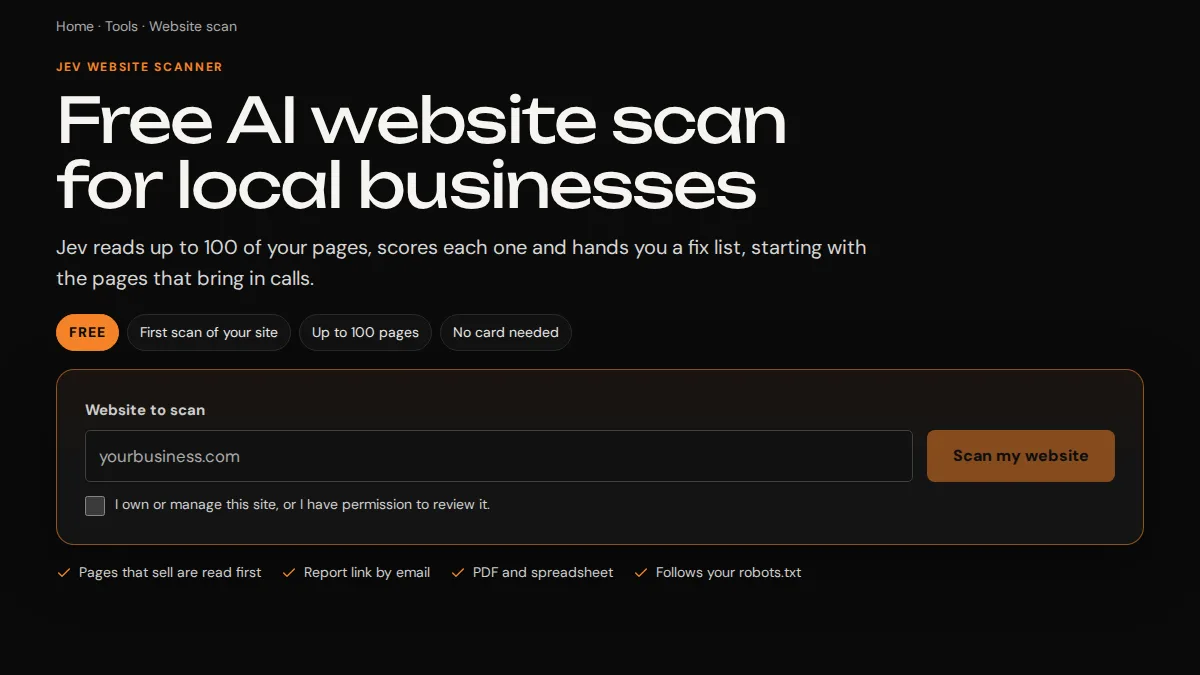
Jev scanner website input and scan action
Product-care answer version record: Scanner website input and button. View the project

Jev's scanner starting screen shows a website input beside its scan action. The existing project image paired here provides a visible example of a defined opening task. We can discuss the same clarity for a care question's first step. The screenshot is not a retailer support tool. It establishes no completed submission or product finding for a Castleton buyer.

Keep the requested information near the action it supports. A returning buyer should know whether the page is opening a document or sending a question. We can inspect the label and the result together. A decorative success treatment should not carry more certainty than the actual message. The business still needs to settle which directions apply when the product version is not yet known.

What should an upload label explain?
State what the store can use the image to inspect and whether it is optional. We can ask staff for the relevant view, such as an identifying label they actually recognize. The page should not imply that a photo always resolves the product match. Some buyers may lack a readable label. The question route needs wording for that situation and an approved way for the staff reviewer to continue.
How should an error affect the care question?
Explain the field needing correction in language that fits its task. We can inspect whether entered context remains available after a failed attempt. A generic error can leave the customer unsure whether the message arrived. The page should show what is known about the result and the business's approved alternative contact. It should never replace a failed request with a confident item-specific instruction.
  1. Read the page as an older buyer Use a marked sample with an edition that has not been identified. We can check whether the page lets that uncertainty reach staff. The proposed test should not silently assume the current product.
  2. Inspect the receiving view Ask the help team to read what arrived from the sample. We compare the item clue with the care document question. The receiving route should preserve their relationship.
  3. Revisit a carried link Open a controlled older page or message that links to the guide. Our check should show whether the destination now explains the revision in a way the earlier purchaser can understand.

Scope the revision around the product facts your store can approve

A useful quote names the care explanation and its dependent copies. We can define that work once the retailer identifies the supplier change and the reviewer responsible for its meaning.

What makes a useful first call?
Bring the current care page and the specific supplier passage the store wants changed. Add an anonymized returning-buyer question if one is available. We can discuss who approves the item coverage and which linked pages contain the old wording. The initial strategy call is free. A precise revision gives us something concrete to review without asking the business to assemble a whole new knowledge library.
What should happen if the supplier answer is incomplete?
The proposal should identify that dependency before publishing advice. We can draft the clear parts and mark the question the retailer still needs resolved. The business may approve a question route while the item-specific wording waits. A project schedule should not force the writer to supply missing product authority. Ask how the quote handles later approved wording and the copies affected by it.
How do we judge the revised public answer?
Follow the route from an older product reference and read the applicable version note. We should be able to tell which instruction is covered and where an uncertain buyer can ask for help. The retailer checks the final meaning against its source. Later observations from answer systems can be documented separately. A corrected controlled page is not proof that every external description has refreshed or that a care question has been settled.

Compare proposals by the instructions and controlled copies included. A narrow care change can involve a product card as well as the main guide. We can name those surfaces and who can edit them. The store's supplier answer determines the public wording. A quoted update should leave that approval responsibility clear, especially when the relevant earlier product edition is still being checked.

The practical Castleton task here is an earlier purchaser trying to understand changed product care. Our work should preserve that person's item and the source they used. The store can then approve an explanation that fits its actual support process. Start with the instruction that changed and the buyer question it created. That gives the revision a purpose beyond adding another general answer about the current catalog.

Sources

From the businesses we've worked with

“They are amazing. Working with them makes life so easy when it comes to SEO and web design”
George B.Google review

Marketing help for Indianapolis businesses

Based in Indianapolis, we serve central Indiana and clients across the United States.

Request a free strategy call

Indianapolis, Indiana

Service area map

Explore Indianapolis on OpenStreetMapArea reference; this is not an office pin. Map © OpenStreetMap contributors.